
Free AI summary of this YouTube video by SumTube
Real Aikido Is TERRIFYING
TL;DR
Aikido Master Ryuji Shirakawa explains the core principles and mechanics behind Aikido techniques to martial artist Jesse Enkamp. Through live demonstrations, Master Shirakawa breaks down wrist locks, joint manipulation, falling techniques (ukemi), and wooden weapon dynamics. He clarifies common misconceptions about Aikido, explaining how soft body control and biomechanics are applied in both practice and real-world combat scenarios.

Key takeaways
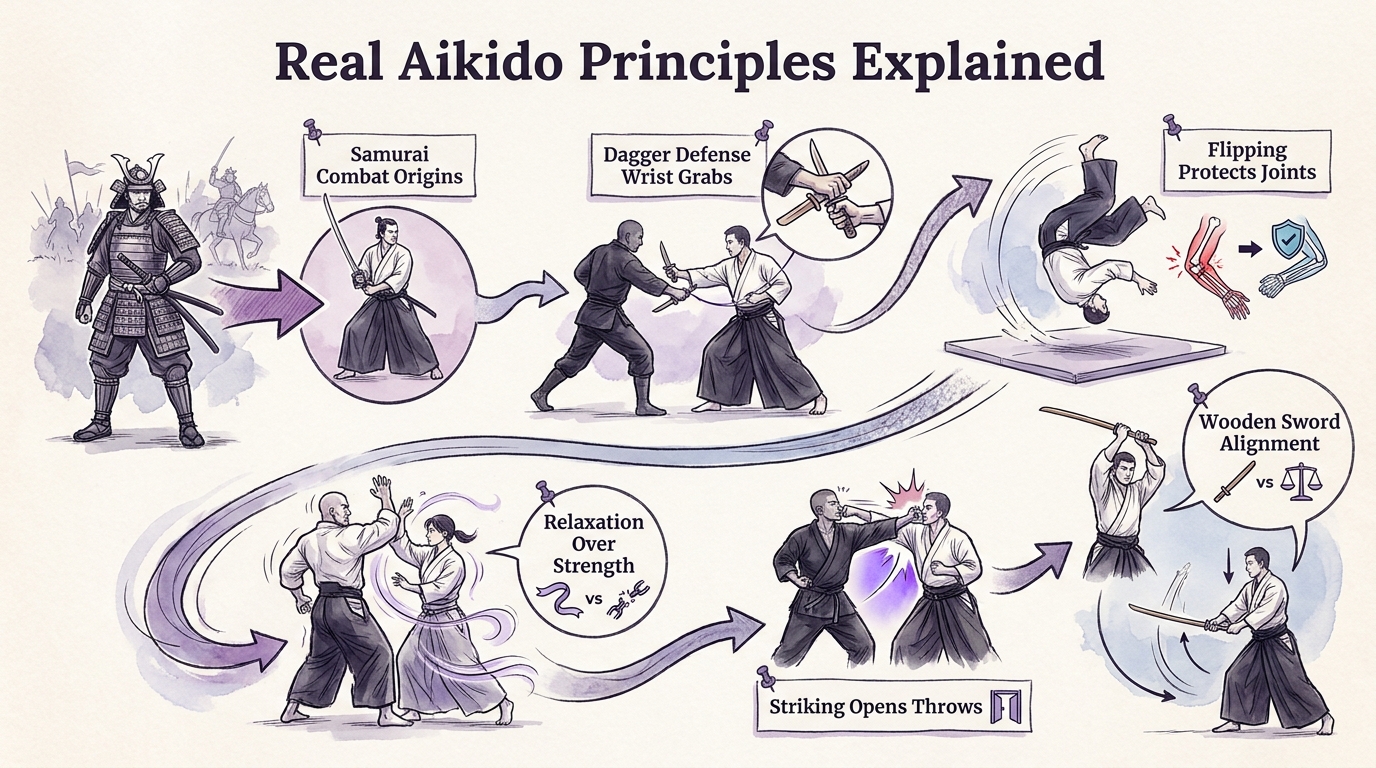
- 0:45Aikido techniques originate from armed samurai combat rather than modern empty-handed fighting
- 5:45High-flying falls in Aikido demonstrations are done to protect the defender's joints from breaking under joint locks
- 5:24Relaxation and body movement (taisabaki) allow techniques to work effectively without relying on brute strength
- 27:01Weapon training with a bokuto (wooden sword) teaches body alignment and force direction that directly transfers to empty-hand throws
Tap to enlarge
Most valuable section
For whom
Martial arts enthusiasts, combat sports practitioners, and anyone curious about the realistic application of Japanese martial arts.
Why Aikido Practitioners Fall5:38
It directly addresses the most common criticism of Aikido—the seemingly exaggerated flips—by demonstrating how non-compliance leads to severe joint damage.
Detailed summary
1. Introduction to Aikido Secrets
0:00Jesse Enkamp visits a traditional Japanese dojo to meet Aikido Master Ryuji Shirakawa. After witnessing impressive demonstrations of throwing and pinning techniques, Jesse asks how these movements function in actual combat. Master Shirakawa introduces himself and prepares to break down the mechanics behind the martial art.
2. The Origin of Wrist Grabs in Martial Arts
0:18Master Shirakawa addresses the common question of why Aikido practitioners grab each other's wrists, noting that wrist grabs rarely occur in modern combat sports like Karate. He explains that Aikido originated during the samurai era, where combat assumed the presence of weapons such as swords and short daggers.
Using a short dagger (tanto) demo, Shirakawa shows how grabbing the weapon arm is a natural defense against being stabbed. Aikido techniques use this initial grab to transition into disarming cuts, throws, and pins.
3. Demonstration of Kotegaeshi
3:32Transitioning to a safer wooden dagger (bokuto), Master Shirakawa demonstrates Kotegaeshi, one of Aikido's foundational wrist-turn techniques. He explains that the ideal execution of Aikido should not rely on causing pain, but rather on manipulating biomechanics to control the opponent's center of gravity.
Jesse attempts the movement and feels how correct body movement (taisabaki) off-balances the opponent smoothly from the wrist through the spine without applying destructive force.
4. Why Aikido Practitioners Fall
5:38Addressing why Uke (the receiver of the technique) takes large acrobatic falls, Master Shirakawa explains that flipping is a protective defense. If an opponent resists the wrist torque during a sharp Kotegaeshi or shoulder lock, their joint will break or dislocate.
By leaping and flipping, the defender neutralizes joint pressure and avoids injury. Shirakawa demonstrates how a stiff recipient suffers immediate pain, whereas rolling allows them to safely absorb impact and potentially counterattack.
5. Applying Techniques Against Resistance
7:28Jesse asks how Aikido techniques can succeed against a larger, resisting opponent who refuses to be thrown. Master Shirakawa explains that basic kata must be adapted into applied techniques using stepping movements and joint locks such as Nikyo.
By driving the force inward toward the opponent's centerline and destabilizing their hips and feet, even strong resistance is overcome. Shirakawa shows how combining body weight shift with wrist control forces the opponent down.
6. The Role of Atemi (Striking) in Aikido
9:16Jesse brings up a famous quote by Aikido founder Morihei Ueshiba stating that Aikido is largely composed of striking (Atemi). Master Shirakawa clarifies that while Aikido does not focus on knockout punches like boxing, Atemi is used to distract the opponent and disrupt their balance prior to a throw.
Shirakawa demonstrates how a subtle strike checks the opponent's guard, opening up entry angles for classic throws like Shihonage (four-direction throw).
7. Shihonage and High-Level Sacrifice Throws
10:40Master Shirakawa presents Shihonage in both its basic practice form and a high-risk street application. He has a senior student demonstrate a severe version where the arm is locked behind the back, resulting in a dangerous, high-velocity throw.
Jesse learns the footwork steps for Shihonage, practicing both gentle control and fast-entry versions. Master Shirakawa shows how similar leverage concepts are utilized in Judo throws like Seoi-nage.
8. Aikido, Judo, and the History of Jujutsu
18:50Master Shirakawa discusses the historical connection between Judo and Aikido, noting that both martial arts evolved from traditional Japanese Jujutsu. While Judo founder Jigoro Kano removed joint locks and strikes to create a safe sport with Randori, Aikido retained joint locks and weapon-based principles.
Shirakawa demonstrates Sutemi-waza (sacrifice techniques) like Ude-garami, showing how dropping your own posture allows you to execute powerful joint-locking throws that are illegal in modern Judo competition.
9. Weapon Techniques with the Jo and Bokuto
23:55The lesson moves to weapon work using the Jo (wooden staff) and Bokuto (wooden sword). Master Shirakawa shows how staff techniques train body alignment, distance management (maai), and hand coordination.
He demonstrates disarming techniques against a staff attack, explaining that weapon movements provide the exact kinetic framework used in unarmored empty-hand Aikido throws.
10. Sword Mechanics and Body Control
27:01Shirakawa demonstrates standard sword cuts with a bokuto, emphasizing that the downward slicing motion directly mirrors the pinning and throwing mechanics of Aikido. He guides Jesse through proper sword swings, focusing on crisp stops at the centerline and decisive stepping footwork.
After practicing the cuts, Jesse experiences how sword movements translate directly into controlling an opponent's balance and pinning them to the mat.
11. The Secret 'Handshake Drop' Technique
31:38To conclude the session, Master Shirakawa reveals a subtle, high-level Aikido technique executed from a standard handshake. He explains that by remaining relaxed and focusing tension into a single point of contact without twisting the wrist, force can be transmitted directly to drop the opponent.
Jesse tests the handshake drop and notes that the technique works best when the receiver is completely relaxed, catching them off guard before they can tense up. The two martial artists exchange bows and close the session.
Questions this video answers
Why do people grab wrists so much in Aikido?
Wrist grabs in Aikido stem from its origins in armed samurai combat, where controlling an opponent's weapon arm or preventing them from drawing a sword/dagger was essential. Master Shirakawa demonstrates that controlling the wrist allows a defender to neutralize or disarm weapons like daggers and swords.
Why do Aikido falls look exaggerated or fake during demonstrations?
The dramatic flips and falls (ukemi) are actually protective measures taken by the defender to escape joint-breaking leverage. If the defender does not flip or roll when a joint lock like Kotegaeshi or Shihonage is applied, their wrist or shoulder joint would dislocate or break.
Can Aikido techniques work against strong or resisting opponents?
Yes, but master practitioners adapt basic forms by applying Atemi (distracting strikes) or changing angles and footwork to break the opponent's balance (Kuzushi). Rather than using brute force against force, Aikido relies on biomechanics and body manipulation to disable a resisting opponent.
Ask a follow-up Premium
About this summary
SumTube AI wrote this recap from the video's words and chapters. Credit and the original belong to Jesse Enkamp.