
Free AI summary of this YouTube video by SumTube
Ratan Tata: Leadership, Innovation & Excellence in Hospitality
TL;DR
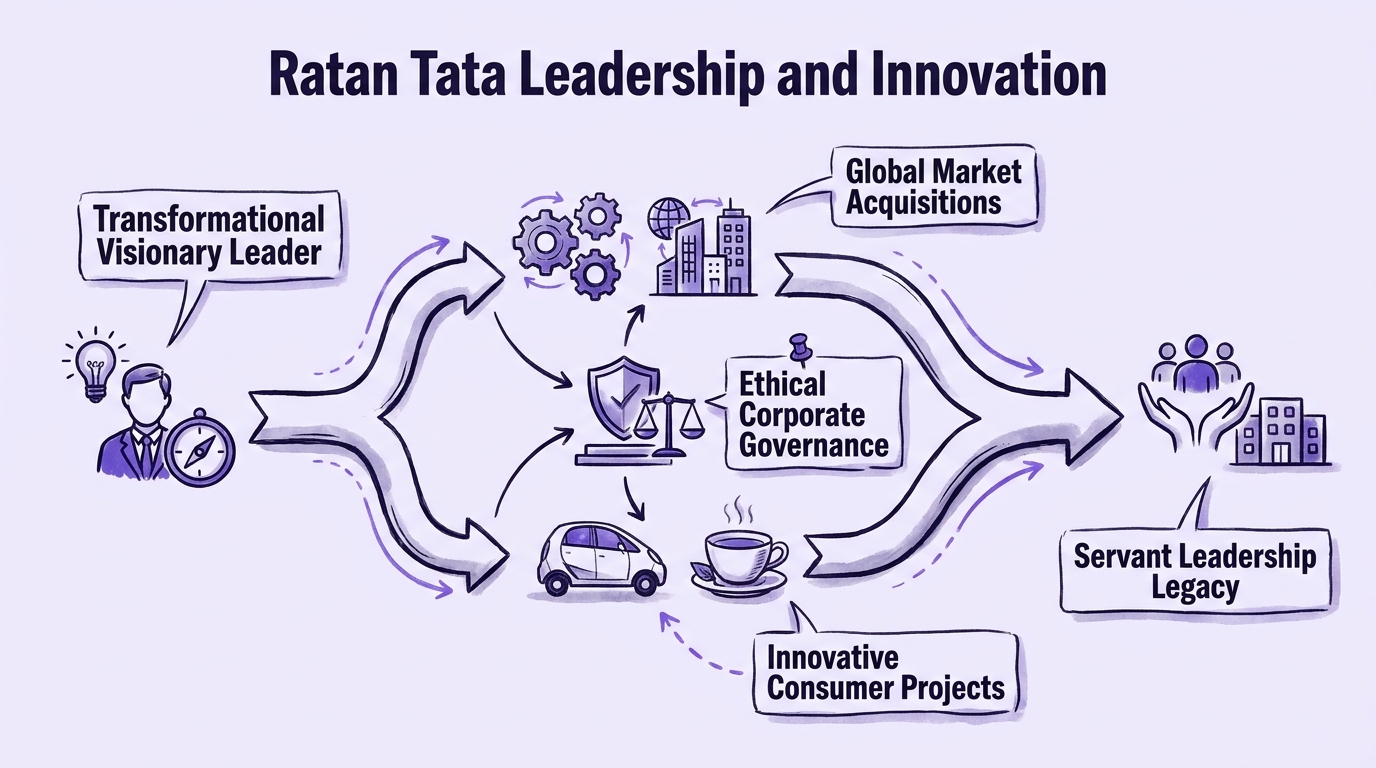
In this podcast-style student presentation, three hosts discuss the leadership career, major business decisions, and philanthropic legacy of Ratan Tata. They analyze his career using three academic theories—transformational, ethical, and servant leadership—and extract practical management lessons applicable to the hospitality and tourism industries.

Key takeaways
- 6:47Ratan Tata's career illustrates how transformational, ethical, and servant leadership theories can be synthesized in real-world corporate governance
- 10:44Innovative projects like the Tata Nano demonstrate that visionary ambition must be balanced with market realities and consumer perception
- 12:12Hospitality leaders can apply servant leadership principles by prioritizing employee support and fair treatment, which directly elevates the guest experience
Tap to enlarge
Most valuable section
For whom
Students and professionals looking for practical applications of business leadership theories to service industries
Leadership Theories: Transformational, Ethical, & Servant6:47
This section breaks down the academic framework behind Ratan Tata's management style and directly connects theoretical concepts to hospitality scenarios.
Detailed summary
1. Introduction to the Podcast & Topic
0:00Host Rohan introduces the podcast episode focused on the life, achievements, and leadership style of Ratan Tata, one of India's most respected business figures. He introduces his co-hosts, Gopi and Om Rimal, who join him to explore how Ratan Tata's leadership principles can be analyzed through academic theories and applied to industries such as hospitality and tourism.
The host outlines the structure of the discussion, which covers Tata's background, key business decisions, and three prominent leadership theories: transformational, ethical, and servant leadership. The panel aims to evaluate both the successes and challenges of Tata's career to extract practical management insights.
2. Ratan Tata's Biography and Business Career
2:02Rohan provides a comprehensive overview of Ratan Tata's life and career, noting his birth on December 28, 1937, in Bombay, India, and his education in architecture and structural engineering at Cornell University. Joining the Tata Group in 1962, Tata eventually became chairman of Tata Sons in 1991, leading the conglomerate through a period of massive international growth and strategic diversification.
Key milestones discussed include the global acquisitions of Tetley in 2000 and Jaguar Land Rover in 2008, as well as the creation of the affordable Tata Nano car. The summary highlights his retirement in 2012, his passing in October 2024, and his enduring legacy in philanthropy and corporate social responsibility.
3. Discussion: What Defines an Effective and Ethical Leader?
4:15The panel enters a mock-interview segment where Rohan asks his co-hosts to define what makes a leader effective and how businesses should balance profit with social responsibility. Om Rimall emphasizes that leadership goes beyond holding a senior title or issuing orders; it requires active listening, clear decision-making, and aligning an organization toward shared goals.
On the topic of corporate ethics, the speakers argue that financial sustainability must coexist with commitments to employees, customers, and the broader community. They stress that long-term trust and evaluating the social consequences of corporate decisions are far more important than pursuing short-term profit.
4. Leadership Theories: Transformational, Ethical, & Servant
6:47Gopi introduces three academic theories to analyze Ratan Tata's leadership. First, transformational leadership (Bass & Riggio, 2006) explains how leaders inspire followers through a shared vision and ambitious change, as seen in Tata's global acquisitions. Second, ethical leadership (Brown et al., 2005) focuses on integrity, role modeling, and moral conduct, matching Tata's reputation for transparent corporate governance.
Third, servant leadership (Greenleaf, 1977) prioritizes serving others and supporting community development, exemplified by Tata's extensive philanthropic initiatives. Gopi connects these frameworks to hospitality settings, illustrating how ethical and servant leadership manifest in fair guest treatment, honest communication, and staff empowerment.
5. Case Studies: Tata Nano & Global Acquisitions
10:31The group examines specific business ventures from Ratan Tata's career to highlight the real-world complexities of leadership. Rohan analyzes the 2008 launch of the Tata Nano, designed as an ultra-affordable car for Indian families. While visionary and innovative, the project faced commercial and production challenges, demonstrating that innovative ideas require strong market positioning and an understanding of consumer perceptions to succeed.
Gopi discusses the acquisition of Jaguar Land Rover and Tetley, noting how these bold moves expanded the group's global footprint. However, he highlights that international acquisitions carry significant financial risk, cultural integration hurdles, and operational challenges that require meticulous planning.
6. Critical Evaluation & Limitations of Leadership Models
13:32The panel engages in a critical academic evaluation of leadership, cautioning against assuming every decision made by a revered leader is inherently correct. They emphasize that business outcomes depend on multiple external factors—including employee contributions, market dynamics, and economic conditions—rather than the actions of a single individual.
Furthermore, the speakers note that academic leadership theories provide helpful analytical frameworks but cannot fully capture the messy realities of complex corporate decision-making. Effective analysis requires examining empirical evidence and real-world results alongside theoretical models.
7. Key Takeaways for Hospitality & Tourism Managers
15:24Rohan summarizes four core takeaways for future managers in the hospitality and tourism sectors based on their study of Ratan Tata. These include establishing a clear organizational vision, fostering innovation while carefully managing risks, demonstrating consistent ethical behavior, and valuing employees as essential drivers of the customer experience.
Om Rimal reiterates that hospitality leaders must remain adaptable, act responsibly, and commit to continuous learning from both successes and failures. The episode concludes with a final summary of references supporting their research and a wrap-up of the discussion.
Questions this video answers
Who was Ratan Tata and what were his key business achievements?
Ratan Tata was an influential Indian business leader born in 1937 who served as the chairman of Tata Sons from 1991 to 2012. Under his leadership, the Tata Group expanded globally through major acquisitions like Tetley, Corus, and Jaguar Land Rover, while also pioneering affordable domestic initiatives like the Tata Nano.
Which leadership theories best describe Ratan Tata's management style?
The speakers analyze Ratan Tata through three main leadership frameworks: transformational leadership (driving global expansion and innovation), ethical leadership (maintaining organizational integrity and social responsibility), and servant leadership (focusing on philanthropy and supporting employees and community welfare).
How can Ratan Tata's leadership style be applied to hospitality and tourism?
Hospitality managers can adopt his transformational vision by implementing innovative service systems, his ethical leadership by ensuring fair pricing and guest privacy, and his servant leadership approach by supporting frontline staff with training and resources to enhance overall customer satisfaction.
Ask a follow-up Premium
About this summary
SumTube AI wrote this recap from the video's words and chapters. Credit and the original belong to Mr. GOPI VLOGS.