
Free AI summary of this YouTube video by SumTube
Réglementation aéronautique niv1
TL;DR
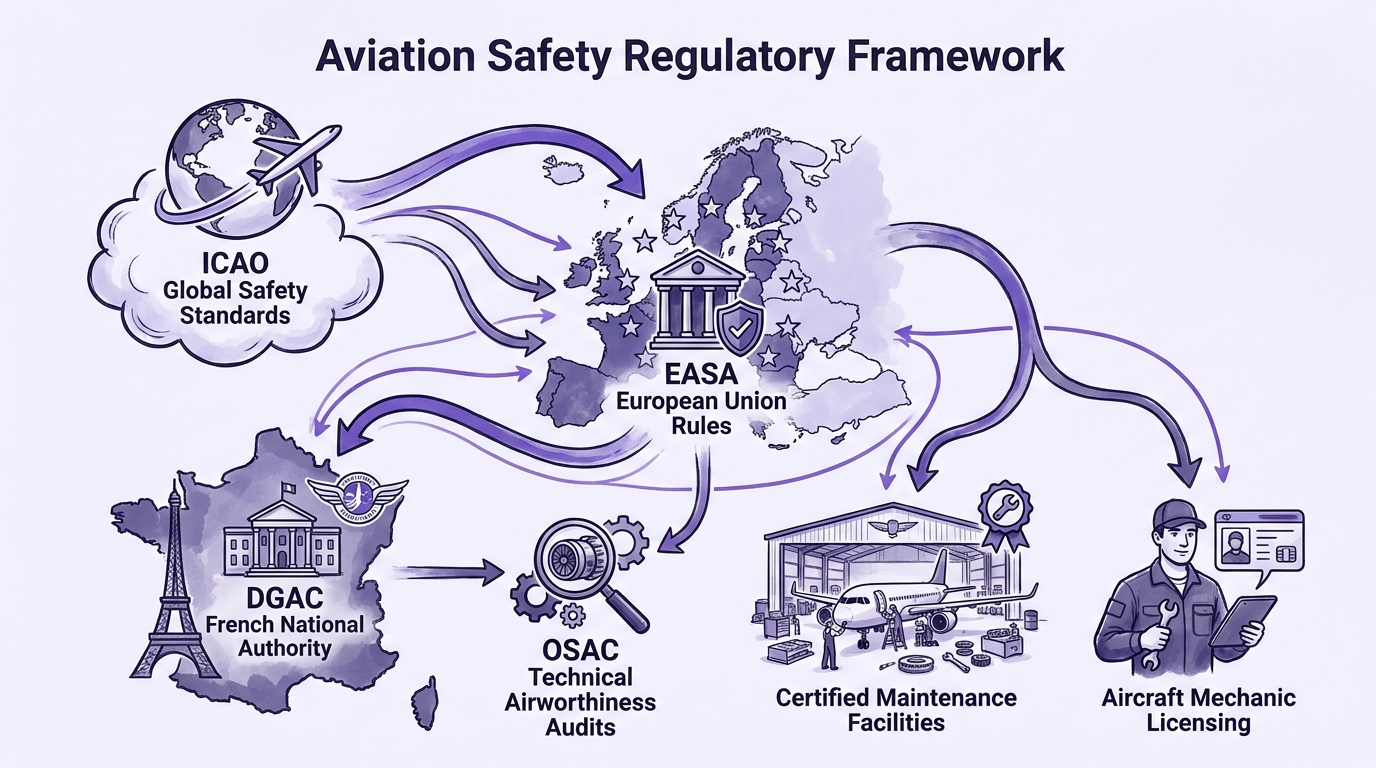
This educational video outlines the global, European, and national regulatory framework governing aviation safety. It explains how international standards established by ICAO are adapted by EASA in Europe and enforced in France by the DGAC and OSAC across aircraft design, production, maintenance, and personnel training.

Key takeaways
- Aviation safety relies on a cascading regulatory hierarchy from ICAO globally to EASA in Europe and DGAC/OSAC in France
- European aviation regulations are categorized into key 'PARTS': Part 21 for design/production, Part 145 for maintenance, Part 147 for training centers, and Part 66 for mechanic licensing
Tap to enlarge
Most valuable section
For whom
Aviation students, aerospace engineering trainees, and maintenance professionals seeking an overview of aeronautical regulations.
European Regulations: Parts 21, 145, 147, and 6613:23
This section provides a clear synthesis of how the different European Part certifications interconnect across the entire lifecycle of an aircraft.
Detailed summary
1. Introduction to Aviation Regulation
0:00With billions of passengers traveling globally every year, millions of aircraft share the airspace simultaneously. This high volume of traffic presents continuous risks of collisions, mechanical failures, and flight disruptions if aircraft are poorly designed, neglected, or improperly maintained.
To mitigate these risks, international aeronautical regulations were established to ensure airworthiness, uniform safety standards, and passenger safety worldwide across every stage of an aircraft's lifecycle.
2. Stages of Aircraft Regulation
1:45Aeronautical rules apply to every phase of an aircraft's existence, beginning with design, where engineers must adhere to specific certification standards based on the aircraft type. During production, manufacturing companies follow strict protocols to guarantee quality and structural safety.
Following delivery, rigorous regulations govern maintenance and oversight, requiring repairs to occur at certified facilities. Additionally, aircraft mechanics and specialized training organizations must meet strict competency, qualification, and ongoing assessment standards.
3. The International Civil Aviation Organization (ICAO)
3:28Global aviation rules are created and published by ICAO, an agency established following the 1944 Chicago Convention and officially activated in 1947. Operating as a specialized United Nations agency, ICAO provides a framework for international cooperation across civil aviation sectors.
ICAO focuses on key strategic priorities: safety, security against acts of violence, air navigation efficiency, economic development, environmental protection, and international standardization across personnel licensing and flight rules.
4. European Aviation Safety Agency (EASA)
6:39Standards developed by ICAO are adapted within Europe by the European Aviation Safety Agency (EASA). Working alongside the European Commission, EASA harmonizes international rules with member state laws before publishing them across all official European Union languages.
EASA serves as the central authority for European air safety strategy, taking responsibility for certifying new aircraft models, approving aviation equipment, and overseeing pilot licensing standards across member states.
5. National Authority: DGAC in France
8:25In France, EASA regulations are implemented and supervised by the General Directorate for Civil Aviation (DGAC). The DGAC oversees air traffic management, airspace control, economic regulation, and environmental protection initiatives.
Additionally, the DGAC supports aeronautical research, certifies aircraft and operating entities, and oversees professional training through institutions such as the National School of Civil Aviation (ENAC).
6. Technical Oversight: OSAC and Apave
15:32To execute technical inspections and compliance audits, the DGAC delegates specific supervisory tasks to OSAC, a specialized subsidiary of the Apave Group. OSAC conducts technical audits on behalf of the French Civil Aviation Safety Directorate (DSAC).
OSAC’s scope includes monitoring aircraft airworthiness, inspecting manufacturing and maintenance facilities, approving mechanic licenses, and auditing training organizations across both civil and military sectors.
7. European Regulations: Parts 21, 145, 147, and 66
13:23European aeronautical regulations are structured into specific frameworks called Parts. Part 21 regulates design and production organizations, while Part 145 governs approved maintenance workshops responsible for servicing aircraft and components.
Part 147 sets requirements for educational institutions that train and examine maintenance personnel. Individual mechanic licenses are governed by Part 66, which grants authorization for personnel to issue Airworthiness Release Certificates (APRS) across various aircraft categories.
Questions this video answers
What is the primary role of the International Civil Aviation Organization (ICAO)?
Created in 1944 via the Chicago Convention, ICAO sets global standards and recommended practices for civil aviation. Its main priorities include aviation safety, security, air navigation efficiency, economic development, environmental protection, and international standardization.
How are international aviation safety rules applied in France?
Global rules from ICAO are reviewed and adapted at the European level by EASA and the European Commission. In France, the French Civil Aviation Authority (DGAC) enforces these regulations, delegating technical oversight and auditing duties to OSAC.
What are the key regulatory 'PARTS' governing European aircraft lifecycle?
European regulation requires aircraft to be manufactured by Part 21 approved facilities, maintained in Part 145 certified workshops, serviced by mechanics licensed under Part 66, and trained through Part 147 approved institutions.
Ask a follow-up Premium
About this summary
SumTube AI wrote this recap from the video's words and chapters. Credit and the original belong to Pédro GONZALEZ.