
Free AI summary of this YouTube video by SumTube
Process de fabrication du ciment - Ciments Calcia
TL;DR
This educational video illustrates the step-by-step industrial process of cement manufacturing, from raw material extraction to final packaging. It detail-orientedly highlights the transformation of limestone into clinker through high-temperature burning and fine grinding, while emphasizing environmental initiatives like alternative fuels and material recycling. Additionally, it highlights the continuous quality control and automated monitoring that ensure consistent product standards.

Key takeaways
- 0:57Cement manufacturing relies on extreme thermal transformation, heating raw meal up to 1450°C in rotary kilns
- 1:45Sustainability measures incorporate alternative waste-derived fuels and industrial by-products like slag and fly ash
- 2:20Quality and consistency are guaranteed through 24/7 automated control room monitoring and continuous lab sampling
Tap to enlarge
Most valuable section
For whom
Civil engineering students, industrial professionals, and anyone curious about large-scale manufacturing processes
Kiln Burning & Clinker Production0:57
It vividly illustrates the core chemical transformation where raw meal is subjected to extreme temperatures above 1400°C to create clinker.
Detailed summary
1. Extraction and Transport of Raw Materials
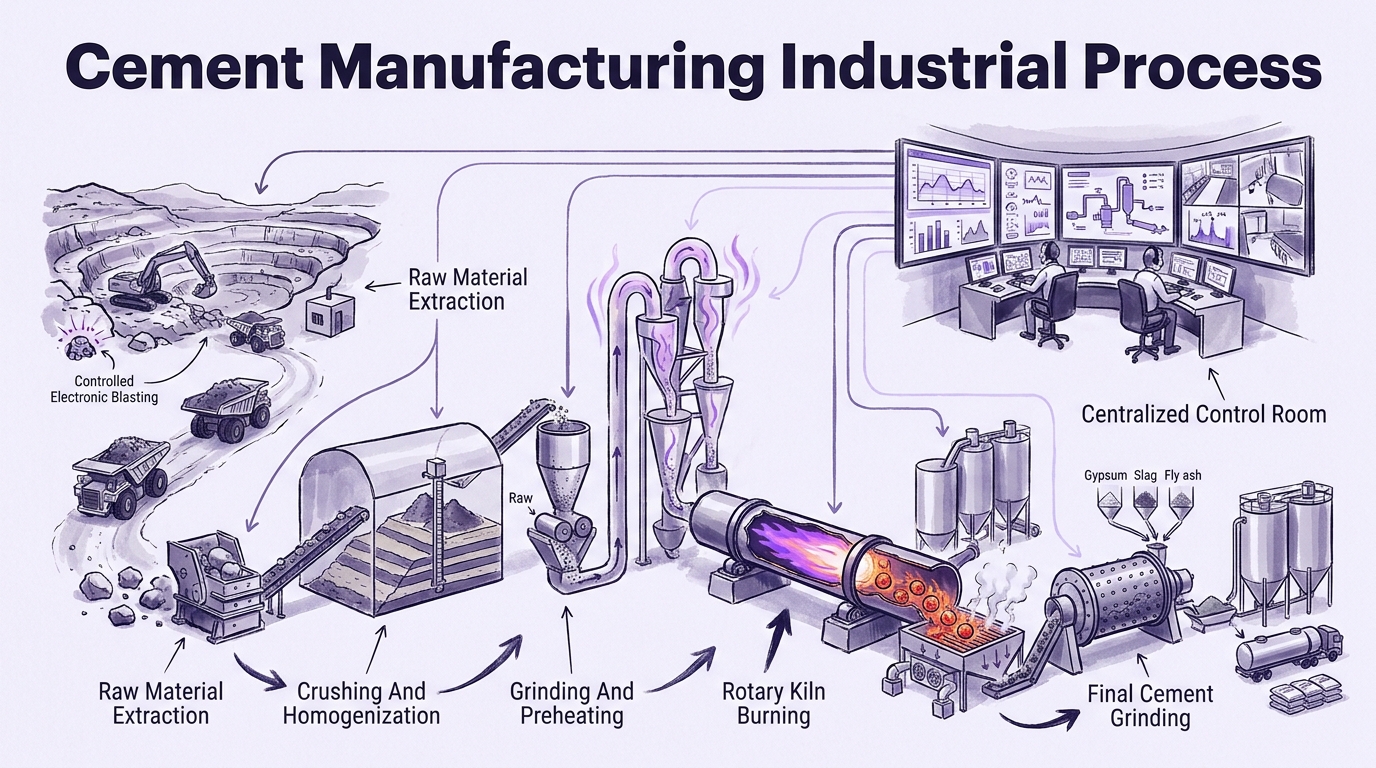
0:00The cement manufacturing process begins at open-pit quarries where raw materials, primarily limestone, are extracted using controlled electronic blasting. Heavy-duty dumpers then transport the extracted limestone blocks directly to the crushing facility.
Simultaneously, environmental management practices are integrated into quarry operations. This includes responsible resource management, biodiversity monitoring, and planned quarry rehabilitation after extraction.
2. Crushing and Pre-homogenization
0:19At the crusher, large limestone boulders are reduced to a uniform size of 80mm or smaller. A conveyor belt system transports the crushed material into the pre-homogenization hall.
In the hall, materials are deposited in horizontal layers and reclaimed vertically. This structured stacking process blends different geological veins to produce a consistent and homogeneous raw mix.
3. Grinding and Preheating
0:41The homogenized material is transferred to a raw mill where it is dried and finely ground into a powder known as 'raw meal' or flour.
Before entering the kiln, the raw meal passes through a multi-stage cyclone preheater tower. Here, it is preheated to approximately 800°C using recycled hot gases from the kiln, dramatically improving energy efficiency.
4. Kiln Burning & Clinker Production
0:57The preheated raw meal enters a large rotary kiln angled slightly downhill. As it travels down the rotating tube, it reaches temperatures of 1450°C, fueled by a burner flame reaching nearly 2000°C. Energy optimization is achieved by utilizing alternative fuels such as biomass, used tires, and industrial waste.
Upon leaving the kiln, the red-hot nodules—now called clinker—are rapidly cooled in a cooler. The cooled clinker is then stored in covered halls or silos to protect it from moisture.
5. Final Grinding and Storage
1:58The clinker is conveyed to a ball mill where it is ground into fine cement powder. During this phase, additives like gypsum, blast furnace slag, and thermal power plant fly ash are incorporated to tailor the cement's physical properties.
The finished cement products are stored in bulk storage silos according to their specific performance grade, ready to be dispatched in bulk tankers or packaged bags.
6. Control Room & Quality Assurance
2:20Plant operation is continuously monitored 24 hours a day, 7 days a week from a centralized control room. Technicians track real-time sensor data from every stage of the production line to maintain optimal operational conditions.
In parallel, automated sampling systems pull physical specimens across all production stages. Laboratory personnel analyze these samples to ensure strict compliance with quality and performance standards.
Questions this video answers
What are the main raw materials used to make cement?
The primary raw material is limestone extracted from open-pit quarries. After initial crushing and homogenizing, other mineral additives like fly ash, blast furnace slag, and gypsum are blended during the final grinding phase to achieve specific cement grades.
How is clinker produced during the cement manufacturing process?
Clinker is produced by preheating raw meal to around 800°C before feeding it into a rotary kiln. Inside the kiln, temperatures reach approximately 1450°C with flame temperatures up to 2000°C, causing chemical reactions that form clinker nodules, which are then rapidly cooled.
What eco-friendly practices are implemented in modern cement plants?
Modern facilities utilize energy recovery by burning alternative fuels made from biomass, used tires, and industrial waste. Additionally, they recycle industrial by-products like thermal power plant ash and blast furnace slag as mineral supplements in the grinding phase.
Ask a follow-up Premium
About this summary
SumTube AI wrote this recap from the video's words and chapters. Credit and the original belong to Ciments Calcia.