
Free AI summary of this YouTube video by SumTube
Pourquoi les poètes de la Pléiade ont révolutionné la langue française
TL;DR
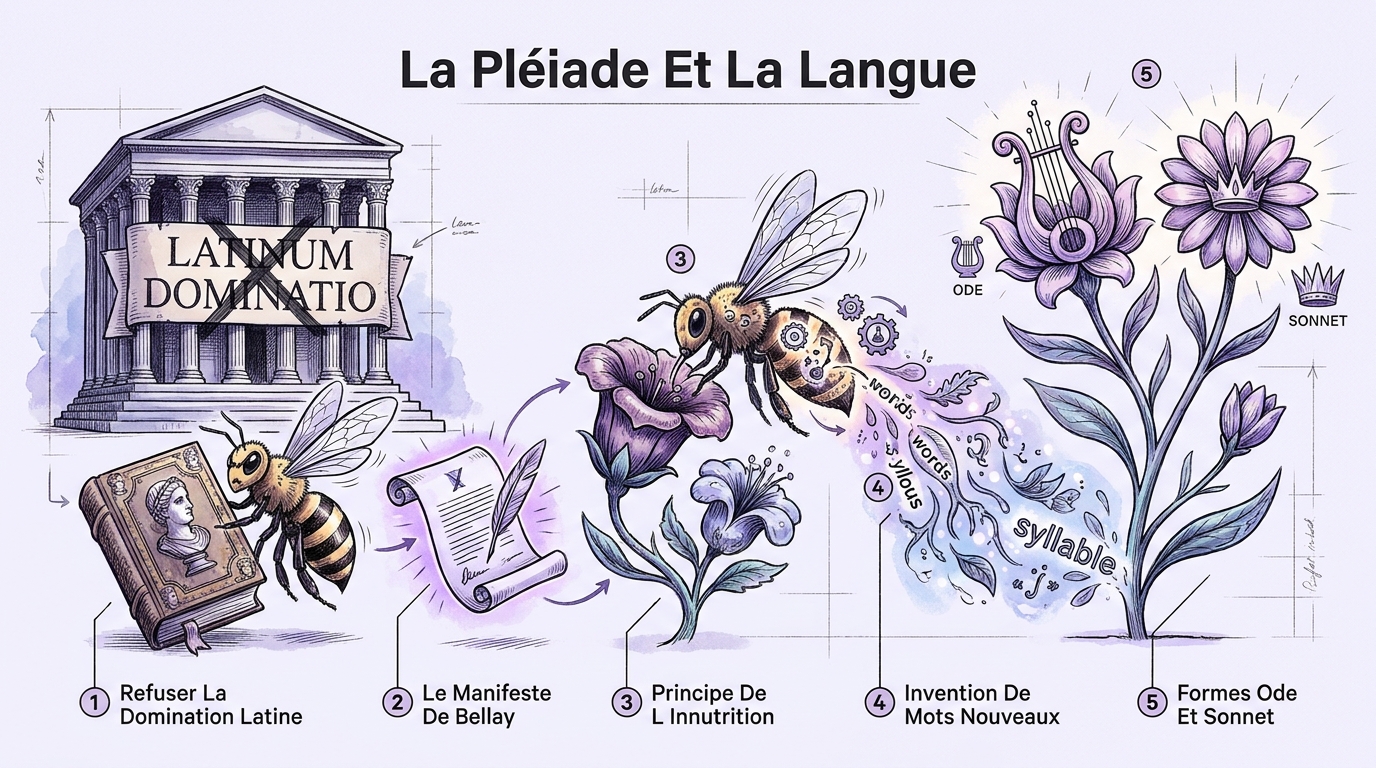
This video explores how La Pléiade, a 16th-century group of French poets including Pierre de Ronsard and Joachim du Bellay, transformed the French language. Rather than viewing imitation as unoriginal, they used the practice of 'innutrition'—digesting and reinventing Latin, Greek, and Italian classics—to elevate French into a major literary language. Through new poetic forms like sonnets and odes, they laid the foundation for modern French literature.

Key takeaways
- 0:45La Pléiade elevated French from a common vernacular to a respected literary language by absorbing and transforming ancient classics
- 4:00The concept of 'innutrition' defined their approach: devouring classical texts to produce original French poetry rather than merely copying
- 7:04By introducing neologisms, Latin-inspired syntax, sonnets, and odes, they permanently enriched the scope of French literature
Tap to enlarge
Most valuable section
For whom
Students of French literature, history enthusiasts, and anyone interested in the creative balance between imitation and originality.
It explains the core creative philosophy of La Pléiade, reframing imitation as a deep, transformative process essential to artistic innovation.
Detailed summary
1. Introduction & Paradox
0:00In 1555, poet Jacques Peletier du Mans posed a paradoxical question to ambitious young authors attempting to shake up French literature. They claimed that to create something truly new, one had to imitate the ancients.
This chapter introduces the core debate of the video: how imitation and creation can be reconciled to reshape the future of the French language.
2. A Language in the Shadow
0:45During the 16th century, French lacked the prestige it holds today. Latin dominated power, science, religion, and high literature, while French was viewed as a popular dialect fit only for daily commerce.
A group of young poets set out to prove that French possessed the potential to rival Latin, Greek, and Italian on the global stage.
3. The Rebel Manifesto
2:15Initially calling themselves 'La Brigade,' this ambitious group of young writers included leader Pierre de Ronsard and theorist Joachim du Bellay. Their goal was to turn French poetry into an immortal art form.
Du Bellay penned 'La Deffence et illustration de la langue françoyse,' a manifesto defending the French language against its detractors while seeking to elevate its standing through literary innovation.
4. The Art of 'Innutrition'
4:00The group championed 'innutrition,' a concept where authors thoroughly digest ancient texts to produce original creation rather than direct copies. Ronsard famously used the metaphor of a bee gathering nectar from diverse flowers to make its own unique honey.
This approach is illustrated through the literary evolution of the 'wounded stag' motif, progressing from Virgil to Petrarch and eventually being reinvented by Ronsard for the French language.
5. Forging a New Poetics
7:04To enrich French, the poets forged neologisms, integrated regional dialects, and adopted Latinized sentence structures. They also popularized major new poetic forms in France, including the ode and the sonnet.
Famous examples like Ronsard's sonnet to Hélène demonstrate how these techniques preserved beauty against the passage of time, popularizing themes like 'carpe diem' in French culture.
6. A Lasting Echo
9:13La Pléiade successfully resolved the paradox of innovation through imitation, using classical models as a springboard to establish French among the world's great literary languages.
The video closes by asking whether all true innovation in art, science, and technology requires first mastering and assimilating the work of those who came before.
Questions this video answers
What was the status of the French language in the 16th century?
In the mid-16th century, French was considered a popular language suitable for daily life, but lacked the prestige of Latin for science, philosophy, and serious literature. Italian had also gained a major advantage through Renaissance poets like Petrarch.
What was the concept of 'innutrition' in La Pléiade's poetry?
'Innutrition' was a biological metaphor coined by Joachim du Bellay. Instead of directly copying ancient authors, poets were encouraged to digest and assimilate classical works until they became part of their own voice, enabling them to create something entirely new.
How did La Pléiade innovate French poetic forms?
They introduced and popularized classical and foreign poetic forms in France, most notably the ode and the sonnet. Pierre de Ronsard and his contemporaries adapted these structures to craft enduring French works about love, mortality, and the passage of time.
Ask a follow-up Premium
About this summary
SumTube AI wrote this recap from the video's words and chapters. Credit and the original belong to Cours de français et déclics littéraires.