
Free AI summary of this YouTube video by SumTube
Petra Documentary: Lost City Of Stone - Documentary HD
TL;DR
This NOVA documentary explores how the Nabataeans built Petra, a thriving city in the harsh Jordanian desert, and how modern scientists unravel its engineering marvels. Through stonemasonry experiments, researchers reveal that its famous rock-cut facades were sculpted top-down using temporary pin-and-plank platforms and natural debris ramps instead of scarce wooden scaffolding. Additionally, hydraulic experiments prove the Nabataeans engineered a 125-mile integrated water system—featuring dams, cisterns, ceramic pipelines with an optimal four-degree slope, and even luxury pools—creating an oasis whose sophisticated infrastructure ultimately fell to severe earthquakes and flash floods.

Key takeaways
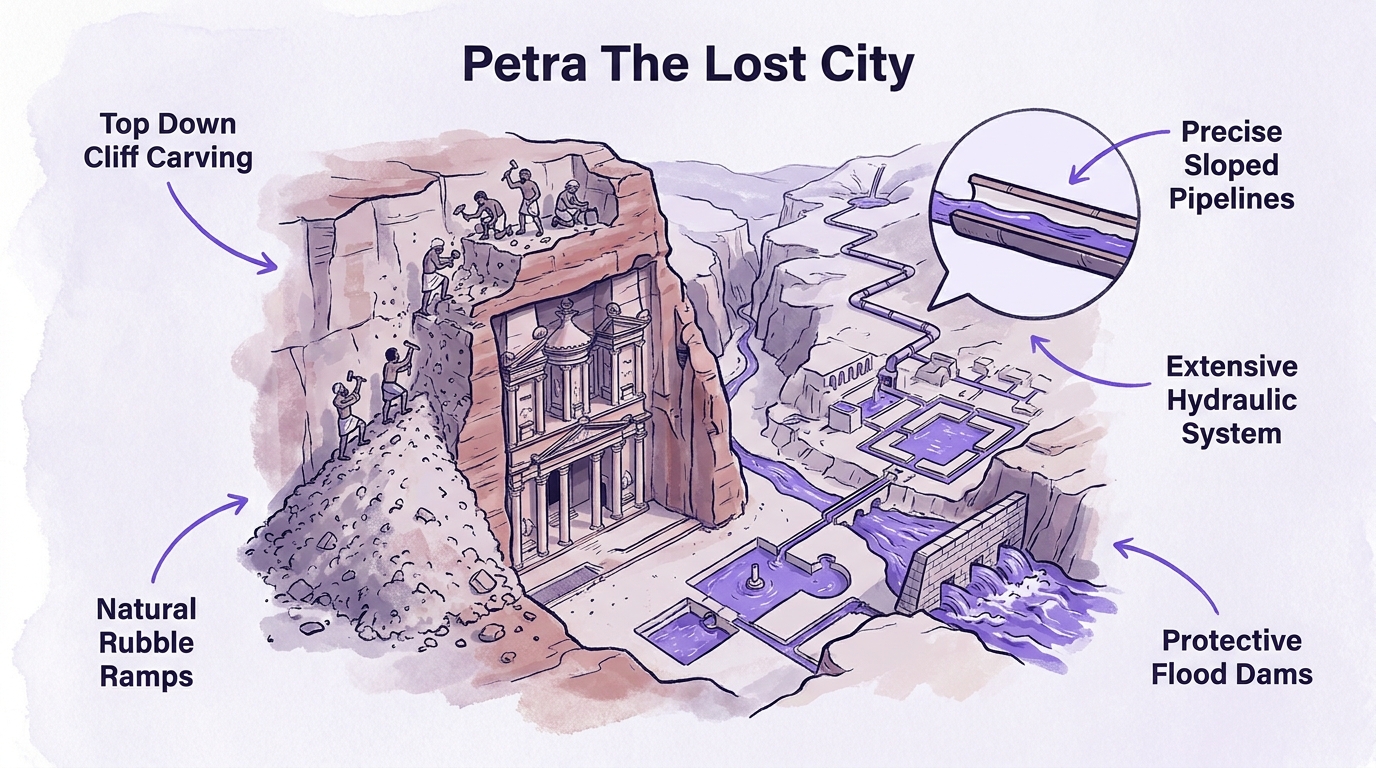
- 32:36The Nabataeans sculpted Petra's monumental cliffside facades from the top down, eliminating the need for expensive wooden scaffolding in the desert
- 40:20Ancient engineers designed ceramic pipelines with a precise four-degree slope to prevent destructive water pressure and maintain leak-free flow
- 40:59Petra featured a massive 125-mile integrated hydraulic system that supported over 30,000 residents and funded luxury water displays like ornamental pools
- 38:40A complex network of dams and bypass channels protected Petra from devastating flash floods while simultaneously harvesting precious rainwater
Tap to enlarge
Most valuable section
For whom
enthusiasts of ancient history, engineering marvels, and experimental archaeology
Engineering the Water Supply37:58
It features real-world hydraulic testing in a flume tank that reveals the exact physics behind the Nabataeans' 2,000-year-old pipeline design.
Detailed summary
1. Introduction to Petra
0:00The ancient city of Petra, located in the dry deserts of modern-day Jordan, features monumental tombs and structures carved directly into red sandstone cliffs. Standing over 100 feet tall, these engineering achievements were home to over 30,000 people at the city's peak. As a central trading hub for frankincense and myrrh, Petra grew into a wealthy metropolis despite its inhospitable environment.
Researchers, engineers, and archaeologists examine how the Nabataeans carved these intricate facades high up in the cliffs and brought enough water to sustain a large population in the desert. Through experimental stonemasonry and hydraulic testing, experts reconstruct the techniques used to build and protect this ancient desert oasis.
2. Rediscovery of the Lost City
1:56For over a thousand years, Petra remained hidden from the Western world, guarded by harsh terrain and local Bedouin tribes. In 1812, Swiss explorer Johann Ludwig Burckhardt disguised himself as an Arab pilgrim to locate the lost city. Traveling through the Siq, a narrow canyon stretching nearly a mile long, Burckhardt emerged to discover the iconic Treasury, known locally as Al-Khazneh.
Built over 2,000 years ago, the Treasury stands 127 feet tall and features complex Hellenistic columns and detailed sculptures. Burckhardt's discovery revealed that Petra was not merely a collection of isolated tombs, but the ruins of an expansive metropolitan capital containing an amphitheater, paved streets, and grand public buildings.
3. Who Were the Nabataeans?
5:14Ancient Greek and Roman texts identify the builders of Petra as the Nabataeans. Historical records from 350 BCE depict them as nomadic tent-dwellers, but within three centuries, they transformed into a settled, wealthy urban society. Positioned at the intersection of major trade routes, the Nabataeans generated vast wealth by controlling the trade of spices, silk, and incense between Asia, Arabia, and the Mediterranean.
Geoscientist Tom Paradise has spent decades studying Petra's sandstone structures to understand the Nabataeans' architectural capabilities. By analyzing mysterious square marks on the cliff face next to the Treasury, Paradise investigates whether these holes were used for scaffolding or served a different purpose during the carving process.
4. Experimental Stonemasonry in California
12:46Because Petra is a protected UNESCO World Heritage Site, direct experimental carving on its cliffs is prohibited. Geoscientist Tom Paradise teams up with professional stonemasons Blake Rankin and Nathan Hunt in Southern California, where they locate a sandstone formation with physical properties identical to the rock in Petra.
Using replicas of ancient iron tools—including pointed, flat, and claw chisels—the masons attempt to carve a Nabatean-style facade into the rock face. Matching the tool marks left on the experimental rock with those preserved on ancient structures in Jordan allows the team to verify the exact carving techniques used by Nabatean craftsmen.
5. Deciphering Nabataean Architectural Style
15:53Petra's architecture reflects the international connections of the Nabataean trade empire. Facades across the city display a blend of architectural elements, including Greco-Roman columns, Egyptian obelisks, Assyrian step patterns, and elephant-headed capitals inspired by Indian design motifs.
The Nabataeans combined these foreign influences with their own distinct styles, such as split pediments topped with urns and simplified capitals. Tom Paradise selects a classic 'crowstep' tomb facade for the carving experiment, which represents the most common architectural template found throughout Petra.
6. Solving the Scaffolding Mystery
21:00Timber was extremely scarce in the desert environment surrounding Petra, making full-scale wooden scaffolding impractical for constructing hundred-foot-tall cliffside tombs. The carving team in California develops a method using small metal pins driven into drilled holes to hold temporary wooden planks, creating a compact ledge for workers.
As the carvers work from the top of the cliff downward, the removal of stone generates large piles of rubble at the base. This rubble forms a natural rising ramp, eliminating the need for elevated scaffolding. As carving progresses downward, the upper pin holes are carved away, leaving no trace of the temporary ledges on the finished facade.
7. Engineering the Water Supply
25:13Supporting a population of 30,000 in an arid desert required advanced water management. Archaeologist Sue Alcock utilizes Ground Penetrating Radar (GPR) at Petra's Great Temple, revealing an extensive underground network of stone-lined channels beneath the paved courtyards.
To determine how water was transported to the city from distant springs like Ain Musa, hydraulic engineer Charles Ortloff constructs a 26-foot laboratory flume tank at California State University, San Jose. By testing different pipeline angles, Ortloff demonstrates how the Nabataeans controlled water pressure and flow velocity.
8. The Four-Degree Pipeline Principle
28:02Ortloff's fluid dynamics experiments demonstrate that a steep pipeline slope causes water to fill the pipe completely, creating high internal pressure that would burst ceramic pipe joints. Conversely, a gentle slope reduces velocity, leading to sediment buildup.
The experiments show that a precise four-degree slope maintains an open air space above the flowing water, preventing pressurized leaks while delivering a continuous high-speed flow. Field measurements in Petra confirm that Nabataean engineers carved their five-mile pipeline along cliff faces at this exact four-degree angle, demonstrating an advanced understanding of hydraulic principles centuries before they were formalized in Western science.
9. Defending Petra from Flash Floods
36:01Despite its arid climate, Petra faced a constant threat from sudden desert rainstorms that caused catastrophic flash floods through the narrow Siq canyon. Archaeologist Ueli Bellwald investigates an ancient dam system built by the Nabataeans to protect the Treasury and the city entrance.
The Nabataeans constructed a series of five heavy stone dams and carved a 140-foot-long, 16-foot-deep diversion tunnel through the mountains. This diverted floodwaters away from the main canyon into side valleys, safely storing the surplus water in large reservoirs for urban use.
10. The Las Vegas of the Ancient World
40:20Archaeological excavations conducted by Leigh-Ann Bedal near the Great Temple revealed the remains of a massive pool complex originally thought to be a marketplace. The structure, measuring nearly the size of an Olympic swimming pool, featured an island pavilion, surrounding gardens, and decorative fountains.
In a desert environment, displaying large open bodies of water served as a dramatic demonstration of political power and economic wealth. Petra functioned as a luxurious desert oasis where travelers and trading partners were greeted with abundant water features and grand architecture.
11. Earthquakes, Floods, and the Fall of Petra
45:28In 363 CE, a massive earthquake struck the region, collapsing major colonnades and damaging Petra's infrastructure. While the city survived the initial destruction, subsequent earthquakes in the 6th century severely compromised the protective dam systems.
Without maintained dams, subsequent flash floods washed through the city center, stripping away street paving stones and burying structures in mud. The destruction of the trade routes and hydraulic infrastructure led to the gradual decline and eventual abandonment of the city.
12. Completion of the Experimental Facade
47:48In California, the stonemasonry team completes the Nabatean facade after two months of carving. The finished structure demonstrates that the top-down carving method, combined with simple hand tools and rubble ramps, allowed ancient masons to construct monumental rock-cut architecture efficiently.
The project confirms that the Nabataeans' mastery over both stone and water was the key factor in creating and sustaining their desert kingdom for centuries.
Questions this video answers
How did the Nabataeans carve large structures into high cliff faces without wood for scaffolding?
The Nabataeans carved their monumental facades from the top down. They drilled small holes into the rock face to insert metal pins and wood planks, creating small movable ledges. As they carved downward, the accumulating stone debris formed a natural ramp, allowing workers to move and work without massive wooden scaffolding structures.
How did Petra maintain a water supply in the middle of a dry desert?
The Nabataeans engineered a vast, 125-mile integrated water system that collected water from natural springs like Ain Musa and captured seasonal rainfall. This network included over 100 underground cisterns, 36 dams, and ceramic pipelines, supplying enough fresh water for over 30,000 residents and public water features.
Why did the city of Petra eventually decline and become abandoned?
Petra's decline was triggered by catastrophic natural disasters, including a major earthquake in 363 CE that collapsed critical infrastructure. Subsequent major flash floods destroyed key sections of the city's protective dam network and main streets, weakening the economic and physical foundation of the kingdom until it was eventually abandoned.
Ask a follow-up Premium
About this summary
SumTube AI wrote this recap from the video's words and chapters. Credit and the original belong to Documentary HD.