
Free AI summary of this YouTube video by SumTube
Permeability Testing for Coated Paper – Testing Paper-Based Structures | AMETEK MOCON
TL;DR
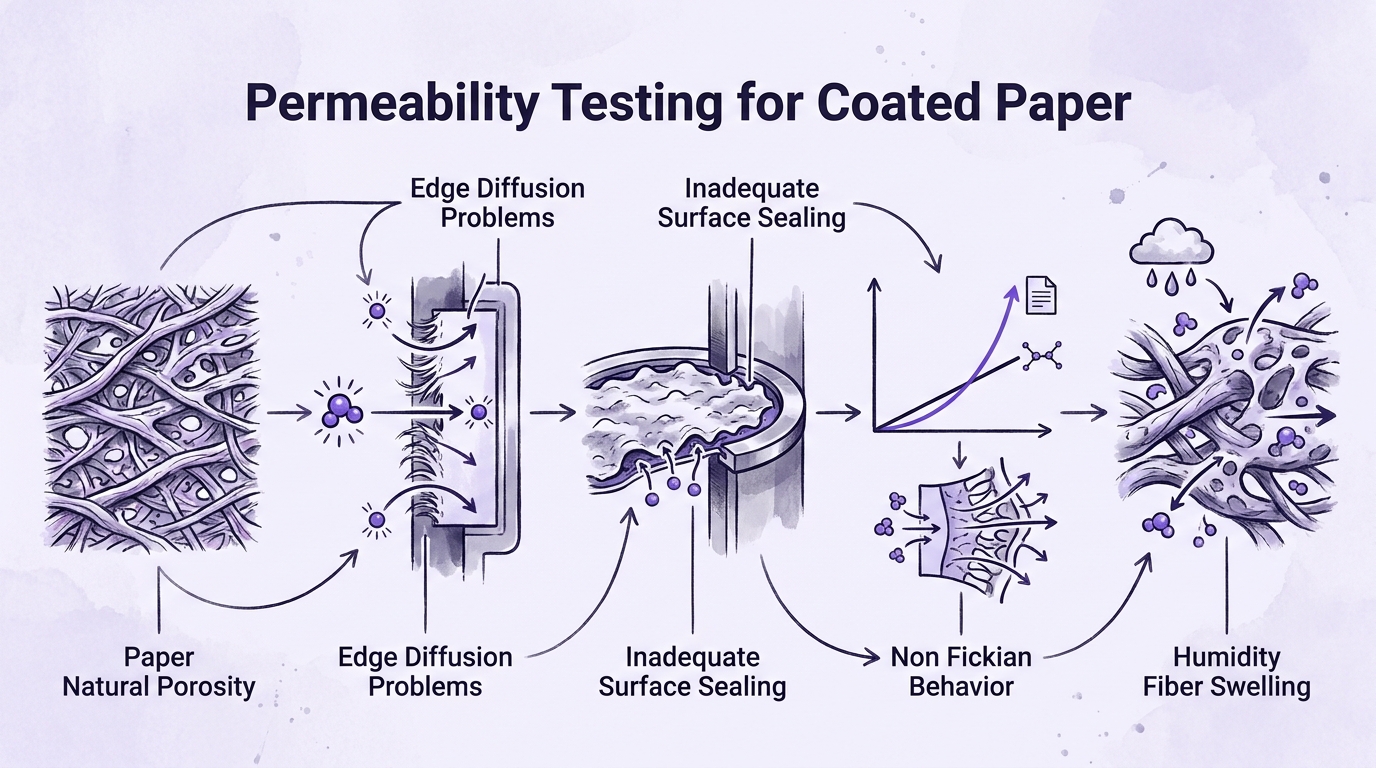
Mike Kragness, Permeation Applications Specialist at AMETEK MOCON, explains the key challenges in testing paper-based and coated paper barrier structures. Due to paper's inherent porosity and non-Fickian behavior, common testing pain points include edge diffusion, improper instrument sealing, and structural changes induced by humidity.

Key takeaways
- 1:51Paper's natural porosity leads to edge diffusion, which skews transmission rate readings by allowing ambient gas or moisture to bypass the sample
- 5:34Unlike standard polymers, paper exhibits non-Fickian permeation behavior because humidity causes the fiber structure to swell, altering its total surface area non-linearly
Tap to enlarge
Most valuable section
For whom
Packaging engineers and material scientists developing sustainable paper alternatives
Non-Fickian Behavior and Humidity Effects5:34
It breaks down the scientific reason paper behaves differently than standard plastics under humid test conditions.
Detailed summary
1. Introduction to Paper-Based Structure Testing
0:00Mike Kragness introduces the growing industrial trend toward sustainable, recyclable, and paper-based packaging materials. Because companies are actively searching for eco-friendly barrier alternatives, coated and pressed paper structures have become increasingly popular.
However, testing paper structures presents unique technical challenges compared to traditional polymers. Paper's inherent porosity makes achieving reproducible and repeatable permeation results difficult without specialized techniques.
2. Edge Diffusion and Instrument Sealing Pain Points
1:51The first major pain point in testing paper-based materials is edge diffusion, which occurs due to random molecular motion escaping through cut edges. This distorts the driving force during testing, causing false high readings in oxygen permeation tests or lowered driving force during water vapor testing in dry ambient environments.
Inadequate sealing within the instrument presents another challenge. Paper surfaces are often textured, bumpy, or inconsistent, which prevents barrier coatings from sealing flat against the testing apparatus and leads to unreliable readings.
3. Non-Fickian Behavior and Humidity Effects
5:34Paper behaves in a non-Fickian manner, meaning its permeation rate does not scale linearly with concentration or relative humidity. In contrast to Fickian polymers that double transmission rates when relative humidity doubles, paper physically changes structure under humid conditions.
Humidity causes paper fibers to swell, expanding the available surface area for permeation. This structural modification breaks the linear relationship between driving force and transmission rate, requiring specific testing equipment and protocols offered by AMETEK MOCON.
Questions this video answers
Why is testing paper-based barriers more difficult than testing traditional plastics?
Paper has high natural porosity and irregular surface textures, making it prone to gas leaking through edges or poor sealing inside test instruments. Additionally, paper reacts to environmental humidity by swelling, which dynamically alters its physical structure during testing.
What is edge diffusion in paper permeation testing?
Edge diffusion occurs when atmospheric gases or moisture penetrate through the cut, unsealed outer edges of a paper sample rather than passing straight through the barrier faces. This causes artificially inflated oxygen readings or compromised relative humidity driving forces.
How does paper differ from Fickian materials in barrier testing?
Fickian materials display a linear relationship between driving force (concentration/humidity) and transmission rate. Paper is non-Fickian because increasing moisture causes the paper fibers to swell and increase total surface area, creating an exponential jump in transmission rate instead of a simple linear one.
Ask a follow-up Premium
About this summary
SumTube AI wrote this recap from the video's words and chapters. Credit and the original belong to AMETEK MOCON.