
Free AI summary of this YouTube video by SumTube
Modulo I:Lectura y comprensión de textos en la práctica del derecho.
TL;DR
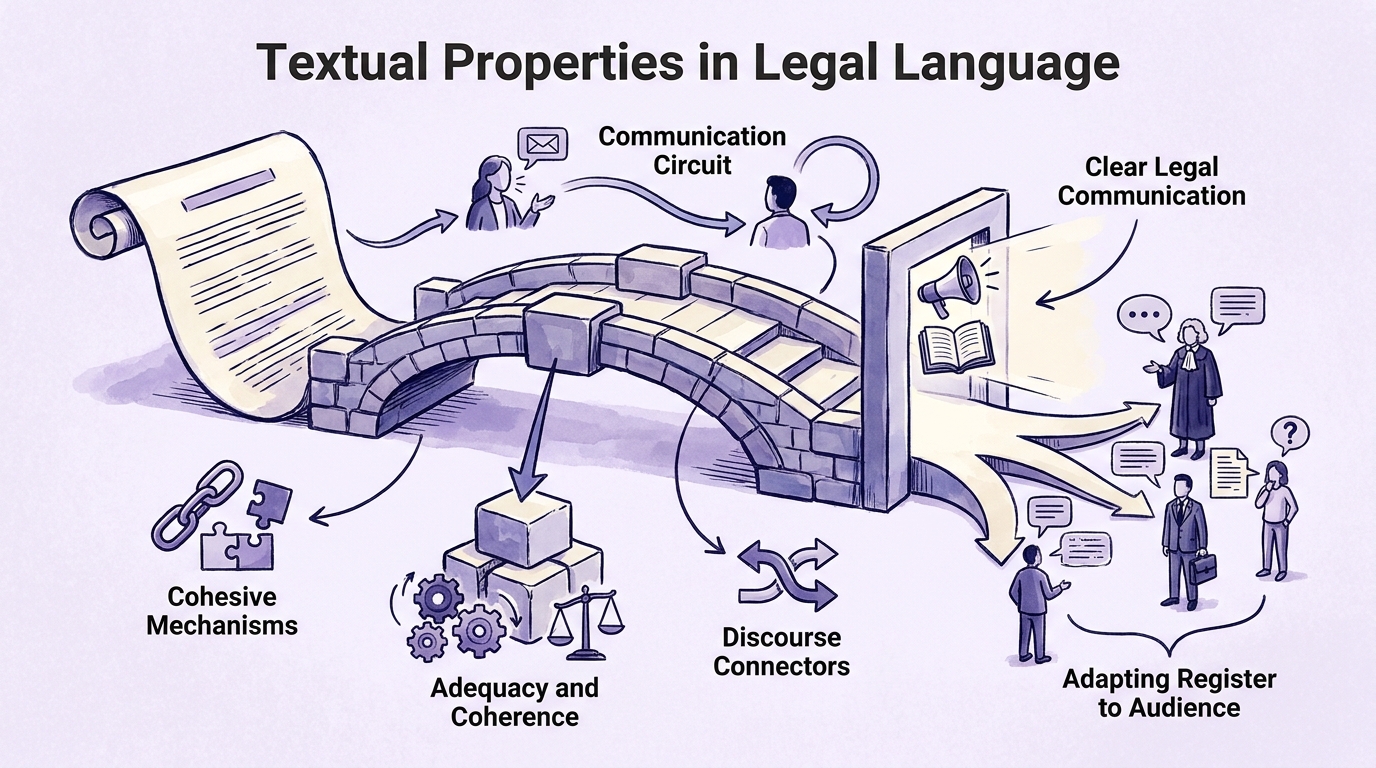
This video presents the second introductory class for law students on oral expression and legal language. The lecture focuses on textual properties—adequacy, coherence, and cohesion—and explores how legal language functions as a specialized register that must be tailored to different addressees such as judges, colleagues, and clients. It also emphasizes the importance of moving toward a clearer, more accessible legal communication without losing technical precision.

Key takeaways
- 3:03A text is defined not merely by a collection of words, but by the simultaneous fulfillment of adequacy, coherence, and cohesion
- 24:08Legal language is a specialized register that must adjust its register and tone depending on whether the recipient is a judge, a fellow attorney, or a lay client
- 48:18Modern legal theory advocates for 'clear legal communication,' urging lawyers to de-automate traditional, opaque formulas so law remains accessible to citizens
Tap to enlarge
Most valuable section
For whom
Law students and legal professionals looking to improve their written and oral communication skills.
Legal Communication Across Different Addressees24:08
This section provides practical, side-by-side examples of how the exact same legal matter must be communicated differently depending on whether the recipient is a judge, a colleague, or a client.
Detailed summary
1. Introduction and Course Overview
0:00Professor María Eugenia Bernal welcomes students to the second class of the 2024-2025 introductory course on Oral Expression and Legal Language. She outlines how student chat feedback is reviewed and reminds students of the virtual classroom resources available to them.
She introduces the required reading materials included in the course booklet, emphasizing key texts by Paula Carlino, Marta Marín, Mikhail Bakhtin, and Mariana Cucatto, as well as upcoming practical manuals.
2. Textual Properties: Adequacy, Coherence, and Cohesion
2:53The lecture reviews the core properties that transform a group of words into a functioning text. Adequacy ensures the text fits its communicative context and intended channel; coherence establishes global and linear thematic unity; and cohesion provides the formal linguistic network connecting sentences and paragraphs.
Common coherence pitfalls such as information overload, missing data, and unorganized ideas are analyzed, alongside cohesive mechanisms including recurrence, substitution, and discourse markers.
3. Textual Structures and Discourse Markers
6:28The professor explains pragmatic markers and discourse connectors—such as additive, oppositional, reformulating, and ordering connectors—which guide the reader through an argument. She illustrates how these markers establish tone and signal speaker intent.
Various structural patterns of texts are outlined, including analyzing (general to specific), synthesizing (specific to general), framed, parallel, interrogative, and repetitive structures.
4. The Role of Language in the Legal Profession
10:57Addressing the core question of why lawyers must master language, the lecture posits that law is constructed, interpreted, and applied entirely through linguistic means. Mastery of language is essential not only for understanding law but also for professional advancement and ethical practice.
Lawyers rely on precise oral and written skills to draft complaints, deliver arguments, interpret legislation, and persuade audiences in judicial hearings.
5. The Communication Circuit in Legal Contexts
18:18The professor breaks down the classic communication model—sender, receiver, message, code, channel, and context—and applies it to the legal domain. She highlights feedback as an indispensable component of any effective dialogue.
She notes that legal communication is inherently dynamic, intentional, and deeply rooted in social, historical, and institutional settings.
6. Legal Communication Across Different Addressees
24:08Using a concrete case of rent default, the professor contrasts how a lawyer communicates the same situation to a judge, a colleague, and a client. To a judge, formal formulas and technical precision are used; to a colleague, direct professional terminology is employed; to a client, the matter is explained in clear, accessible terms.
This comparison demonstrates how the property of adequacy requires lawyers to constantly adapt their register and vocabulary to suit their audience.
7. Characteristics and Challenges of Legal Language
38:12Drawing on Mariana Cucatto's research, the lecture defines legal language as a specialized register characterized by intertextuality, declarative authority, objectivity, and specialized vocabulary. However, excessive reliance on latinisms, archaisms, and complex passive structures often creates communicative barriers.
When legal writing becomes unnecessarily opaque, it leads to a failure in communication, excluding lay citizens from understanding public legal documents.
8. The Move Toward Clear Legal Language and Conclusion
48:18The professor calls for a shift toward 'clear legal language' and the de-automation of inherited writing habits. She stresses that legal language should serve as a bridge between technical expertise and the public, promoting the democratization of legal knowledge.
She concludes the session by assigning specific readings from the course booklet, asking students to review verbal conjugations for the next class, and wishing them success on their upcoming evaluation.
Questions this video answers
What are the three essential properties required for a text to be effective?
A text must possess adequacy (fitting the context and communicative situation), coherence (maintaining a logical thematic unity without contradictions), and cohesion (using linguistic devices like connectors and substitutions to link sentences and paragraphs).
Why must lawyers adapt their language when speaking to a client versus a judge?
When addressing a judge, lawyers use formal, highly technical, and precise legal terminology to establish solid legal arguments. When communicating with a client, they must translate technical terms into clear, accessible language so the client fully understands their legal situation and options.
What is the 'clear legal language' movement discussed in the lecture?
It is an approach that encourages legal professionals to move away from excessively opaque, archaic, and automated legal jargon. The goal is to make legal documents and proceedings accessible to ordinary citizens while preserving necessary legal precision.
Ask a follow-up Premium
About this summary
SumTube AI wrote this recap from the video's words and chapters. Credit and the original belong to Escuela Superior de Ciencias Jurídicas y Políticas.