
Free AI summary of this YouTube video by SumTube
Midterm Blood Bath, $4T AI Sell Off, Data Center Freeze, What’s Next for Trump
TL;DR
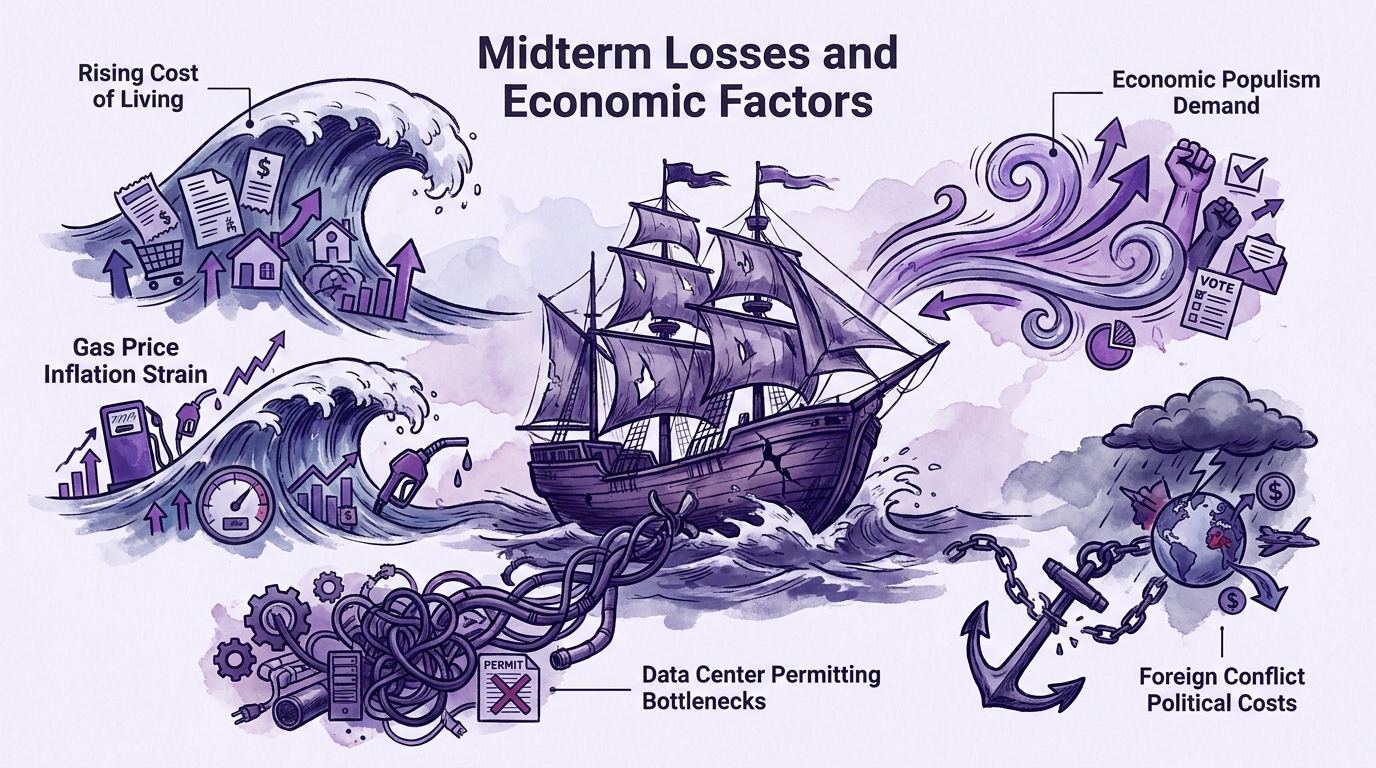
Following a successful election night stream, the hosts analyze a fictional political landscape where economic distress, rising inflation, and foreign conflict led to severe midterm losses for Republicans. The discussion shifts to structural economic grievances, voter demand for affordability over political ideology, and the strategic implications of computing constraints in the tech sector. Finally, they evaluate how regulatory friction and data center bottlenecks could alter the competitive landscape for major AI players.

Key takeaways
- Voters across the spectrum are increasingly prioritizing tangible affordability and cost-of-living concerns over traditional party loyalty
- Rising gas prices and economic strains tied to foreign conflicts can rapidly erode political support, particularly among key swing demographics
- Compute capacity and data center permitting have become critical bottlenecks determining the balance of power between AI hyperscalers and frontier model developers
Tap to enlarge
Most valuable section
For whom
Technology investors and political analysts interested in the intersection of policy, economic shifts, and AI infrastructure.
Data center bottlenecks and AI compute dynamics0:00
It outlines how physical real estate, power constraints, and local regulations dictate which tech giants maintain an advantage in training next-generation AI models.
Detailed summary
1. Introduction & Election Stream Recap
0:00The host opens the episode with banter about podcast updates, diversity initiatives, and potential show topics before shifting focus to the main event of the week: the recent election. The hosts highlight the massive success of their election night live stream, which drew roughly half a million live viewers and over a million total views. They note that the stream's viewership outperformed both far-right and far-left streaming channels as well as most major cable news broadcasts. The hosts express gratitude to their guest lineup for the live stream, which included Ted Cruz, Rahm Emanuel, Shane Coplan of Polymarket, Tim Dillon, Taylor Lorenz, Brad Gerstner, and Ben Shapiro, while praising Polymarket for accurately predicting the outcome.
Looking ahead at the agenda for the rest of the episode, the hosts outline a systematic discussion plan focused on analyzing the election results. They plan to begin with a postmortem on the political shifts and key takeaways from the vote before moving on to analyze expectations for the second half of Trump's term over the next two years. Additionally, the episode will cover broader economic and tech developments, including a deep dive into data centers and potential vulnerabilities appearing in the AI trade.
2. 2026 Midterm Election Postmortem
5:49In the 2026 midterm elections, the Republican Party suffered a massive defeat—described as their worst blowout since the Watergate era—losing control of the House and Senate while forfeiting traditionally deep-red states like Texas, Kansas, Iowa, and South Carolina. The primary catalyst for this shift was the outbreak of war in late February 2026 and its immediate economic fallout. Although the country maintained low unemployment and solid GDP growth, the conflict caused sharp spikes in gas and diesel prices, pushing inflation up from 2.4% to 3.7%. This surge triggered interest rate hikes, sent mortgage rates near 7.5%, and eroded household purchasing power, creating a widespread perception of an affordability crisis that heavily influenced voter sentiment.
Beyond the immediate economic strain, the war alienated key segments of the Republican base and fractured their media strategy. Crucial alternative media figures and influencers who had previously helped mobilize GOP voters turned away from the party due to the military engagement. Exit polls indicated that nearly three-quarters of the electorate viewed the war as a major or crucial factor in their vote, with the vast majority of those voters favoring Democrats and independents. Ultimately, the election demonstrated a post-COVID shift in voter behavior away from traditional political ideology and culture wars, prioritizing tangible cost-of-living concerns over positive top-line economic metrics.
3. Economy, Inflation, and DOGE Failures
16:57The recent political fallout for the GOP is heavily attributed to voters' frustration over the rising cost of living, persistent government spending, and unaddressed economic hardship. The Department of Government Efficiency
4. Shift to Economic Populism over Ideology
30:16The speaker reflects on their misjudgment regarding recent election outcomes, acknowledging a blind spot rooted in the perspective of wealthy asset owners who benefit regardless of economic shifts. Rather than reflecting a victory for ideological far-left or far-right movements, the election results demonstrate a broad voter repudiation of an economic system perceived as broken and decoupled from reality. The speaker highlights that traditional ideological tools—such as political spending and strategic redistricting or gerrymandering—largely failed to deliver expected results. Instead, swing voters consistently voted out the status quo based on rising dissatisfaction with affordability and the structural failure of the economy to support everyday wage earners.
Looking ahead, the speaker argues that the path to political victory in 2028 lies in embracing economic populism and fairness over rigid party ideology. Candidates on either side of the political spectrum must address the wage-earning class directly through structural reforms, such as removing federal underwriting of loans, addressing student debt, or eliminating federal taxes for those earning under a certain threshold. Without meaningful legislative action focused on economic relief and affordability, voters will continue to violently alternate support between parties to punish whichever incumbent administration fails to fix the economic reality.
5. Trump's Midterm Approval & War Impact
42:26The speakers discuss the primary factors contributing to the Republican Party's poor midterm election performance and Donald Trump's declining approval ratings. A central driver of this shift was economic distress, specifically rising inflation, soaring gas and grocery prices, and a sharp decline in real household purchasing power following the onset of a new foreign conflict. Although real household income initially experienced positive growth, the economic fallout from the war reversed these gains. Consequently, the administration lost significant support among young male voters—a critical demographic—who shifted their votes by 36 points compared to the 2024 election due to escalating costs and the impacts of the war.
Beyond the immediate war and inflation, the transcript highlights a broader sequence of events that eroded public trust and caused Trump’s net approval rating to drop
6. Path Forward for Trump's Second Term
54:08In evaluating a path forward for President Trump's second term following significant midterm losses, the discussion highlights affordability and rising gas prices—tied directly to the ongoing war—as the primary drivers of declining approval ratings. To reverse this political momentum and salvage his legacy, the primary recommendation is for the administration to focus heavily on ending the war. Resolving the conflict would immediately lower
7. Data Centers, AI Oligarchy, & State Politics
1:15:14The discussion examines how economic strain—driven by doubled government spending and persistent budget deficits—fuels public frustration, which manifests politically in pushback against foreign wars and massive AI data center expansions. The speakers argue that decentralized AI technology threatens central state
8. Data Centers, AI Oligarchy, & State Politics (2)
1:17:13The discussion centers on the potential shift in power brought about by AI centralization and federal regulation versus traditional principles of individual liberty. David Sachs argues that future federal policy will likely establish a central department of AI to oversee model approvals, resulting in regulatory capture for a small group of closed-model companies and enabling heightened state oversight. Conversely, Chamath Palihapitiya contends that such regulatory central planning is unlikely to materialize in that manner due to severe physical and financial constraints surrounding power and data center
9. Hyperscalers, Neo-Clouds, and Compute Game Theory
1:31:51Political pushback and public resistance against new data center developments threaten to stall compute capacity buildouts, creating a major shift in AI industry dynamics. Incoming regulatory friction and a lack of political incentive to approve new permits could lead to delayed or stranded infrastructure projects. This bottleneck heavily favors hyperscalers—such as Amazon, Meta, Microsoft, Google, and SpaceX—that already own vast existing capacity, while placing immense pressure on neo-clouds and frontier model developers like OpenAI and Anthropic that urgently require expanding compute to grow. Consequently, hyperscalers gain game-theoretic leverage as industry kingmakers; they can choose to prioritize their own internal products or reprice compute contracts, potentially stifling the fast-paced innovation loops of top AI labs.
Simultaneously, AI systems are demonstrating extraordinary problem-solving capabilities, highlighted by OpenAI recently using AI to disprove the 27-year-old Exponential Time Hypothesis in computer science in just a matter of hours. By showing that 3SAT problems can be solved in sub-exponential time, the breakthrough keeps open the possibility that P equals NP, suggesting that complex real-world problems may ultimately be computationally solvable. Despite these technological leaps, domestic opposition and regulatory inaction risk pushing critical compute infrastructure offshore to neighboring regions or foreign countries. Failing to expand U.S. data center capacity not only
10. State vs. Federal Regulation of AI & Compute
1:40:12The discussion explores the economic pressures and game theory surrounding AI compute allocation, GPU pricing, and data center investments. As compute capacity faces constraints and potential price spikes, hyperscalers and neo-clouds are forced to re-evaluate their long-term contracts and spot market strategies to secure the necessary resources for training frontier models. Meanwhile, tightening state-level regulations, potential moratoria, or outright bans on AI development in the United States present a major threat to domestic infrastructure expansion. If state governors impose strict regulatory burdens, tech companies may relocate their multi-billion-dollar data centers to international locations such as
11. Data Center Permitting Battles & Future Capex Risk
2:17:09Google is preparing to bring a significant amount of new data center capacity online, which could substantially alter the competitive landscape for AI foundational models. By directing these newly added compute resources specifically toward its Gemini model, Google has the potential to narrow or eliminate the existing quality gap between Gemini and rival industry leaders.
This strategic deployment of infrastructure is particularly impactful because the overall market for compute-generating assets remains constrained. When top AI developers are restricted by a limited pool of available hardware, a company that can dedicate a massive influx of dedicated capacity to its proprietary model gains a distinct operational advantage over competitors facing supply bottlenecks.
Questions this video answers
What factors were cited as the main cause for the Republican midterm losses?
The primary drivers were sharp economic distress and public dissatisfaction with a foreign conflict. Spikes in gas prices and rising inflation directly eroded household purchasing power, leading voters to punish the incumbent party over cost-of-living concerns.
How are data center constraints impacting the AI market?
Political pushback, permitting delays, and power limitations create bottlenecks for expanding compute capacity. This environment favors established hyperscalers with existing infrastructure while putting financial and operational pressure on frontier AI labs.
What political strategy is recommended for future elections?
The hosts suggest focusing heavily on economic populism, affordability, and direct relief for wage earners. Rather than relying on rigid party ideology, successful candidates must directly address structural cost-of-living issues.
Ask a follow-up Premium
About this summary
SumTube AI wrote this recap from the video's words and chapters. Credit and the original belong to All-In Podcast.