
Free AI summary of this YouTube video by SumTube
Memahami Fenomena Kecerdasan Buatan | Menyelisik Ide Pokok & Ide Pendukung dalam Teks Teknologi
TL;DR
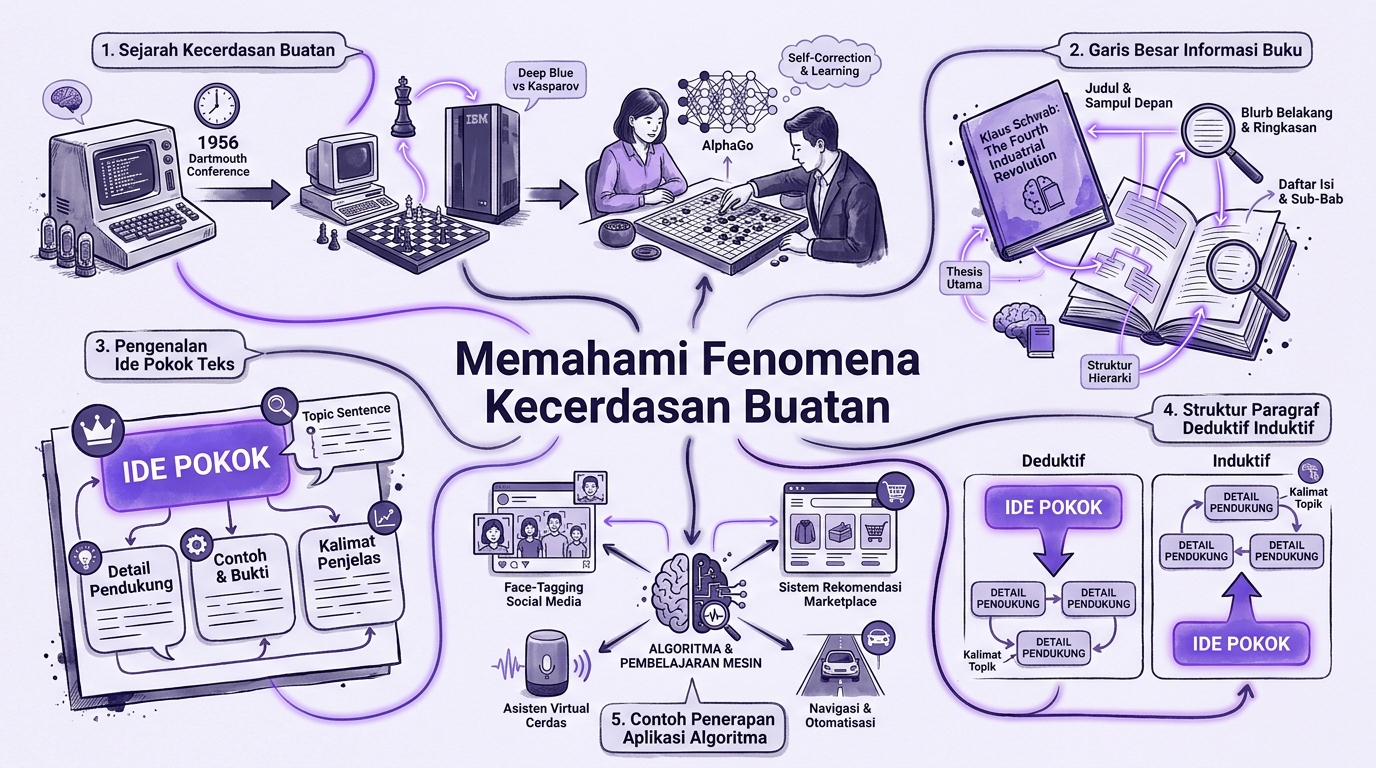
This Indonesian language video lesson for Grade 12 students explores Artificial Intelligence (AI) and teaches techniques to identify main and supporting ideas in complex non-fiction texts. It uses historical examples of AI, such as Deep Blue and AlphaGo, to illustrate machine learning concepts and their economic and societal impacts. Additionally, the instructor demonstrates practical textual analysis by walking through textbook readings, book layouts, and practice exercises.

Key takeaways
- 2:04Historical milestones like Kasparov vs. Deep Blue and AlphaGo showcase how AI system capabilities evolve rapidly through self-correction and iterative learning.
- 15:23Main ideas in a text are anchored in titles, key phrases, and topic sentences, while supporting details appear in subheadings and explanatory sentences
- 18:25Long-form non-fiction sources like books reveal their core thesis and structural hierarchy through front cover titles, back cover blurbs, and table of contents summaries
- Analyzing textual structure enables readers to grasp an author's core message efficiently while providing writers with a framework to organize complex ideas logically
Tap to enlarge
Most valuable section
For whom
High school students and educators learning or teaching textual analysis methods for non-fiction literature
Identifying Main and Supporting Ideas in Complex Texts15:17
It breaks down practical grammatical rules for distinguishing paragraph types (deductive vs. inductive) and structural clues across full-length books.
Detailed summary
1. Introduction to AI and Technological Impact on Labor
0:00The instructor introduces the Grade 12 Bahasa Indonesia lesson focused on understanding artificial intelligence topics while developing critical reading skills. The lecture opens by addressing common societal anxieties about automation, examining infographics and survey data regarding job displacement caused by robotics.
The discussion touches upon historical milestones, such as Gary Kasparov's chess matches against IBM's Deep Blue, illustrating the transition from simple mechanical automation to machines capable of complex cognitive reasoning. Surveys highlight public concern over potential economic inequality resulting from increased reliance on AI.
2. Defining Artificial Intelligence and Machine Learning Mechanisms
5:04This segment reviews an introductory article on AI, tracing the history of the term from the 1956 Dartmouth conference organized by John McCarthy to modern practical applications. Examples include virtual assistants like Siri and Google Assistant, as well as smart features integrated into modern smartphones and vehicles.
The lesson details how AI models human intelligence through learning, reasoning, and self-correction processes. Using Deep Blue and AlphaGo as primary examples, the instructor explains how algorithms self-improve by running millions of trial simulations and digesting massive interaction datasets.
3. Real-World AI Applications and Career Shifts
11:54The lesson discusses everyday applications of AI that users encounter regularly, such as automated face-tagging algorithms on social media platforms like Facebook and recommendation systems on marketplace apps. These features rely on digital footprints—data gathered from past searches, views, and purchase behaviors.
The instructor emphasizes that while AI and automation will eliminate traditional job roles, they will simultaneously create new career paths. Students are encouraged to adopt a mindset of lifelong learning to adapt to evolving technological landscapes.
4. Structure of Main and Supporting Ideas in Paragraphs
15:07Transitioning to language mechanics, the lecture explains how to locate main ideas and supporting details within short passages. Main ideas are typically stated in topic sentences, whereas supporting ideas offer detailed explanations, evidence, or contextual examples.
The video outlines paragraph structures based on topic sentence placement: deductive paragraphs place the main idea at the beginning, inductive paragraphs place it at the end, and mixed paragraphs feature main ideas at both boundaries.
5. Extracting Main Ideas from Full-Length Books
18:25The lesson scales textual analysis techniques up to long-form media, such as non-fiction books. Key components for identifying core themes include the front cover title, the back cover blurb or summary, and the structured table of contents.
Using Klaus Schwab's 'The Fourth Industrial Revolution' as a visual example, the instructor illustrates how book chapters and sub-chapters systematically divide a overarching thesis into manageable, supportive analytical points.
6. Practice Exercise and Textbook Question Breakdown
21:45The instructor guides students through a series of textbook comprehension questions designed to reinforce the day's topics. Sample answers are provided to help students formulate concise single-sentence main ideas and correctly extract supporting details from their reading assignments.
An additional practice sample analyzes Charles Duhigg's non-fiction book 'The Power of Habit'. The instructor demonstrates how to isolate the central framework—cues, routines, and rewards—and map out its corresponding supporting elements.
7. Summary and Conclusion
26:56The video concludes with a quick recap of the key grammatical concepts covered during the session. The instructor reiterates the definitions of deductive, inductive, and mixed paragraphs, highlighting how recognizing paragraph structure improves reading comprehension.
Students are encouraged to practice analyzing non-fiction materials independently to sharpen both their reading and analytical writing skills before the lesson closes.
Questions this video answers
How does Artificial Intelligence improve its decision-making capabilities?
AI improves its performance by acquiring data through human interaction and processing it using learning, reasoning, and self-correction algorithms. Systems like Deep Blue and AlphaGo simulate thousands or millions of scenarios autonomously, learning directly from past errors to refine their logic far faster than humanly possible.
What techniques help identify main and supporting ideas in non-fiction texts?
Main ideas can be located by analyzing section titles, primary keywords, and topic sentences positioned at the beginning (deductive), end (inductive), or both ends (mixed) of a paragraph. Supporting ideas are identified through explanatory detail sentences, subheadings, or structural breakdowns found in table of contents and cover blurbs.
How can readers outline the main structure of an entire book before reading?
Readers can evaluate an entire book's structure by examining the main title and subtitle on the front cover, reading the back cover blurb or summary, and reviewing the table of contents. The table of contents breaks down the overarching main idea into chapter topics and sub-topics, providing a clear roadmap of the author's argument.
Ask a follow-up Premium
About this summary
SumTube AI wrote this recap from the video's words and chapters. Credit and the original belong to Masyhur Riady.