
Free AI summary of this YouTube video by SumTube
Melawan Lupa - Jejak Cahaya Buddha di Nusantara
TL;DR
This documentary explores the historical journey of Buddhism across the Indonesian archipelago (Nusantara), tracing its early introduction by Indian traders and monks to its golden eras under the Srivijaya and Shailendra dynasties. It highlights the syncretism of Hindu-Buddhist traditions during the Majapahit period and details Buddhism's modern revival through figures like Bhikkhu Ashin Jinarakkhita and the establishment of Sanghyang Adi Buddha.

Key takeaways
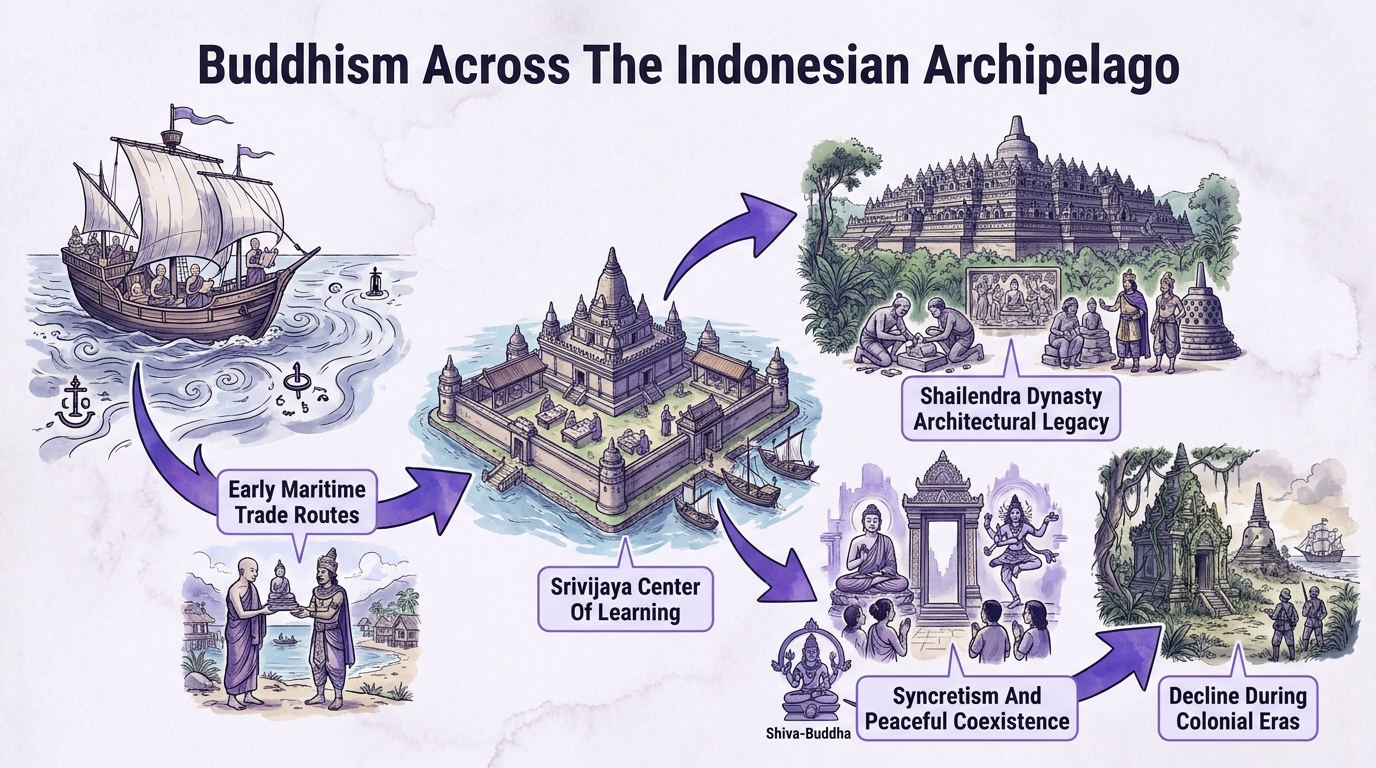
- 1:04Buddhism arrived in Nusantara around the 3rd to 5th century CE, initially through maritime trade routes, eventually becoming a major state religion
- 4:28Srivijaya served as an international center for Buddhist learning, hosting over 1,000 monks and key scholars like Yijing and Atisha
- 11:04During the Majapahit era, Hinduism and Buddhism syncretized seamlessly into Shiva-Buddha, forming a foundational model for Indonesian religious tolerance
- 18:06Bhikkhu Ashin Jinarakkhita spearheaded the modern revival of Indonesian Buddhism by introducing 'Sanghyang Adi Buddha' to align with Pancasila
Tap to enlarge
Most valuable section
For whom
History enthusiasts, students of comparative religion, and researchers of Southeast Asian heritage
The Modern Revival of Buddhism in Indonesia17:04
It explains the fascinating story of how Indonesian Buddhist leaders navigated post-colonial political pressures and G30S/PKI aftermath to re-establish Buddhism as an official state religion.
Detailed summary
1. Introduction to Buddhism in Nusantara
0:00The video opens with an introduction to the deep historical roots of Buddhism in the Indonesian archipelago. Born in India around the 6th century BCE, Buddhism traveled across maritime trade routes to become a dominant spiritual and cultural force in Nusantara alongside Hinduism.
Archaeological sites, ancient statues, and temples such as Borobudur stand as enduring testaments to Buddhism's early influence on Indonesian society and identity.
2. Early Arrival and Maritime Spread
1:04Historians and archaeologists discuss the timeline of Buddhism's arrival, estimated between the 3rd and 5th centuries CE. Travelling monks accompanied merchant ships arriving at coastal ports across Sumatra and Java.
Historical records from Chinese pilgrims like Faxian (414 CE) describe early encounters with local religious practices, indicating that while Brahmanism was prevalent, Buddhist communities were gradually establishing themselves.
3. Srivijaya: The Golden Center of Buddhist Learning
5:07The Srivijaya Kingdom in Sumatra emerged in the 7th century as a monumental Buddhist maritime empire. Srivijaya developed into a premier learning center for Buddhist philosophy, attracting over a thousand monks from across Asia.
Chinese pilgrim Yijing documented Srivijaya's vibrant monastic life and scholarly institutions. Prominent figures like Atisha Dipankara spent years in Srivijaya studying under Master Dharmakirti before reviving Buddhism in Tibet.
4. The Shailendra Dynasty and Central Java Temples
8:45By the 8th century, the Shailendra Dynasty flourished in Central Java, championing Mahayana Buddhism. Their reign left behind world-renowned architectural masterpieces, including Candi Borobudur, Candi Mendut, and Candi Pawon.
Inscriptions like the Kalasan Inscription (778 CE) document royal patronage for sacred Buddhist structures, highlighting the empire's dedication to Mahayana art, culture, and spirituality.
5. Syncretism and the Shiva-Buddha Tradition
10:47Following the decline of the Shailendra dynasty, the Hindu Sanjaya dynasty gained prominence, leading to centuries of peaceful religious coexistence. A unique syncretism developed between Hinduism and Buddhism, culminating in the Shiva-Buddha concept during the Singhasari and Majapahit eras.
Royal marriages and shared cultural practices fostered harmonized worship. In literature like the Kakawin Sutasoma, the phrase 'Bhinneka Tunggal Ika' was coined to reflect the underlying unity between Shiva and Buddha.
6. Decline During the Islamic and Colonial Eras
14:01With the fall of the Majapahit Empire in the late 15th century and the rapid spread of Islam, Buddhism went into a long period of decline in Java and Sumatra. Monastic communities dispersed, and many ancient temples were abandoned to nature.
During the Dutch colonial era and Japanese occupation, the Buddhist population remained small and mostly restricted to Chinese-Indonesian communities practicing Chinese Buddhist traditions.
7. The Modern Revival of Buddhism in Indonesia
17:04In the 1930s, Sri Lankan monk Narada Maha Thera visited the Dutch East Indies, reigniting public interest in Theravada Buddhism and holding early celebrations at Borobudur.
After Indonesian independence, Bhikkhu Ashin Jinarakkhita emerged as the primary pioneer of modern Indonesian Buddhism, establishing organizations, ordaining monks, and promoting unified Buddhist practice across ethnic groups.
8. Sanghyang Adi Buddha and State Recognition
18:59In the political aftermath of G30S/PKI in 1965, the Indonesian government required all citizens to register a monotheistic religion. Bhikkhu Ashin Jinarakkhita introduced the concept of 'Sanghyang Adi Buddha', sourced from ancient Kawi texts, to fulfill Pancasila's requirement of belief in One Supreme God.
This crucial theological development protected Indonesian Buddhists and secured Buddhism's position as an officially recognized state religion in modern Indonesia.
Questions this video answers
How did Buddhism first arrive in Indonesia?
Buddhism was brought to the archipelago around the 3rd to 5th century CE by Buddhist monks traveling alongside foreign traders. Early archaeological evidence and inscriptions from Sumatra and Java confirm its historical presence.
What role did the Srivijaya Kingdom play in Buddhist history?
Srivijaya was a premier global center for Mahayana and Theravada Buddhist scholarship in Southeast Asia. International scholars and monks, including Chinese pilgrim Yijing and Indian master Atisha, visited Srivijaya to study Buddhist philosophy.
What is the concept of Sanghyang Adi Buddha?
Sanghyang Adi Buddha is a concept formulated by Bhikkhu Ashin Jinarakkhita in the mid-20th century to represent the supreme deity in Indonesian Buddhism. This formulation ensured Buddhism fulfilled the monotheistic requirement of Indonesia's Pancasila state philosophy.
Ask a follow-up Premium
About this summary
SumTube AI wrote this recap from the video's words and chapters. Credit and the original belong to Melawan Lupa Metro TV.