
Free AI summary of this YouTube video by SumTube
Manual Software Testing Training Part-1
TL;DR
This video serves as an introductory session to Manual Software Testing, covering the foundational curriculum structure and basic concepts. It defines what software is, outlines the main categories of software, and explains the primary objective of software testing: delivering a quality, bug-free product to the client.

Key takeaways
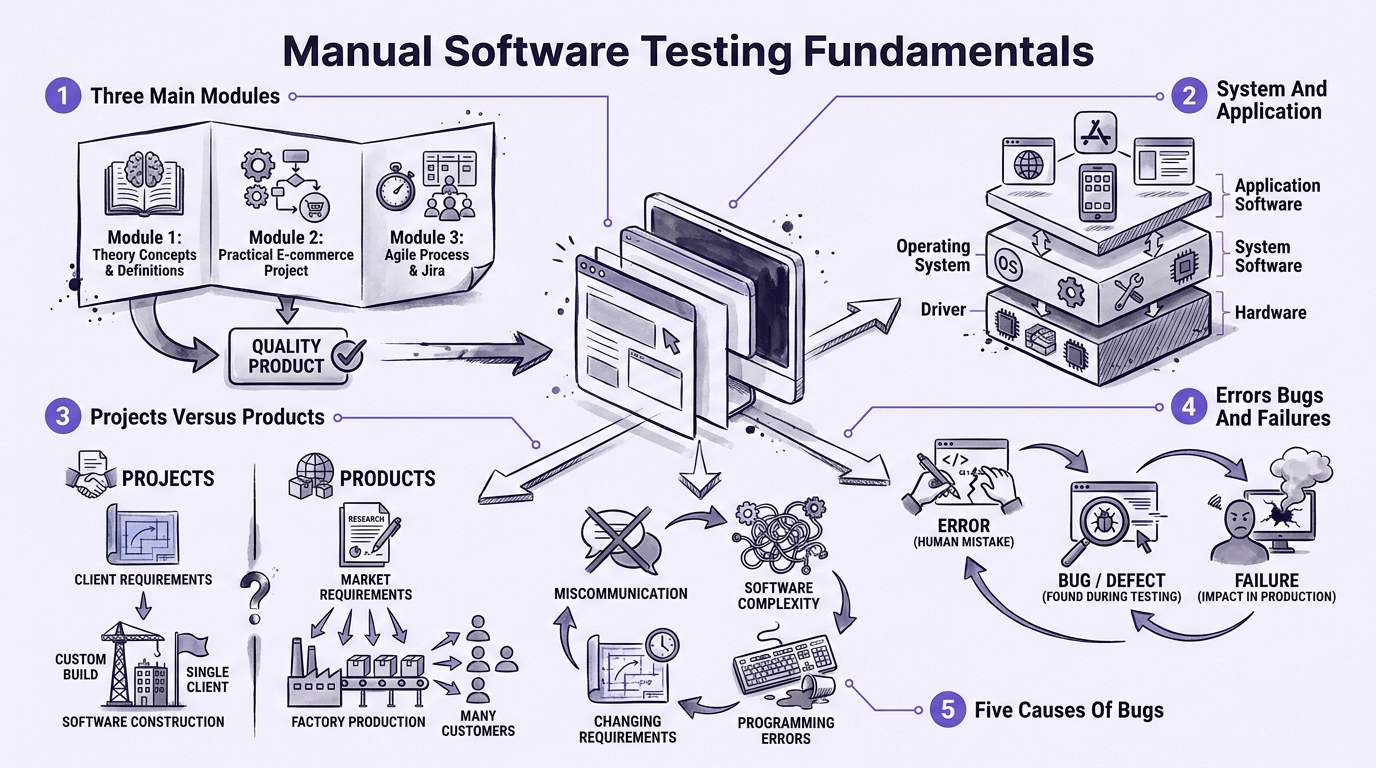
- 0:36Software testing is split into three core modules: theoretical testing concepts, practical project execution, and the Agile process using Jira
- 33:28A software product is developed based on general market requirements for multiple customers, whereas a project is custom-built for a specific client
- 39:58Bugs, errors, and failures represent different stages of an issue: errors are human mistakes in code, bugs/defects are found during testing, and failures occur in production
Tap to enlarge
Most valuable section
For whom
Beginners seeking an entry-level explanation of software testing fundamentals and terminology.
Error, Bug & Failure Definitions39:58
It clearly distinguishes between technical terms like error, bug/defect, and failure, which are essential for technical interviews and day-to-day testing.
Detailed summary
1. Manual Testing Course Overview
0:00The instructor introduces a new live series on Manual Software Testing tailored for beginners and those without an IT background. The curriculum is divided into three distinct modules to ensure comprehensive learning.
Module 1 focuses on theoretical testing concepts and basic definitions. Module 2 transitions into a practical e-commerce project, teaching requirement analysis, test planning, and defect lifecycle execution. Module 3 covers the Agile process and test management using Jira.
2. What is Software and Its Types
8:29Software is defined as a collection of computer programs designed to perform specific tasks. The instructor breaks down software into three primary categories: System Software, Programming Software, and Application Software.
System software includes operating systems and drivers that help run the computer hardware. Programming software includes compilers and debuggers used by developers. Application software, such as web, mobile, and desktop apps, forms the primary focus for manual software testers.
3. Introduction to Software Testing & Quality
17:30Software testing is presented as an essential part of the software development process aimed at identifying defects before delivery. The ultimate goal of testing is to ensure that a quality product reaches the client.
Quality is measured through key parameters: being bug-free, delivered on time, within budget, meeting client requirements, and being easily maintainable. Testing plays a critical role in verifying all these parameters.
4. Project vs. Product
23:11The instructor explains the fundamental distinction between a software project and a software product. A project is developed for a specific client based on their custom requirements.
A product, however, is built based on general market requirements and sold to multiple customers. Service-based companies typically work on projects, while product-based companies develop standardized software applications.
5. Error, Bug, Defect & Failure
39:58This section clarifies the technical differences between errors, bugs, defects, and failures. An error is a human mistake made by a developer while writing code or designing software.
A bug or defect is an unexpected behavior or deviation from requirements found by testers during the testing phase. A failure occurs when a bug goes undetected and impacts the end user in a production environment.
6. Why Software Has Bugs
44:48The instructor outlines the five primary reasons why bugs occur in software applications. These include miscommunication, software complexity, programming errors, changing requirements, and a lack of skilled testers.
Effective testing requires testers to adopt a critical, analytical mindset focused on breaking the application to uncover potential issues before deployment.
Questions this video answers
What are the main categories of software discussed in manual testing?
Software is categorized into System Software (operating systems, device drivers), Programming Software (compilers, debuggers), and Application Software (web, mobile, and desktop apps). Manual testing primarily focuses on testing Application Software.
What defines 'Software Quality' in software testing?
Software Quality is determined by parameters such as being bug-free, delivered on time, within budget, meeting client requirements/expectations, and being easily maintainable.
Why do software applications end up having bugs?
Bugs occur due to miscommunication or lack of communication, software complexity, programming errors, frequently changing requirements, and a lack of skilled testers.
Ask a follow-up Premium
About this summary
SumTube AI wrote this recap from the video's words and chapters. Credit and the original belong to SDET- QA.