
Free AI summary of this YouTube video by SumTube
MÉTODO SECRETO: 42 ACERTOS em MATÉMATICA no ENEM em 1 MINUTO!
TL;DR
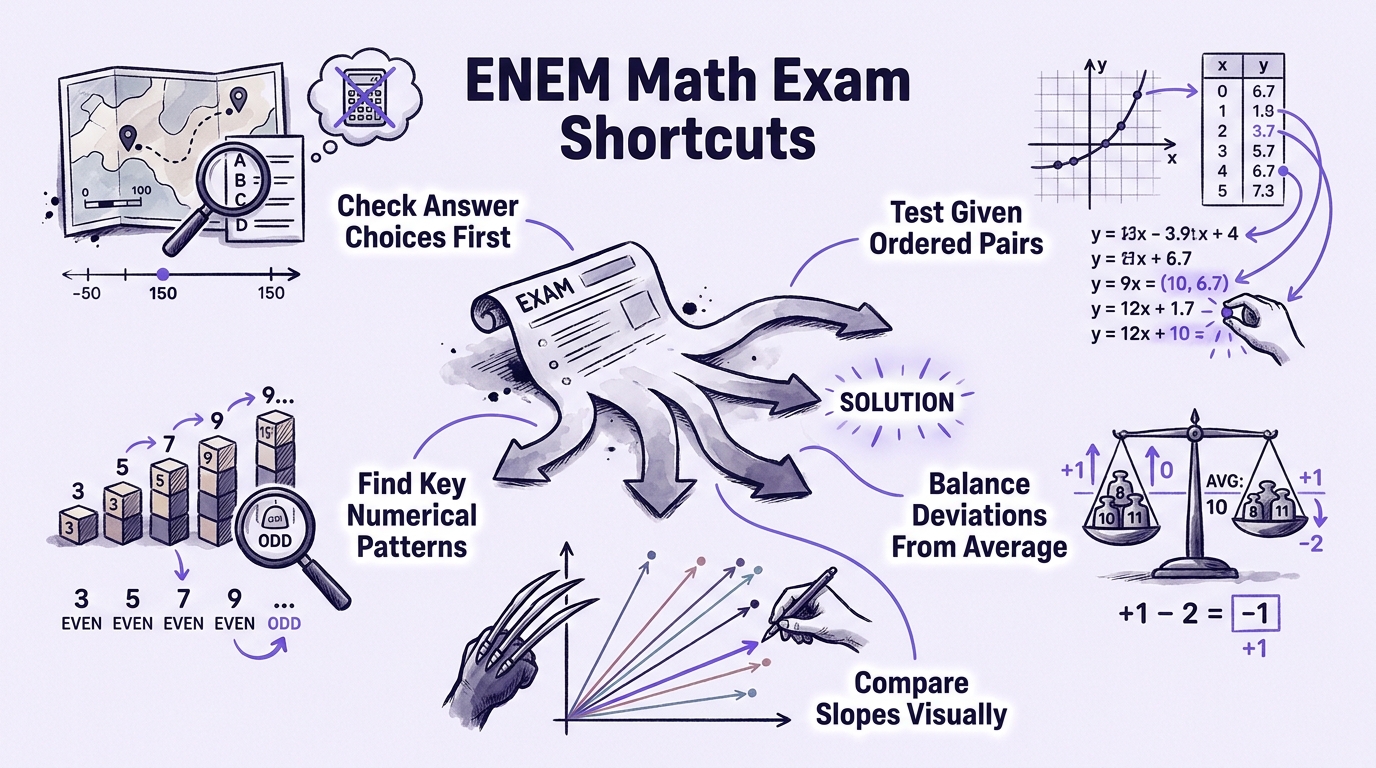
This video presents several shortcut strategies to solve ENEM mathematics exam questions in under a minute without needing full traditional analytical solutions. By leveraging answer choices, key graph properties, pattern recognition, and estimation, students can save valuable time and increase their scores.

Key takeaways
- 1:46Eliminate choices using basic magnitude checks directly from the scale equation
- 2:11Substitute ordered pairs into formula options (TGH method) instead of deriving full algebraic equations
- 6:57Look for structural patterns—like even vs. odd numbers—to instantly narrow down multiple-choice options.
- 10:43Solve mean problems quickly by balancing deviations from the target average until the net sum is zero
Tap to enlarge
Most valuable section
For whom
ENEM test-takers looking to optimize their exam timing and increase their math scores
Shortcut 2: The TGH Technique2:11
It demonstrates how to bypass setting up tedious linear algebraic systems by simply plugging table values into multiple-choice options.
Detailed summary
1. Introduction & Why Shortcuts Matter for ENEM
0:00The instructor introduces seven practical math shortcuts tailored specifically for the ENEM exam. These techniques are designed to help students solve questions in less than a minute and gain extra points on test day.
Because the ENEM exam features 45 math questions with tight time constraints, using non-traditional shortcuts is vital. Traditional analytical methods taught in school often waste time, whereas these techniques help secure high scores and free up time for difficult problems.
2. Shortcut 1: Looking at the Answer Choices (OI A)
1:46The first hack uses a simple scale and distance problem to demonstrate how examining the answer choices saves calculation time. Setting up the proportion reveals that the final result must be larger than 250, instantly eliminating four incorrect options.
By focusing on order of magnitude and checking choice boundaries, students can solve map and scale problems in 20 seconds or less without completing detailed multiplication.
3. Shortcut 2: The TGH Technique for Functions
2:11The TGH (Table, Graph, History) method is applied when question options are given as linear equations or functions. Instead of manually constructing a linear equation system using standard formulas, students pick ordered pairs from the given table.
Testing a single pair like (10, 6.7) in the choices eliminates all incorrect equations immediately. If necessary, a second pair can be tested, saving significant time over traditional algebraic systems.
4. Shortcut 3: Pattern Recognition & Number Properties
6:57This trick involves spotting key numerical patterns, such as odd and even parity, within arithmetic progressions. In a problem tracking overlapping repair floors in a building, listing the first few meeting points reveals that all overlap floors are odd numbers.
Scanning the answer choices shows that four of them are even numbers. Identifying this single property pinpoints the only possible odd answer without doing complex arithmetic formulas.
5. Shortcut 4: Fast Arithmetic Mean via Deviations
9:57Instead of calculating an arithmetic mean using full summation and algebraic division, this shortcut calculates differences relative to the target average. The differences from the target mean are listed and canceled against one another.
To maintain the target average, the missing value must equal the target mean plus the remaining net difference. This deviation balance method solves target-mean problems in seconds with simple addition.
6. Shortcut 5: The Wolverine Technique (Line Slope)
13:37The Wolverine technique solves rate-comparison graph questions by drawing radial secant lines from the origin to each data point. The slope or inclination of each line corresponds directly to the ratio between the vertical and horizontal quantities.
The line with the lowest slope instantly highlights the option with the minimum ratio per unit. Visualizing these slopes avoids doing repetitive long-division calculations for every single data point.
7. Shortcut 6: Linear Function Intercepts and Slope Sign
17:08Linear function graphs can be solved in seconds by reading two key features: the y-intercept (value of b) and the slope direction (sign of a). A decreasing line indicates a negative slope coefficient, while the point crossing the vertical axis gives the exact constant term.
Comparing these visual clues directly against the multiple-choice formulas eliminates options with positive slopes or wrong intercept values, identifying the correct function almost instantaneously.
8. Shortcut 7: Strategic Estimation from Options
19:07The final macete leverages realistic estimation in percentage and proportion problems. Rather than performing exact multi-digit cross-multiplication, students calculate simple benchmark percentages like 50% or 10% to bound the expected result.
By comparing the estimated range with the answer choices, incorrect values are systematically ruled out, leaving only the correct answer without tedious scratchwork.
Questions this video answers
Why should I use shortcut tricks instead of solving math problems step-by-step?
The ENEM math section consists of 45 questions with strict time limits. Using shortcuts allows you to solve easy-to-medium questions in under a minute, preserving crucial time for complex problems and reducing exam fatigue.
What is the TGH (Table, Graph, History) technique?
TGH is a method where you take known ordered pairs (x, y) from a provided table or graph and substitute them directly into the multiple-choice equations. Whichever formula holds true for the values is the correct choice, eliminating the need to solve a system of linear equations from scratch.
How can slope or inclination help answer graph questions faster?
The steepness (inclination) of lines from the origin represents the ratio between the y and x axes. In proportional problems, the line with the smallest slope automatically has the lowest ratio, allowing you to identify minimums or maximums visually without performing long division.
Ask a follow-up Premium
About this summary
SumTube AI wrote this recap from the video's words and chapters. Credit and the original belong to Escola xequemat enem.