
Free AI summary of this YouTube video by SumTube
La educación uruguaya en 1943
TL;DR
This 1943 archival documentary examines the educational system of Uruguay, highlighting its progressive reforms and high literacy rates across primary, secondary, and tertiary levels. It showcases how compulsory, free public education and co-ed classrooms contributed to building a literate, democratic society in 20th-century South America.

Key takeaways
- 0:55Uruguay achieved the highest literacy rate in Latin America through early 20th-century educational reforms
- 3:24President José Batlle y Ordóñez expanded free, compulsory co-educational access from primary school to university levels
- 1:44The country's diverse European immigrant population unified under a shared commitment to public education and democratic ideals
Tap to enlarge
Most valuable section
For whom
Historians, educators, and researchers interested in 20th-century Latin American public policy and educational history.
Secondary and Higher Education Expansion3:22
It outlines the historic policy changes introduced by President José Batlle y Ordóñez that modernized Uruguayan education.
Detailed summary
1. Primary Education and Literacy in Uruguay
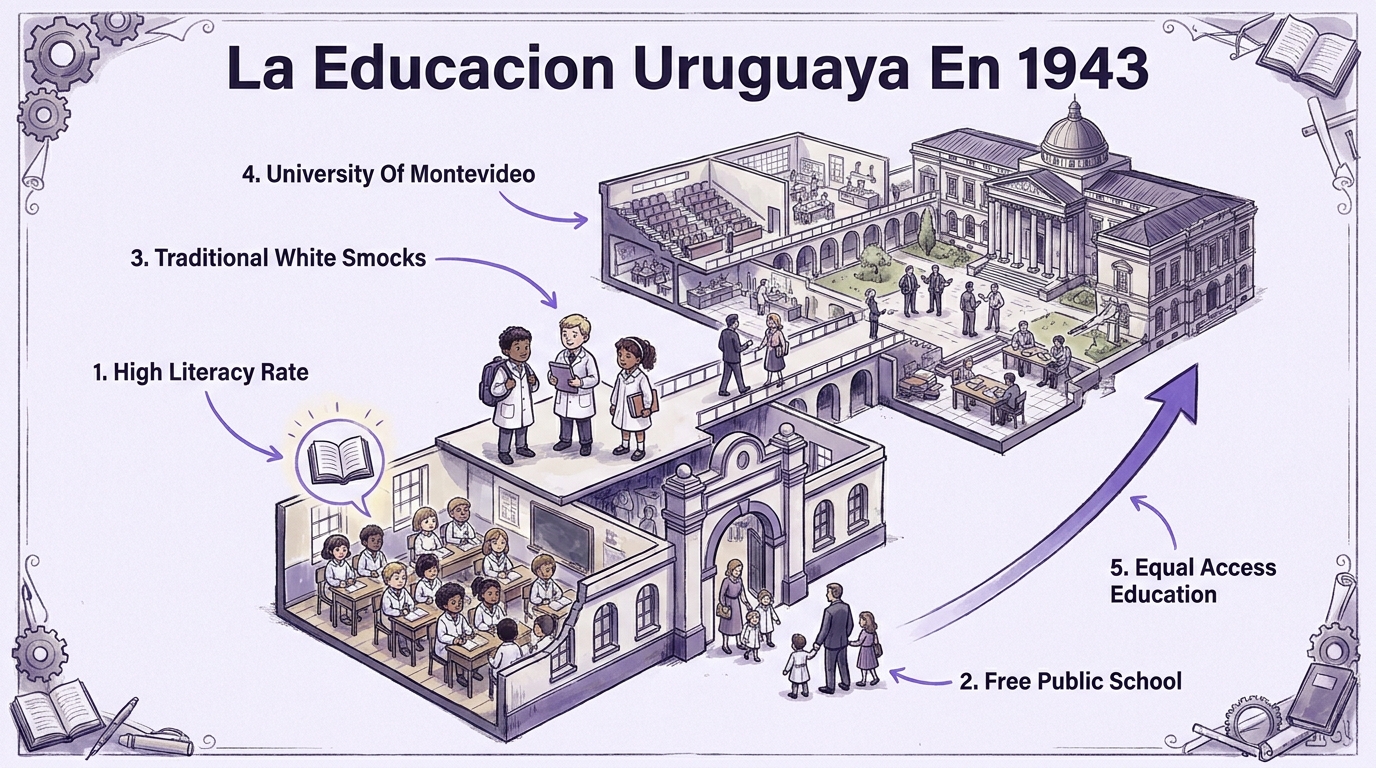
0:00Young children across Uruguay start school wearing traditional white smocks regardless of their socioeconomic background. Over the past four decades, Uruguay achieved substantial educational advancements, leading to the highest literacy rate in all of Latin America.
The country's population reflects a blend of various European cultural backgrounds, including Basque, Catalan, Italian, Swiss, and Slavic immigrants. Public primary schools foster social cohesion by educating boys and girls together, while private institutions represent only a minor fraction of overall enrollment.
2. Secondary and Higher Education Expansion
3:22The secondary school system originated from the vision of President José Batlle y Ordóñez, who launched a broad social revolution in 1903. Believing primary education alone was insufficient, he expanded secondary institutions into outer provinces to ensure free, compulsory education for all citizens.
At the University of Montevideo, students gather in open patios to study and debate political topics. Higher education emphasizes practical professional training alongside traditional academic subjects like logic and philosophy, preparing a new generation of educated citizens for the nation's future.
Questions this video answers
What made Uruguay's education system unique in Latin America in 1943?
Uruguay stood out for having the highest literacy rate in Latin America and implementing widespread free, compulsory public education. Its public primary and secondary schools promoted gender integration and co-education, which was uncommon in the region at the time.
Who was responsible for expanding Uruguay's secondary education network?
President José Batlle y Ordóñez initiated major social and educational reforms in 1903. He envisioned free, accessible public education across all departments and levels, extending secondary schooling well beyond Montevideo into rural provinces.
How were Uruguayan universities structured compared to US institutions?
The University of Montevideo focused primarily on practical professional training rather than traditional campus dormitories or fraternity housing. Students gathered in central open-air patios for intense political debates, academic discussion, and intellectual discourse.
Ask a follow-up Premium
About this summary
SumTube AI wrote this recap from the video's words and chapters. Credit and the original belong to En la Mira - VTV.