
Free AI summary of this YouTube video by SumTube
KATOLICKA NAUKA SPOŁECZNA | Rerum Novarum i Leon XIII
TL;DR
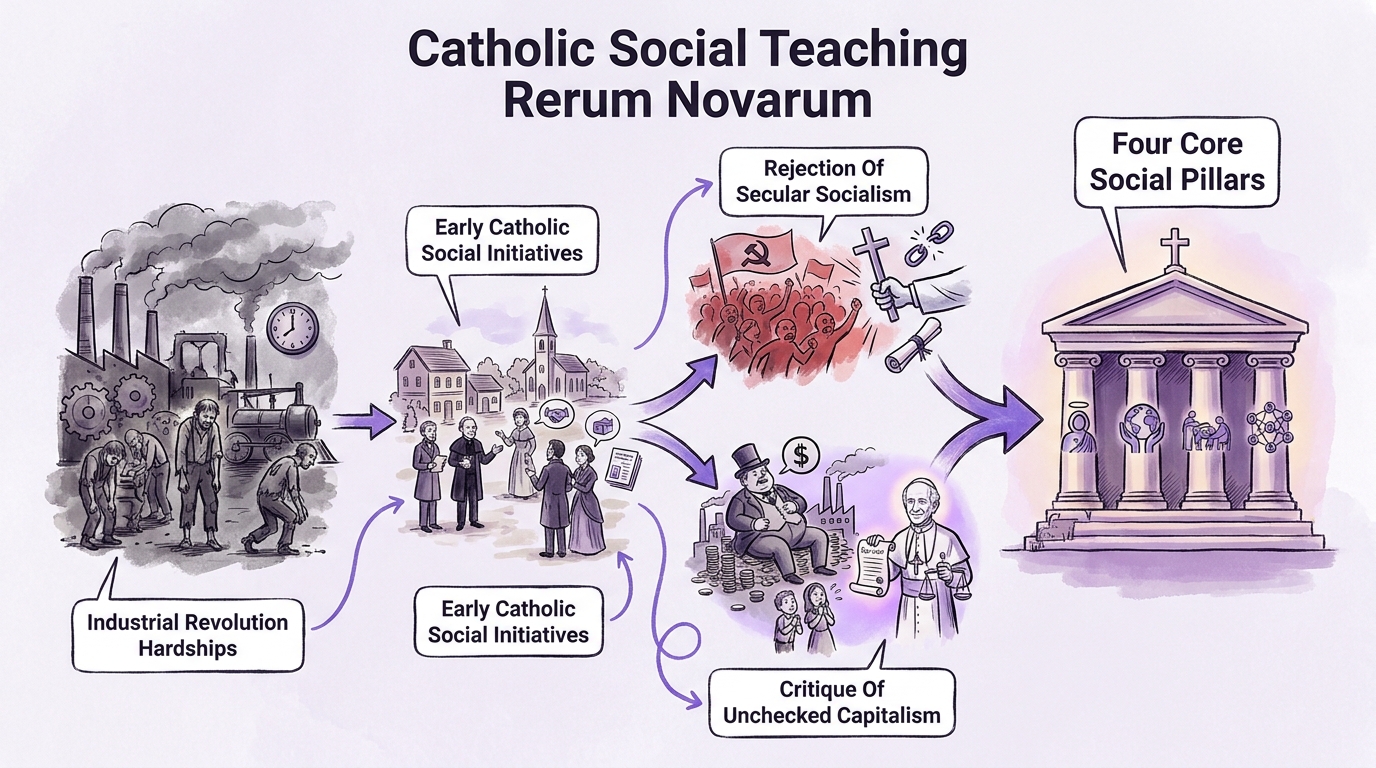
This video explores the origin, development, and core principles of Catholic Social Teaching, focusing on Pope Leo XIII's landmark 1891 encyclical *Rerum Novarum*. It analyzes how the Church responded to the Industrial Revolution, navigating a middle path between unbridled capitalism and radical socialism. The discussion covers historical Catholic social movements, papal critiques of both liberalism and communism, and key principles such as human dignity, the common good, subsidiarity, and solidarity.

Key takeaways
- Catholic Social Teaching rejected both laissez-faire capitalism and radical socialism, proposing a balanced framework based on human dignity
- The 19th-century Industrial Revolution created harsh labor conditions, prompting early Catholic thinkers in France and Germany to advocate for state intervention and workers' rights
- Pope Leo XIII's *Rerum Novarum* affirmed the right to private property while insisting that property carries social obligations and workers deserve a living wage
- Catholic social doctrine rests on four core pillars: human dignity, the common good, subsidiarity, and solidarity
Tap to enlarge
Most valuable section
For whom
History enthusiasts, students of political philosophy, and anyone interested in the intersection of religious ethics and modern social economics.
Catholic Social Principles42:00
It breaks down the foundational pillars of Catholic Social Teaching—human dignity, the common good, subsidiarity, and solidarity—explaining how they apply to real-world socio-economic systems.
Detailed summary
1. Introduction to Catholic Social Teaching
0:00The host introduces Pope Leo XIII and his monumental contribution to the Catholic Church through social encyclicals. During a period marked by the decline of monarchies, the rise of industrial capitalism, and growing social unrest, Leo XIII issued *Rerum Novarum*, establishing the Church's official stance on social and economic issues.
The video sets out to examine the historical background of the industrial age, early Catholic social initiatives in France and Germany, and the key philosophical principles that continue to guide Catholic social thought up to the modern era.
2. The Industrial Revolution & Worker Misery
2:01This section examines the 19th-century Industrial Revolution, highlighted by technological breakthroughs like James Watt's steam engine, urban migration, and new communication tools. While these innovations boosted productivity and wealth creation, they also dramatically altered the nature of labor and social organization.
The dark side of industrialization involved extreme poverty, 12-to-14-hour workdays, child labor, unsafe factory conditions, and a lack of social safety nets. Workers faced severe hardship without legal protections or the right to strike, driving many toward radical anti-system movements like socialism and anarchism.
3. Early Catholic Social Movements
7:23Before the Vatican issued official decrees, Catholic thinkers and activists in France and Germany sought solutions to the 'worker question.' In France, the School of Angers (led by Frédéric Le Play) focused on moral renewal and charitable works, while the School of Liège (led by Count Albert de Mun) advocated for state-enforced labor reforms and trade union rights.
In Germany, Bishop Wilhelm Emmanuel von Ketteler became known as the father of Catholic Social Teaching. Ketteler argued that whoever solves the worker question holds the future, proposing legal limits on work hours, fair wages, protection for women and child laborers, and a Thomistic view of property.
4. Historical Context of *Rerum Novarum*
16:29The growing popularity of secular socialism and massive worker pilgrimages to Rome forced Pope Leo XIII to issue a comprehensive response. Catholic workers needed an ideological framework that addressed economic exploitation without resorting to Marxist revolution or anti-religious rhetoric.
Issued in 1891, *Rerum Novarum* provided a formal papal stance on labor relations, rejecting both pure laissez-faire capitalism and revolutionary communism in favor of a balanced social order rooted in Christian ethics.
5. Catholic Critique of Socialism
20:59Pope Leo XIII and later Pope Pius XI strongly condemned socialism and communism for advocating class struggle, attempting to eliminate private property, and promoting state totalization. The Church argued that abolishing private property deprives workers of the fruits of their labor and harms the family unit.
While Pius XI noted that moderate social democracy shared some concerns with Christian reformers—such as opposing economic hegemony—the Church maintained that materialist and anti-religious foundations render socialism fundamentally incompatible with Catholic doctrine.
6. Catholic Critique of Liberal Capitalism
27:02Catholic Social Teaching is equally critical of unrestricted liberal capitalism and unbridled market competition. Popes Pius XI and Leo XIII warned that unchecked free markets lead to economic dictatorships, where wealth concentrates in the hands of a few while the masses suffer.
The Church rejects the idea that labor is a mere commodity subject solely to market supply and demand. State regulation and moral frameworks are considered necessary to ensure fair competition, protect human dignity, and prevent market excesses.
7. Human Dignity as the Foundation
37:00At the core of all Catholic social doctrine lies the principle of human dignity. Rooted in the belief that every person is created in the image and likeness of God, human dignity is intrinsic, universal, and non-negotiable.
Because of this inherent dignity, human beings must always be treated as ends in themselves, never as economic instruments or tools for state goals. This principle grounds all human rights and demands that labor conditions respect the individual's spiritual and physical well-being.
8. Catholic Social Principles
42:00This section outlines the primary principles derived from human dignity: the Common Good, Subsidiarity, and Solidarity. The Common Good refers to social conditions that allow individuals and groups to reach fulfillment, requiring public authorities to guarantee basic rights, peace, and natural resource protection.
Subsidiarity dictates that higher-level authorities should not usurp the functions of lower-level bodies (such as families or local communities) unless necessary. Solidarity emphasizes inter-dependence, calling for a firm commitment to the welfare of all people, especially the poor and vulnerable.
9. Private Property & Moral Obligations
57:12The Church defends private property as an essential right that enables personal freedom, family stability, and work incentives. However, this right is not absolute; it is subordinate to the 'universal destination of goods,' which holds that God created the earth's resources for the benefit of all humanity.
Property owners are morally obliged to use their excess wealth to assist those in need. Furthermore, fair wages must allow workers to save enough to acquire property of their own, bridging the gap between rich and poor.
10. Rights and Duties of Workers and Employers
1:01:23Pope Leo XIII outlined clear duties for both employers and employees to foster class harmony rather than conflict. Workers are obliged to perform their agreed-upon work faithfully, refrain from violence or vandalism, and reject demagogic promises.
Employers are forbidden from treating workers as slaves or mere muscle power. They must pay living wages sufficient to support a family, respect workers' religious and family duties, refrain from imposing tasks beyond a worker's capacity, and allow time for rest.
11. Conclusion and Legacy
1:04:03The host concludes by reflecting on the lasting impact of *Rerum Novarum* and subsequent social encyclicals, including John Paul II's *Laborem Exercens* and recent papal writings on ecology. Catholic Social Teaching avoids political partisanship, offering timeless principles rather than detailed economic blueprints.
By focusing on human dignity, social justice, and solidarity, Catholic social doctrine continues to provide a critical framework for evaluating modern economic systems, labor rights, and social policies.
Questions this video answers
What prompted the Catholic Church to formulate Catholic Social Teaching in the 19th century?
The rapid expansion of the Industrial Revolution created severe economic inequality, harsh factory conditions, and widespread worker poverty. At the same time, radical anti-clerical movements like socialism and anarchism gained popularity among the working class. The Church needed to address these socio-economic crises directly, offering a Christian perspective on labor rights and economic justice
What is the main message of Pope Leo XIII's encyclical *Rerum Novarum*?
*Rerum Novarum* (1891) criticized both unregulated capitalism for exploiting workers and socialism for seeking to abolish private property and promote class struggle. It defended the natural right to private property while emphasizing that property owners have moral obligations toward the poor. It also supported fair wages, reasonable working hours, and the right of workers to form unions.
How does Catholic Social Teaching view private property?
Catholic Social Teaching upholds private property as a natural right essential for family security and personal initiative. However, it denies that ownership rights are absolute or unrestricted. Property is subject to the principle of the 'universal destination of goods,' meaning material wealth must ultimately serve the common good and benefit all of society.
Ask a follow-up Premium
About this summary
SumTube AI wrote this recap from the video's words and chapters. Credit and the original belong to Filozoficzne Mambo Dżambo.