
Free AI summary of this YouTube video by SumTube
It’s Tough, But Burns Fat 4x Faster Than 10K Steps/Day
TL;DR
Fitness trainer Jeremy Ethier tests 11 different physical activities against standard 10,000-step walking using laboratory-grade metabolic masks to measure exact calorie expenditure across three individuals with varying body compositions. The experiment evaluates popular alternatives—such as interval walking, rucking, air squats, StairMaster, and incline walking—to determine which methods burn equivalent calories in the shortest amount of time. Ultimate results highlight incline treadmill walking and the StairMaster as the most effective time-saving cardio alternatives for sustainable fat loss.

Key takeaways
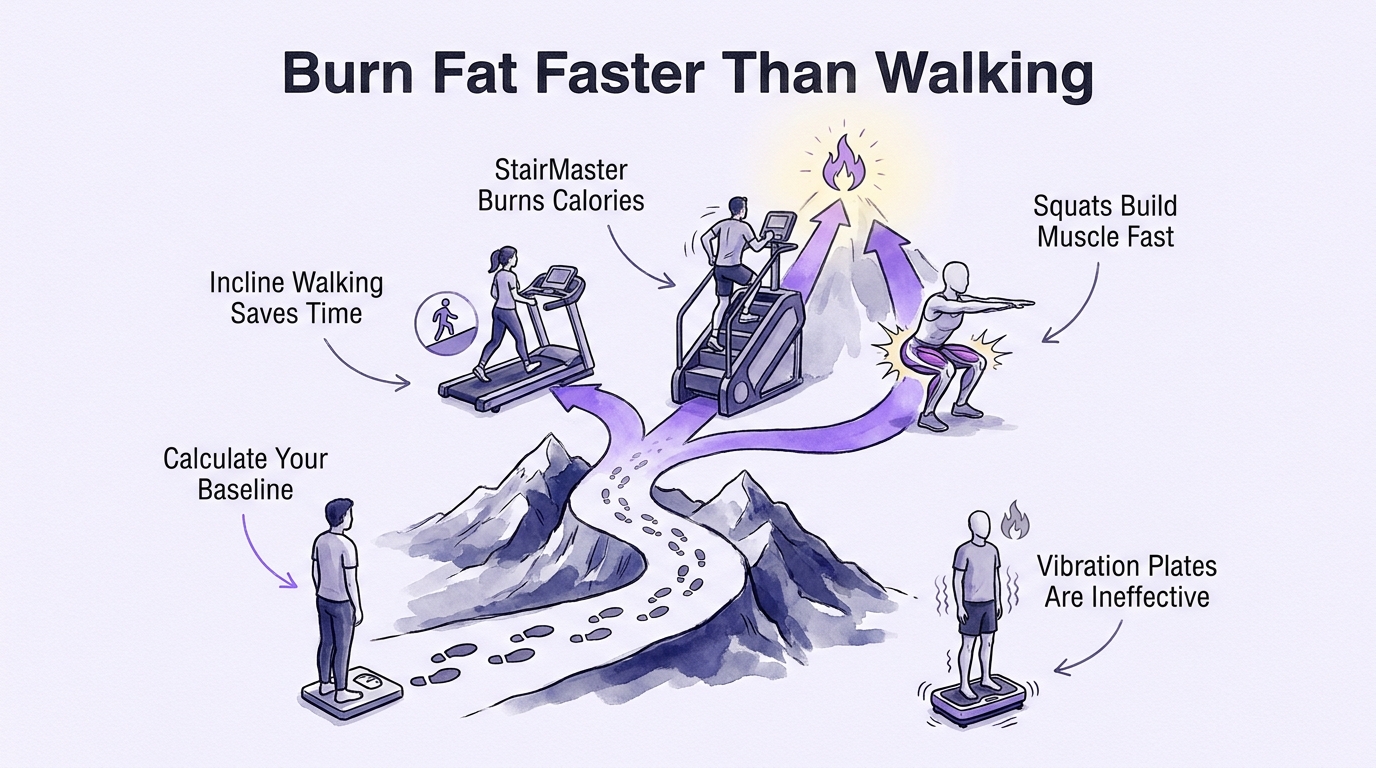
- Body weight significantly impacts calorie burn during daily step goals; multiplying body weight in pounds by 2.7 provides a reliable baseline for total calories burned across 10,000 steps.
- 11:39Incline treadmill walking and the StairMaster are the most efficient time-savers, burning 2 to 3 times more calories than flat walking without the joint strain of high-impact exercises
- 9:11Passive devices like vibration plates generate negligible calorie burn compared to active muscle contraction exercises like squats or incline walking
- 15:20High-intensity movements like burpees trigger a post-exercise 'afterburn' effect, though full workout efficiency depends on maintaining proper movement form
Tap to enlarge
Most valuable section
For whom
Individuals looking to optimize their cardio routines and achieve fat loss goals without spending hours walking every day.
Incline Walk & StairMaster Tests11:39
This section provides clear, data-driven proof of how targeted incline and vertical resistance dramatically accelerate calorie burn using standard gym equipment.
Detailed summary
1. Baseline Test: 10,000 Steps
0:00Jeremy introduces the goal of the experiment: finding exercises that replicate the calorie burn of 10,000 steps in a fraction of the time. To set an accurate baseline, three individuals of varying weights and fitness levels—Jeremy, Melody, and Dennis—wear metabolic masks on an athletic track to complete 10,000 flat walking steps.
The initial results reveal that body weight heavily dictates total caloric expenditure. Jeremy (158 lbs) burns 418 kcal in 91 minutes, Melody (156 lbs) burns 438 kcal in 91 minutes, and Dennis (128 lbs) burns 342 kcal in 91 minutes. Jeremy establishes a formula: multiplying body weight in pounds by 2.7 yields an estimated baseline calorie burn for 10,000 steps.
2. Japanese Interval Walking
2:24The group tests 'Japanese Walking,' a protocol featuring alternating intervals of 3 minutes of slow walking and 3 minutes of fast walking over a 30-minute period. The study behind this method suggests interval walking increases aerobic capacity and calorie burn significantly compared to continuous flat walking.
Jeremy and Dennis struggle to elevate their heart rates sufficiently during the fast walking intervals, resulting in minimal time savings compared to standard walking. However, Melody experiences a higher sustained heart rate throughout the session, burning 249 kcal in 30 minutes and cutting her equivalent 10,000-step burn time down to 53 minutes.
3. Slow Jogging in Place
6:46The test moves indoors to evaluate 'slow jogging in place,' an exercise trend popularized in Asia that involves light, continuous steps at a cadence of 180 beats per minute while staying on the toes. The team uses a TV metronome guide to maintain a synchronized rhythm for 10 minutes.
Despite raising average heart rates by nearly 10 bpm over regular walking, the total calorie burn remains relatively low (43 kcal for Jeremy, 62 kcal for Melody, and 31 kcal for Dennis). Jeremy concludes that while it isn't a dramatic shortcut, it serves as a convenient indoor substitute for regular walking.
4. Air Squats
9:06Jeremy tests air squats performed at a steady pace of 30 reps per minute using a metronome. Because squats engage large lower-body muscle groups like the quadriceps and glutes, they theoretically burn energy much faster than walking when performed continuously.
Jeremy and Melody achieve significant calorie expenditure during 10 minutes of squats (81 kcal and 78 kcal respectively), making it one of the top time-savers. Dennis, however, struggles with fatigue and poor movement mechanics, burning only 29 kcal. Jeremy also notes research showing that taking quick 10-squat breaks every 45 minutes aids post-meal blood sugar management better than a single 30-minute walk.
5. Vibration Plate
12:20The team tests an inexpensive home vibration plate to see if passive muscle stimulation can burn calories without physical exertion. Jeremy highlights existing studies claiming body composition improvements from vibration platforms, though he points out potential commercial bias in that research.
The metabolic data confirms the machine's inefficiency for active fat loss: over 10 minutes, Jeremy burns 28 kcal, Dennis burns 22 kcal, and Melody burns 33 kcal. These values represent only a tiny margin above baseline standing expenditure, making vibration plates ineffective for replacing cardio.
6. Mini Trampoline (Rebounding)
15:30Rebounding on a mini trampoline is evaluated as a low-impact alternative. Fitness claims online often estimate rebound workouts burn between 500 and 800 calories per hour, comparable to intense running sessions.
While the actual metabolic results fall short of online claims, rebounding outperforms flat walking for all three participants over a 10-minute session (62 kcal for Jeremy, 66 kcal for Melody, and 41 kcal for Dennis). It proves to be an enjoyable, high-engagement exercise that reduces the time needed to match a 10,000-step burn.
7. Weighted Vest (Rucking)
17:13The group tests rucking by wearing 20-pound weighted vests during a 20-minute outdoor walk. Rucking originated in military training to build load-carrying stamina and has grown into a popular exercise for fat loss.
Carrying the extra 20 pounds increases energy expenditure by 20% to 30% compared to unweighted walking, yielding 108 kcal for Jeremy, 128 kcal for Melody, and 91 kcal for Dennis in 20 minutes. While effective for burning extra calories over long distances, it remains relatively time-intensive compared to high-intensity gym equipment.
8. Incline Walking
18:58Walking on a treadmill at 3 mph with a 9% incline is tested for 20 minutes with a strict 'no-hands' rule on the handrails to prevent leaning. Mathematical models indicate that every 1% increase in incline elevates energy expenditure by 10% to 15%.
Incline walking yields dramatic performance, burning 166 kcal for Jeremy, 252 kcal for Melody, and 124 kcal for Dennis in 20 minutes. Because incline walking heavily engages the glutes and quads, Melody burns calories nearly three times faster than flat walking, making it the most effective time-saving walk variation.
9. Indoor Cycling
22:32The team tests stationary indoor cycling for 20 minutes at a self-selected comfortable pace. Unlike treadmill tests with set speeds, cycling relies on personal effort levels and resistance settings.
Jeremy pushes harder on the bike, burning 130 kcal, while Melody burns 119 kcal and Dennis burns 88 kcal. Cycling offers modest time savings over flat walking, but the total benefit depends heavily on individual motivation and resistance settings.
10. Burpees & Afterburn Effect
23:58The group attempts a 10-minute burpee challenge outdoors, aiming to complete up to 100 reps. Burpees represent high-intensity interval effort, raising heart rates to maximum levels and triggering an excess post-exercise oxygen consumption (EPOC) or 'afterburn' effect.
Jeremy completes 100 burpees and burns 141 total kcal (including afterburn recovery), while Melody completes 85 reps for 108 total kcal. Dennis completes 73 modified reps for 49 total kcal. EPOC adds roughly 10% extra caloric burn during the 20-minute recovery period, making burpees the fastest calorie burner per minute for Jeremy.
11. StairMaster
27:33The final equipment test places participants on the StairMaster at speed setting 7 for 20 minutes. Climbing stairs continually lifts body weight upward, demanding immense work from lower-body muscle groups while enforcing a set cadence.
Despite Dennis leaning heavily on the handrails, the StairMaster claims the top spot for overall caloric efficiency. Over 20 minutes, Jeremy burns 239 kcal, Melody burns a massive 345 kcal (reaching a peak heart rate of 175 bpm), and Dennis burns 146 kcal.
12. Final Results & Winner
32:20Jeremy brings the group together to review the compiled rankings across all 11 activities. The StairMaster and Incline Walking rank as the ultimate time-savers, reducing the time required to match 10,000 steps from 90 minutes down to just 25–45 minutes depending on the person.
To help Melody continue her fitness journey, Jeremy gifts her a foldability incline treadmill for home use. The video concludes by emphasizing that while intense shortcuts exist, overall consistency and daily walking remain the most sustainable strategy for long-term health and weight management.
Questions this video answers
How do you calculate calories burned from 10,000 steps?
A reliable rule of thumb based on metabolic data is to multiply your body weight in pounds by 2.7. For example, a 180-pound person will burn approximately 486 calories by completing 10,000 steps. Heavier individuals burn more total calories because moving a larger body weight requires greater energy expenditure.
Does walking at an incline burn significantly more calories than flat walking?
Yes, increasing the treadmill incline forces larger muscle groups like the quadriceps and glutes to perform more work against gravity. Every 1% increase in incline elevates calorie burn by roughly 10% to 15%. Walking at a 9% incline can allow individuals to match the calorie burn of 10,000 steps in about 35 to 55 minutes.
Are vibration plates effective for fat loss?
Vibration plates result in minimal calorie burn—only slightly more than standing still. Over a 10-minute session, participants burned between 22 and 33 calories, meaning the machine offers negligible help in replacing traditional cardio or step goals.
What is the Japanese walking method, and does it save time?
The Japanese walking method involves alternating between 3 minutes of slow walking and 3 minutes of brisk fast walking over a 30-minute period. For individuals who can elevate their heart rate to roughly 70% of maximum during the fast intervals, it significantly increases intensity and burns calories faster, though fitter individuals may struggle to reach a high enough heart rate through walking a
Ask a follow-up Premium
About this summary
SumTube AI wrote this recap from the video's words and chapters. Credit and the original belong to Jeremy Ethier.