
Free AI summary of this YouTube video by SumTube
বাংলা । ফাইনাল সাজেশন । আইএইচটি ম্যাটস ভর্তি পরীক্ষা ২০২৬-২৭ । IHT MATS Admission 2026-27
TL;DR
In this interactive practice session, instructor Md. Sohel Rana presents a comprehensive 100-MCQ suggestion class tailored for IST and MATS admission test candidates covering the Bangla syllabus. The class walks students through essential grammar rules, including language basics, phonetics, antonyms, synonyms, idioms, cases, voice, sentence structures, and etymology. By combining live quiz questions with detailed rule explanations, the lesson serves as an all-in-one preparation assessment tool.

Key takeaways
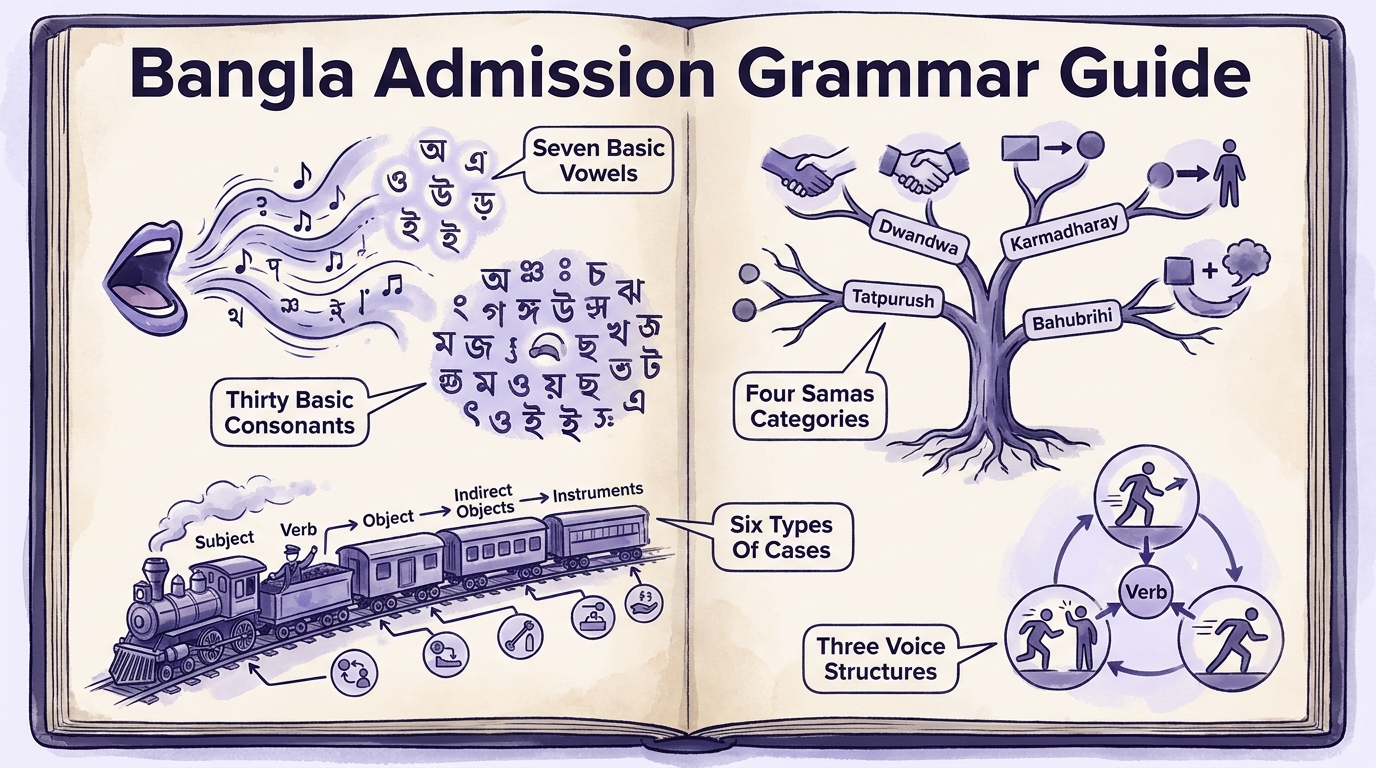
- Bangla script contains 50 letters, but the language relies on 37 basic sounds: 7 basic vowels and 30 basic consonants
- 30:21The spelling rule for 'মুমূর্ষু' (one near death) follows a 1-2-1 vowel pattern (Rosho-u, Dirgho-u, Rosho-u)
- 1:05:00Compound words rely on semantic prominence across four major Samas categories: Dwandwa, Karmadharay, Tatpurush, and Bahubrihi
- 1:10:16Upasarga (prefixes) attach to the beginning of root words to alter or create new meanings, whereas Protoy (suffixes) attach to the end
Tap to enlarge
Most valuable section
For whom
Students preparing for competitive admission tests who want a fast-paced review of core Bangla grammar rules
Syntax, Sentence Types, and Samas50:04
This section breaks down complex grammatical structures like voice transformations, sentence types, and compound word analysis (Samas) with concise rules and shortcuts.
Detailed summary
1. Introduction and Class Setup
0:00Instructor Md. Sohel Rana introduces the 100-MCQ final suggestion class aimed at IST and MATS admission examinees. He outlines the format of the session, emphasizing active student participation through the live chat to test overall subject readiness.
The initial minutes cover routine streaming checks, confirming audio visual quality and encouraging students to review recorded segments later for maximum retention.
2. Language Basics and Phonetics (Q1–Q4)
5:41The quiz begins with fundamental concepts of speech and reading methods, establishing that language is the primary medium for conveying thoughts. Questions cover the Braille tactile reading method for the visually impaired and highlight the smallest linguistic unit, the phoneme or sound (ধ্বনি).
A core breakdown of Bangla sound structure is presented, distinguishing the 50 letters of the alphabet from the 37 basic sounds (7 basic vowels and 30 basic consonants).
3. Antonyms, Synonyms, and Idioms (Q5–Q12)
12:10This section reviews vocabulary skills through common antonyms, synonyms, and idiom meanings. Questions test opposites such as 'Utkarsha' (Apakarsha) and 'Tiroshkar' (Puroshkar), alongside precise word associations for natural elements like the moon and sea.
Idioms like 'Espar Ospar' (reaching a resolution) and 'Koi machher pran' (surviving easily) are explained alongside distractor options to help students avoid common exam pitfalls.
4. One-Word Substitutions and Idiomatic Phrases (Q14–Q17)
28:49The instructor covers high-frequency one-word substitutions and spelling rules. Special emphasis is given to the term 'Mumurshu' using a memorization shortcut based on vowel order patterns.
Additional questions clarify terms describing actions toward benefactors—distinguishing between acknowledging help (Kritojno), failing to acknowledge help (Okritojno), and actively harming a helper (Kritoghno).
5. Cases (Caraka) and Voice (Bachya) (Q19–Q25)
35:28Grammar questions transition to syntactic relations, beginning with the 6 types of Cases (Caraka) in Bangla. Examples demonstrate Karma Caraka (answering 'whom' to the verb) and Apadan Caraka (identifying source or origin).
The lesson then addresses the 3 Voice structures (Active, Passive, and Impersonal), offering clear sentence examples for Karma Bachya and Bhab Bachya.
6. Sentence Structures and Transformations (Q26–Q32)
50:04The lesson reviews sentence classifications based on structure (Simple, Complex, Compound) versus meaning. Practical examples illustrate how single finite verbs form Simple sentences while conditional markers like 'যদি...তবে' form Complex structures.
Students practice converting complex multi-clause sentences into streamlined Simple sentences containing only one main finite verb.
7. Compound Words (Samas) and Word Formations (Q33–Q36)
1:02:08This segment introduces Samas, detailing the breakdown of analytical sentences (Vyas Bakya) into composite compound forms (Somasto Pod). The discussion outlines the primary categories based on semantic prominence.
Specific examples are analyzed, including Upaman Karmadharay Samas ('Kajol-kalo') and Bahubrihi Samas ('Hatekhori'), where the combined term yields a completely new third meaning.
8. Prefixed Elements (Upasarga) and Suffixes (Protoy) (Q38–Q50)
1:10:16The instructor explains affixation in word generation, showing how Upasarga (prefixes) attach before root words to alter meanings despite lacking independent dictionary definitions. Suffixes (Protoy) and determiners are contrasted by their positioning at the end of words.
Phonetic blending (Sondhi) is defined alongside practical breakdowns like 'Porikkha' (Pori + Ikkha), closing out the first half of the 100-question session.
9. Mid-Class Break and Question Review (Q51–Q66)
1:23:42Following a brief intermission, the review resumes with advanced Sondhi breakdowns such as 'Nabik' (Nou + Ik) and gender classification rules. Inherently feminine terms lacking masculine equivalents ('Bibhoba') and common gender words ('Sontan', 'Montri') are identified.
Etymological word origins are explored, categorizing vocabulary into Tatsama (Sanskrit origin), Deshi (indigenous), Todbhave, and foreign loanwords like Arabic and Portuguese.
10. Parts of Speech, Tenses, and Case Endings (Q67–Q89)
1:40:01The quiz delves into word classification across the 8 modern parts of speech, focusing on nouns, adjectives, adverbs, and postpositions (Onusorgo). Conjugation mechanics, root verbs (Dhatu), and tense structures are reviewed with clear examples.
Questions also address grammatical number (Bachan), case markers (Vibhakti), and functional sentence types like imperatives (Anujjabachak).
11. Final Vocabulary, Literary History, and Wrap-Up (Q90–Q100)
1:51:57The final block covers sentence components (Subject and Predicate), advanced one-word substitutions, and synonyms for elements like fire and wind. Standard written forms (Promito Riti) and Sadhu Riti features are highlighted.
The class closes with literary history questions, such as Michael Madhusudan Dutt introducing sonnets to Bangla, before the instructor offers final encouragement and study tips for exam day.
Questions this video answers
What is the difference between basic sounds and letters in Bangla?
The Bangla alphabet contains 50 written letters ( বর্ণ ). However, phonetically there are only 37 basic sounds ( ধ্বনি ), composed of 7 basic vowel sounds and 30 basic consonant sounds.
How are sentences classified by structure in Bangla grammar?
Structurally, Bangla sentences fall into three categories: Simple (সরল), Complex/Mixed (জটিল/মিশ্র), and Compound (যৌগিক). A Simple sentence contains only one finite verb, while Complex sentences use conditional connectives like 'যদি...তবে'.
What distinguishes Upasarga from Protoy in word formation?
Upasarga refers to prefix elements attached before a root word to alter or generate new meanings. Protoy refers to suffix elements attached at the end of root words or verbal stems.
Ask a follow-up Premium
About this summary
SumTube AI wrote this recap from the video's words and chapters. Credit and the original belong to SAS IHT MATS & Nursing Coaching.