
Free AI summary of this YouTube video by SumTube
⚡I Ran the TSLA + SPCX Merger Math on My Retire-On Bags 💰 V Surprising
TL;DR
This analysis breaks down the financial modeling and share exchange mathematics behind a potential merger between Tesla and SpaceX into a single combined entity. By evaluating potential deal premiums, share conversion ratios, and 2032 valuation targets, the host demonstrates why holding a core position of 323 Tesla shares could yield a million-dollar-plus retirement bag under combined operations. The presentation also outlines market caps, Elon Musk's corporate voting control, and tax-efficient portfolio holding strategies.

Key takeaways
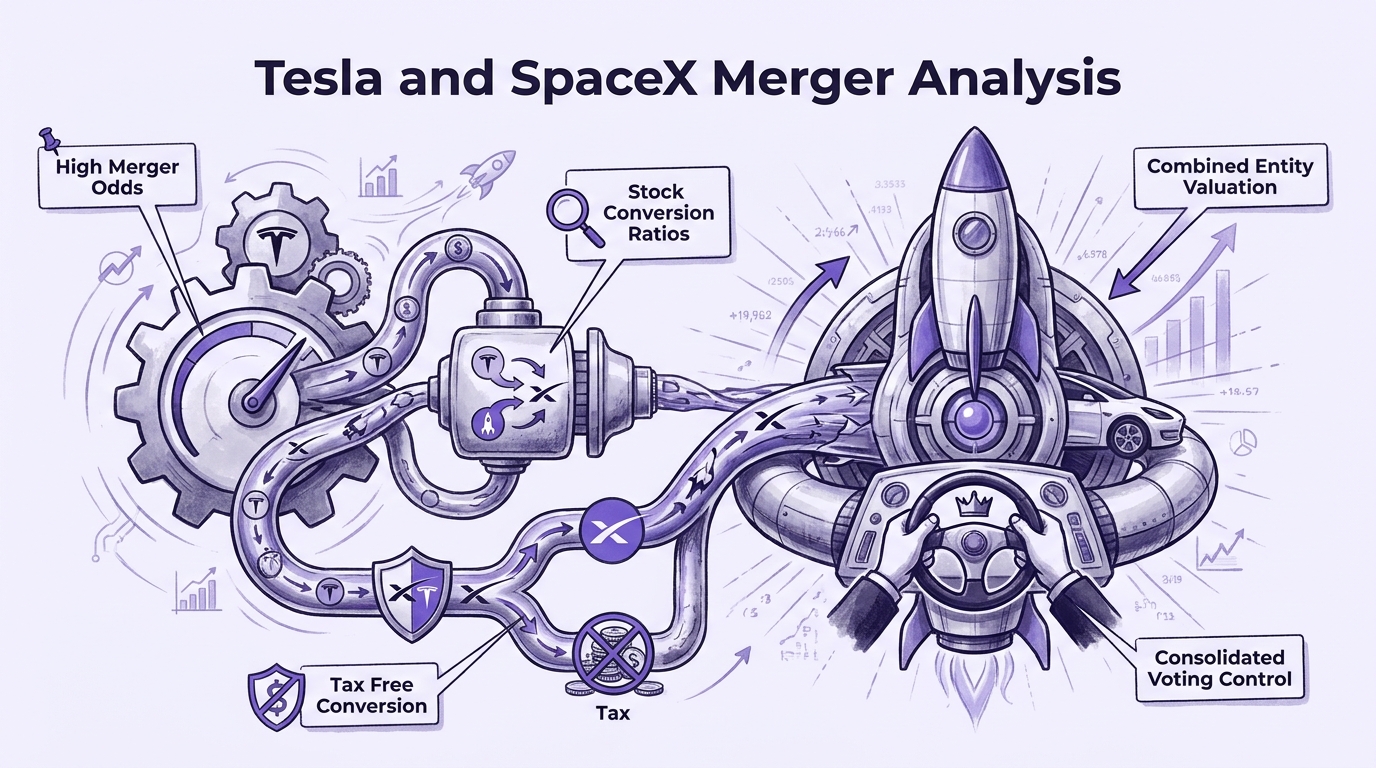
- 5:01Prediction markets indicate a 70% to 81% likelihood of a Tesla-SpaceX merger by the end of 2027
- 8:45The expected stock conversion ratio floor is modeled at 3.3x SpaceX shares per Tesla share, with a likely deal range of 3.65x to 3.85x.
- 50:13A combined entity could mitigate capital gains taxes through a tax-free stock conversion rather than a cash transaction
- Holding winning long-term growth assets without selling enables price compounding without triggering premature tax penalties
Tap to enlarge
Most valuable section
For whom
Investors holding Tesla or SpaceX shares interested in merger conversion ratios and long-term valuation modeling.
Merger Ratios and bag conversions7:04
It details the static exchange ratios, implied share value premiums, and percentage share splits for shareholders in a deal scenario.
Detailed summary
1. Introduction and Merger Odds
0:06The host opens by addressing the high volume of viewer questions regarding the financial impact of a potential merger between Tesla and SpaceX. He notes that recent prediction markets place the likelihood of a merger occurring by the end of 2027 at between 70% and 81%, with short-term odds rising significantly as well.
The framework introduces the concept of a 'retire-on bag' focused on reaching a target value of $1 million by the year 2032. The primary objective is to outline how existing shareholdings in either standalone company will convert and perform if an acquisition or unified entity is created.
2. Merger Exchange Math and Ratios
7:04This section walks through the core conversion metrics and valuation floors for a stock-for-stock transaction. The host establishes a baseline deal floor ratio of 3.3x SpaceX shares per Tesla share, alongside a primary deal target zone of 3.65x to 3.85x, which implies a Tesla value premium between $490 and $520 based on static market pricing.
The discussion covers how shifts in daily market caps alter the implied pair trading ratios. Higher exchange ratios raise shareholder approval odds, with a bull case ratio of 4.1x to 4.45x yielding approval probabilities exceeding 90%.
3. Historical Models vs. Current Projections
15:00The host reviews historical price targets for Tesla, comparing legacy standalone models to updated post-merger mathematical scenarios. Under standalone targets, a 323-share position ranges from a conservative $872,000 to an expected mid-level scenario of $1.68 million based on autonomous driving, energy, and robotics execution.
The discussion highlights that asset evaluation should focus on relative ownership percentage of the overall business entity rather than ticker symbol prices alone. As market caps and underlying share counts scale up, the slice of ownership translates directly into final bag valuation.
4. Sum-of-the-Parts Valuations for SpaceX and Tesla
25:12A detailed sum-of-the-parts analysis is presented for both SpaceX and Tesla to justify long-term valuation targets. For SpaceX, key growth drivers include Starlink Direct-to-Cell capabilities and orbital AI compute services, which the host projects could elevate standalone enterprise value dramatically by 2032.
Tesla's standalone sum-of-the-parts model incorporates Full Self-Driving, Cybercab networks, Optimus humanoid robots, and grid energy storage, reaching a multi-trillion-dollar cumulative market cap. These independent revenue streams serve as the building blocks for the combined enterprise math.
5. Combined Entity (X Corp) 2032 Valuation
32:05Combining the standalone sum-of-the-parts valuations yields a total unified market cap estimate of over $34 trillion across an estimated 26.75 billion outstanding shares. At this level, individual share prices for the unified entity are modeled at approximately $1,287 per share.
Under these combined calculations, a target bag of 323 original Tesla shares converts into roughly 1,211 shares of the combined company. This position would exceed the $1 million threshold by 2032, absorbing share dilution due to the massive expansion in total business value.
6. Shareholder Impact and Voting Control
37:05The analysis compares the final outcome for standalone Tesla versus SpaceX share bag holders following a merger deal. Due to conversion premiums, holding Tesla prior to the transaction yields a higher net share count and superior bag valuation compared to holding standalone SpaceX shares through dilution.
The section also examines governance and operational control post-merger. By combining Elon Musk's current 20% voting power in Tesla with his 82.4% super-voting control in SpaceX, his consolidated voting power in the merged entity is projected at approximately 56%, retaining executive control.
7. Risk Factors, Compounding, and Audience Q&A
45:05The host outlines key risk factors that could alter the retirement projections, including deal premiums falling below 25% or structural regulatory delays. Investors are advised to manage tax liabilities carefully, noting that tax-free share conversions preserve long-term compounding better than triggering taxable capital gains events.
The stream concludes with an audience Q&A session addressing pair-trading tactics, LEAP options conversions, and the mechanics of asset price compounding over multi-year horizons.
Questions this video answers
What is the targeted size for a Tesla retire-on bag by 2032?
The target bag size discussed is 323 Tesla shares, or alternatively 655 standalone SpaceX shares. Under the projected valuation models, either bag is structured to reach approximately $1 million or more in value by 2032.
How will a stock-for-stock merger affect share count and ownership percentage?
In a hypothetical 3.75x deal, 323 Tesla shares would convert into roughly 1,211 shares of the combined company. While total outstanding shares increase across the unified entity, shareholders gain fractional ownership across both Tesla's operations and SpaceX's communications and compute lines of business.
How does Elon Musk retain operational control in a combined company?
Musk currently holds approximately 20% control of Tesla and 82.4% voting control of SpaceX through super-voting shares. In the modeled combined entity, his consolidated voting power is estimated at around 56%, maintaining majority control over key corporate decisions.
Ask a follow-up Premium
About this summary
SumTube AI wrote this recap from the video's words and chapters. Credit and the original belong to InvestAnswers.