
Free AI summary of this YouTube video by SumTube
I finally saw quantum physics with my own eyes...
TL;DR
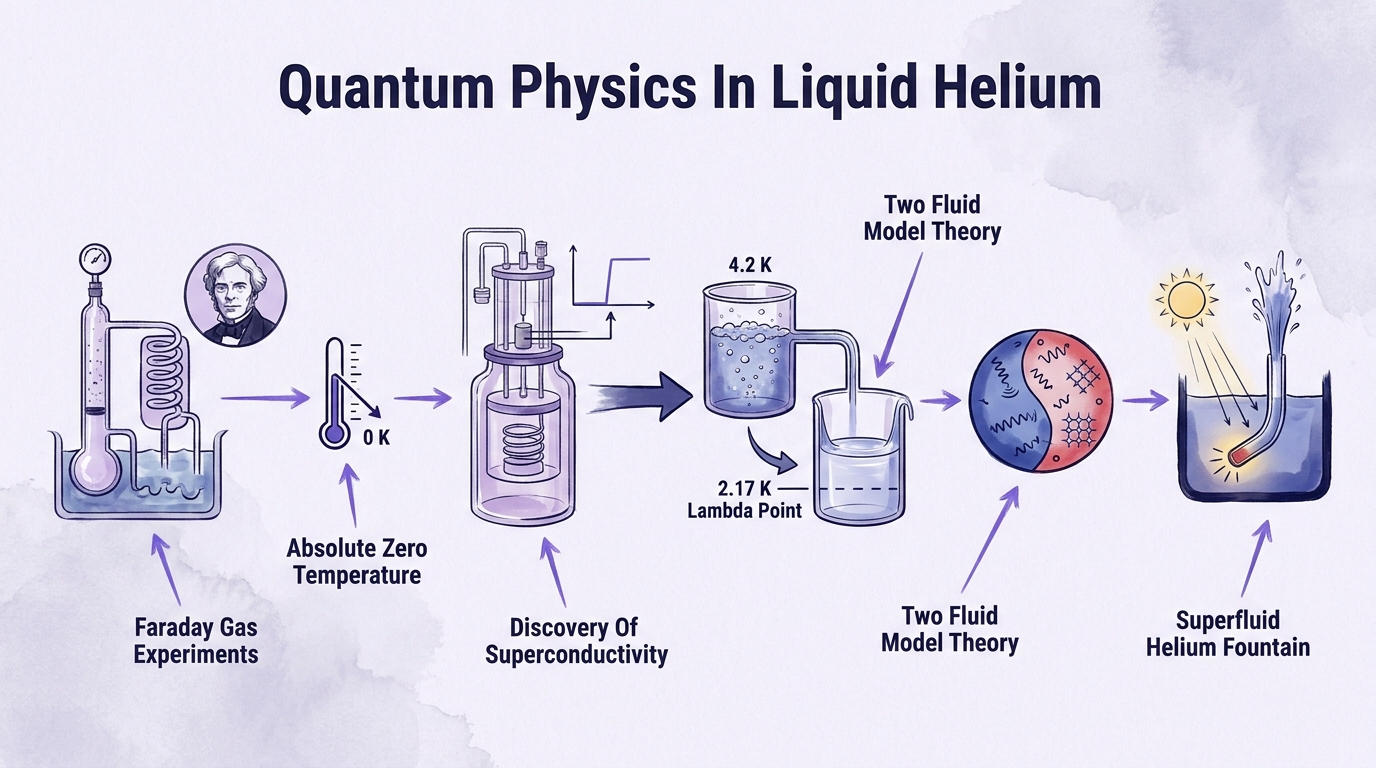
Liquid helium transforms into a superfluid below 2.17 Kelvin, displaying uncanny zero-viscosity phenomena like escaping containers and forming light-powered fountains. The video traces the historical timeline from Faraday's initial gas liquefaction through Kamerlingh Onnes's discovery of superconductivity to Landau's quantum theoretical explanation of superfluidity.

Key takeaways
- 50:34Superfluid helium has zero viscosity because flowing below a critical velocity cannot produce quantum excitations like phonons or rotons
- 52:17In two-fluid model theory, liquid helium below 2.17 K behaves as a mixture of a friction-free superfluid component and a heat-carrying normal fluid component.
- 1:00:46Helium remains liquid down to absolute zero at normal pressures due to its high zero-point energy preventing solid lattice crystallization
Tap to enlarge
Most valuable section
For whom
Physics enthusiasts interested in quantum mechanics and extreme thermodynamics
The Superfluid Transition and Laboratory Experiments20:00
It shows real-time laboratory footage of liquid helium abruptly stopping boiling and leaking through porous materials as it reaches its superfluid phase.
Detailed summary
1. Introduction to Liquid Helium
0:00Liquid helium sits at 4 Kelvin, just degrees above absolute zero. When cooled below 2.17 Kelvin, it abruptly ceases boiling and transitions into a state with remarkable physical properties known as a superfluid.
In its superfluid state, helium leaks through porous materials, creeps up and over container walls, and can form fountain jets powered purely by light. Historically, scientists spent decades experimenting with low temperatures before fully comprehending the quantum mechanisms driving these behaviors.
2. The Quest for Absolute Zero
1:59The journey toward extreme low temperatures began in the 19th century with the discovery that expanding gas against a piston lowers its temperature by transferring particle kinetic energy. Lord Kelvin used this relationship to establish the concept of an absolute zero temperature scale, calculated at -273.15 °C.
In 1823, Michael Faraday accidentally liquefied chlorine gas by heating chlorine hydrate in a sealed glass tube to increase pressure. He subsequently liquefied several other gases, but encountered a wall when attempting to compress gases like ethylene, oxygen, and nitrogen without sufficient cooling.
3. Thermodynamics of Liquefaction
4:16Gas particles move at hundreds of meters per second and bounce off each other. Increasing pressure pushes particles closer together so that interatomic van der Waals forces cause them to condense into a liquid, provided the temperature is low enough.
Faraday realized that cooling was necessary alongside pressure. By using dry ice combined with ether, he cooled and liquefied ethylene at -79 °C. However, six permanent gases—including oxygen, nitrogen, and hydrogen—resisted liquefaction until colder techniques were developed later in the 19th century.
4. The Race to Liquefy Helium
7:00Helium is the second most abundant element in the universe, but it easily escapes Earth's atmosphere into space, making pure helium exceptionally rare on Earth in the early 20th century. Dutch physicist Heike Kamerlingh Onnes obtained helium by extracting it from monazite sand rich in radioactive thorium, which releases helium nuclei via alpha decay over millions of years.
After extracting helium through intense chemical purification, Onnes built a large-scale cryogenic laboratory in Leiden. Helium presented a challenge because its noble gas electronic structure has a full outer electron shell, resulting in extremely weak attractive forces between atoms.
5. First Liquefaction of Helium and Discovery of Superconductivity
12:12To insulate the experiment against external room heat, Onnes utilized nested Dewar vacuum flasks cooled sequentially with liquid air and liquid hydrogen. He monitored temperature using a constant-volume helium gas pressure meter based on ideal gas relationships.
On July 10, 1908, Onnes successfully liquefied helium at around 4.2 Kelvin. Shortly after, while testing the electrical resistance of metals at these temperatures, he discovered superconductivity in mercury at 4.2 K, earning the 1913 Nobel Prize in Physics while missing the significance of superfluid helium's unique flow behavior.
6. The Mystery of the Lambda Point
21:22In the 1930s, graduate student Donald Misener and physicist Jack Allen investigated liquid helium's viscosity. Measurements of specific heat around 2.17 Kelvin showed a sharp spike resembling the Greek letter lambda, leading scientists to designate 2.17 K as the 'lambda point.'
Researchers noticed that the liquid became strangely quiet below this temperature. Measurements of specific heat and density confirmed a phase transition, but initial researchers misattributed irregular data points to experimental errors or unwanted condensation.
7. Discovery of Superfluidity
28:04In 1937, Pyotr Kapitsa in Moscow, alongside Allen and Misener in Cambridge, conducted independent flow experiments through narrow glass capillaries. Both groups observed that liquid helium below 2.17 K flowed at speeds virtually independent of pressure or tube tightness.
Kapitsa coined the term 'superfluid' by analogy with superconductors, publishing his findings alongside Allen and Misener in Nature in January 1938. The measurements indicated that the fluid possessed effectively zero internal viscosity.
8. Bose-Einstein Condensation and Quantum Mechanics
36:02Fritz London suggested that superfluid helium was an experimental realization of Bose-Einstein Condensation (BEC), a quantum state predicted by Albert Einstein and Satyendra Nath Bose. According to quantum theory, subatomic particles act as wave packets whose wavelength increases as temperature drops.
Particles split into bosons (integer spin) and fermions (half-integer spin). Because Helium-4 atoms contain six half-spin subatomic particles, their net spin is zero, making them bosons that can overlap into a single macroscopic ground state wave function.
9. Landau's Theory and Excitations
43:16Lev Landau realized that an ideal Bose-Einstein condensate alone does not explain superfluidity because interatomic forces are ignored. Landau was imprisoned during Stalin's Great Purge in 1938, but Kapitsa successfully petitioned Soviet authorities for his release so he could solve the theoretical problem.
Landau demonstrated that in a true superfluid, flow energy can only be dissipated by creating collective quantum excitations: sound waves called phonons and localized lattice-like structures called rotons. Below a critical velocity, the flow cannot generate these excitations, making friction physically impossible.
10. The Two-Fluid Model and Second Sound
51:52László Tisza and Lev Landau developed the two-fluid model, describing liquid helium below 2.17 K as a mix of a zero-viscosity, zero-entropy superfluid component and a normal fluid component carrying all the heat. As temperature drops toward absolute zero, the superfluid fraction approaches 100%.
This model explains why superfluid helium creeps out of cups via film siphoning and how light powers a fountain: absorbed heat converts local superfluid into normal fluid, creating a density imbalance that drives fluid through narrow channels. It also predicted 'second sound,' where temperature variations propagate through the fluid as thermal waves.
11. Why Helium Never Freezes at Atmospheric Pressure
58:20Helium is the only substance that remains liquid down to absolute zero under atmospheric pressure. Due to the Heisenberg uncertainty principle and the light mass of helium atoms, the quantum zero-point energy accounts for roughly 98% of the liquid's total energy, preventing atoms from locking into a solid lattice.
Helium can only be forced into a solid state by applying at least 25 atmospheres of pressure at 1 Kelvin. The video concludes by reflecting on how scientists often need a theoretical framework to recognize groundbreaking phenomena right before their eyes.
Questions this video answers
Why does liquid helium stop boiling when it becomes a superfluid?
Above 2.17 K, local thermal fluctuations vaporize small pockets of liquid into bubbles. Below 2.17 K, thermal counterflow transfers heat extremely efficiently—about 1,000 times better than copper—so the entire liquid maintains a uniform temperature without localized hot spots where bubbles can form.
How can superfluid helium climb out of a container?
The atoms in the wall of a container exert stronger van der Waals attractive forces on helium atoms than the helium atoms exert on each other. This causes a thin film of superfluid to creep up over the walls and siphon out with zero friction.
Why doesn't helium freeze at absolute zero like other substances?
Helium atoms are light and loosely bound. According to Heisenberg's uncertainty principle, confining them into a fixed solid lattice creates a massive zero-point energy that exceeds the weak attractive forces, keeping the helium liquid unless external pressure of at least 25 atmospheres is applied.
Ask a follow-up Premium
About this summary
SumTube AI wrote this recap from the video's words and chapters. Credit and the original belong to Veritasium.