
Free AI summary of this YouTube video by SumTube
I am VERY concerned for these girls... - Therapist Plays Doki Doki Literature Club - 1
TL;DR
A licensed therapist plays Doki Doki Literature Club Plus for the first time, offering real-time psychological analysis of the characters' behaviors and underlying motivations. He analyzes how characters like Sayori, Yuri, Natsuki, and Monika utilize different coping mechanisms, masks, and compensatory behaviors to manage anxiety, depression, and social insecurity. Throughout the playthrough, he breaks down the psychological dynamics of the interactions while reacting to the visual novel's subtle signs of underlying mental health struggles.

Key takeaways
- 36:21Sayori's hyper-agreeable and upbeat persona functions as a compensatory mask to hide deep-seated feelings of worthlessness and depression
- 35:12Natsuki's defensive and abrasive front stems from insecurity and anxiety over not being taken seriously by others
- 58:32Yuri uses social timidity as a protective mask, revealing extreme confidence and focus only when discussing her niche passions
- 1:42:00Monika's perfectionist, highly controlled demeanor acts as a proactive defense mechanism against loss of control or vulnerability
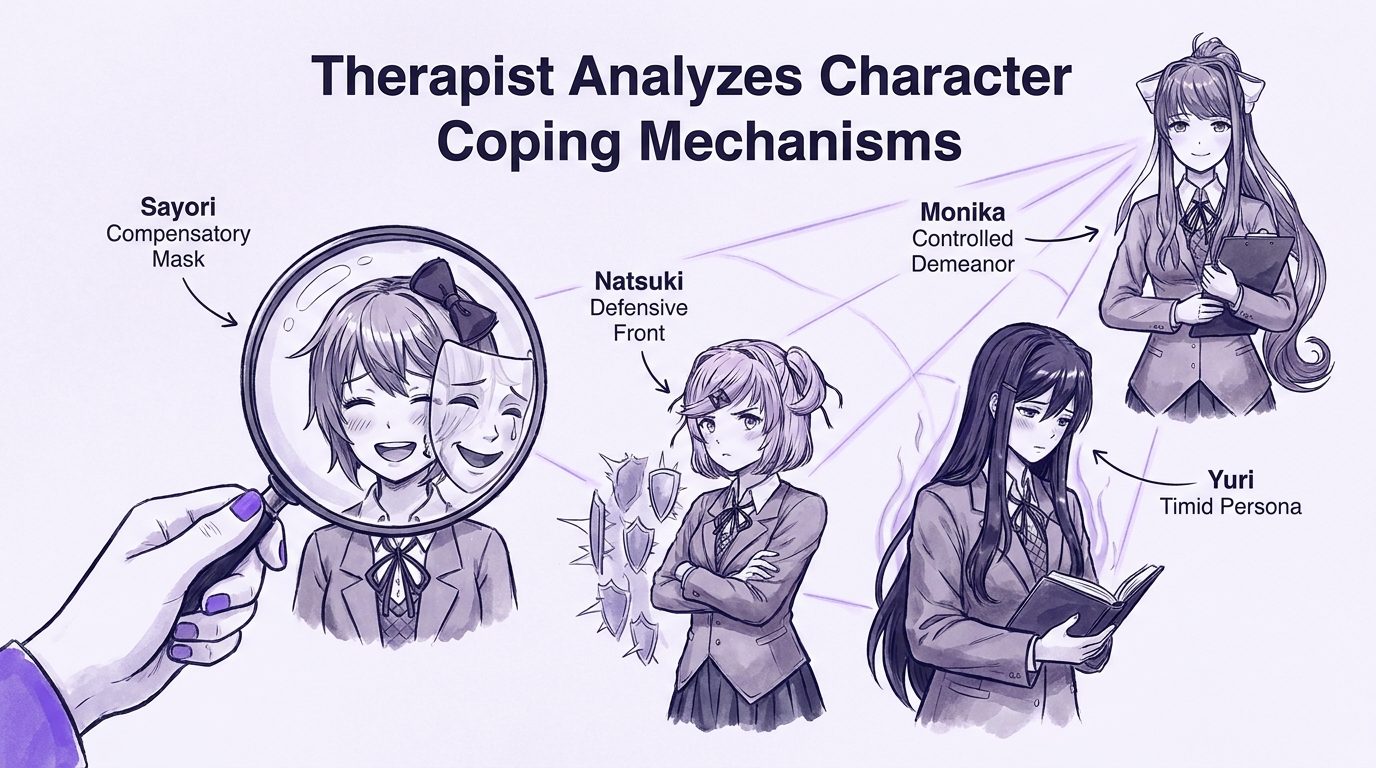
Tap to enlarge
Most valuable section
For whom
Gamers interested in deep psychological breakdowns of fictional character motivations and visual novel story analysis.
Deconstructing Natsuki & Yuri's Argument1:45:30
It showcases a live breakdown of how two distinct defensive masks collide in high-stress social conflict, offering insightful analysis into real-world communication dynamics.
Detailed summary
1. Introduction & Initial Expectations
0:00The host introduces the video as a therapist's playthrough of Doki Doki Literature Club Plus. He discusses his background as a mental health professional and explains his curiosity about analyzing a narrative centered on themes of anxiety, depression, and mental health struggles. Expecting a visual novel that subverts traditional dating simulator tropes, he sets up the game and prepares to observe the character interactions through a clinical lens.
He names his character Brady and reflects on how visual novels often place protagonists in situations where subtle behavioral cues go unnoticed. He pledges to pay close attention to subtle behavioral signs and emotional cues as the story unfolds.
2. Meeting Sayori & The Morning Walk
2:30The game begins with the protagonist meeting Sayori on the way to school. The therapist quickly picks up on Sayori's personality traits, noting her energetic yet scattered demeanor. He observes that while she presents herself as cheerful and carefree, her persistent oversleeping, self-deprecating remarks, and intense concern for Brady's social life point toward hidden anxiety and emotional distress.
He explores the concept of emotional codependency, noting how Sayori's personal wellbeing seems entirely tied to whether the protagonist is doing well. He highlights how the protagonist's dismissive responses, while typical for a visual novel lead, ignore Sayori's underlying need for genuine reassurance and emotional connection.
3. Entering the Literature Club
13:30Sayori convinces Brady to visit the Literature Club, promising cupcakes made by Natsuki. Upon arriving, Brady meets the other members: Yuri, Natsuki, and Monika. The therapist evaluates the initial impressions of each member, contrasting Yuri's reserved, cautious nature with Natsuki's defensive, tsundere attitude, and Monika's poised, assertive posture as club president.
He discusses how group dynamics function in newly formed social settings, pointing out that Monika's polished demeanor and command over the room serve as a controlled public facade. Meanwhile, Natsuki's immediate defensiveness reveals an insecurity about how others perceive her passions and contributions.
4. Coping vs. Compensation in Psychology
33:00During a break in the game's dialogue, the therapist takes time to draw a clear distinction between coping mechanisms and compensatory behaviors. He explains that coping involves productive actions that actively relieve stress and build emotional resilience, whereas compensation involves masking insecurity or over-correcting for a perceived personal flaw in ways that often generate secondary stress.
He applies these concepts directly to the club members, explaining that Natsuki's hostility and Sayori's hyper-agreeableness are classic compensatory behaviors designed to protect their vulnerabilities from being exposed or judged by others.
5. Analyzing Yuri's Passion for Complex Horror
40:00Brady interacts with Yuri, who discusses her love for fantasy and psychological horror novels. The therapist observes how Yuri's timid demeanor completely transforms when she engages in discussions about her favorite literary themes. Her stutters vanish, replaced by articulate, confident insights into narrative craftsmanship and dark storytelling.
He notes that Yuri finds comfort in structured, deep intellectual pursuits because they provide a safe space away from unpredictable real-world social interactions. However, her sudden self-consciousness after speaking reveals how quickly her social anxiety returns when the spotlight shifts back onto her personally.
6. The Poem Minigame & Sayori's Dark Cues
44:40The gameplay shifts to the poem creation minigame, where players select words to appeal to specific characters. The therapist notices that words associated with Sayori—such as 'misery,' 'tears,' 'empty,' and 'hopeless'—starkly contrast with her upbeat in-game persona. This realization deeply affects him as he recognizes clear indicators of severe internal depression.
He reflects on the burden of recognizing these psychological cry-for-help signals in real life and expresses genuine concern for Sayori's character arc, realizing that her cheery exterior is an elaborate mask hiding profound emotional pain.
7. Sharing Poems with Yuri
49:40The next day at the club, Brady shares his poem with Yuri, leading to an intimate moment where they read a novel together side by side. The therapist analyzes the growing emotional intimacy between them, noting how physical proximity subtly breaks down Yuri's guardedness while triggering moments of self-conscious hesitation.
Yuri presents her poem, 'Ghost Under the Light,' which the therapist reads carefully. He interprets the poem's dark imagery of flickering lights and consuming darkness as a metaphor for existential dread and a fading sense of hope for the future.
8. Natsuki's Poem & Defense Mechanisms
1:21:00Brady exchanges poems with Natsuki, reading her poem 'Eagles Can Fly.' Despite its simple structure, the therapist praises the poem's subtle commentary on human limitation and pressure. He points out how Natsuki's frustration with people not taking her writing seriously stems from her deeper fear of being dismissed as childish or unsophisticated.
He commends Brady for offering genuine validation to Natsuki, showing how positive reinforcement helps de-escalate her defensive hostility and allows her to express pride in her work without feeling threatened.
9. Sayori's Poem: 'Dear Sunshine'
1:29:00Brady reads Sayori's poem, 'Dear Sunshine,' which uses the sun as a metaphor for someone who gives her a reason to get out of bed each morning. The therapist breaks down the poem's haunting subtext, highlighting the line where Sayori mentions she could 'sleep forever' if not for the sunshine waking her up.
He analyzes this as an expression of passive suicidal ideation and depression, emphasizing that relying entirely on external sources for self-worth and motivation is unsustainable and dangerous for mental health.
10. Monika's Poem & Deconstructive Control
1:34:00Monika shares her poem, 'Hole in Wall,' which features abstract and meta-narrative themes about looking out from a confined space. The therapist notes Monika's meticulous approach to writing and her calculated feedback, pointing out her desire to maintain an image of effortless perfection.
He discusses how Monika's need to appear composed and in control at all times prevents her from forming genuine, vulnerable connections with others, ultimately isolating her behind her own perfected persona.
11. Natsuki & Yuri's Clash & Resolution
1:45:30A heated argument breaks out between Natsuki and Yuri over their differing writing styles, with passive-aggressive insults escalating into personal attacks. The therapist watches the conflict closely, identifying how each girl's insecurity drives the argument—Natsuki feels disrespected, while Yuri feels misunderstood and accused of pretentiousness.
Brady is forced to step in and mediate the situation. The therapist evaluates Brady's diplomatic handling of the argument, noting how validating both perspectives helps cool down the tension, even though Natsuki ultimately storms off due to emotional overload.
12. Desktop Discovery & Final Thoughts
1:57:00After concluding the in-game day, the therapist exits to the DDLC Plus virtual desktop interface, discovering internal files, character logs, and system directories. Confused and intrigued by this meta-layer, he realizes the game possesses deeper horror elements than a standard narrative visual novel.
In his closing remarks, he summarizes his psychological impressions of the four club members, expressing anxiety over the dark directions their character arcs are heading. He concludes the episode promising to return for the next chapter to see how these mental health dynamics continue to unfold.
Questions this video answers
What is the psychological difference between coping and compensation in DDLC?
Coping involves productive responses that actively reduce distress or transform negative feelings into positive outlets, such as Natsuki expressing herself through poetry. Compensation, on the other hand, consists of defensive behaviors—like Sayori putting on an overly bubbly mask or Natsuki lashing out—to make up for felt insecurities without resolving the root cause.
How does the therapist analyze Sayori's behavior in the early game?
The therapist notes that Sayori exhibits extreme emotional dependency on the protagonist's happiness to validate her own existence. Her tendency to oversleep, messy room, and fixation on sad themes during the poem minigame reveal hidden depression beneath her energetic exterior.
What is the therapist's reaction to Monika's leadership style?
He observes that Monika maintains an intense, highly curated 'power stance' and total composure at all times. This relentless perfectionism and need for control suggest a deeply concealed anxiety about vulnerability that prevents others from knowing her true self.
Ask a follow-up Premium
About this summary
SumTube AI wrote this recap from the video's words and chapters. Credit and the original belong to Euro Brady.