
Free AI summary of this YouTube video by SumTube
Human Cannonball Stunt Goes Wrong | Fascinating Horror
TL;DR
This short documentary explores the origins and mechanics of the human cannonball circus act, tracing its invention by William Leonard Hunt in the late 19th century. It then details the tragic 2011 death of 24-year-old stuntman Matthew Cranch, whose safety net collapsed after a faulty release mechanism was triggered during a live performance. The video concludes with the legal aftermath, which resulted in safety breaches being prosecuted and the removal of the stunt from the touring show.

Key takeaways
- 1:06Human cannonball stunts rely on compressed air pistons or springs rather than real explosives, using pyrotechnics only for dramatic visual effect
- 3:23The act was invented in the late 1800s by Canadian daredevil William Leonard Hunt and first performed in London by 14-year-old Rossa Matilda Richter
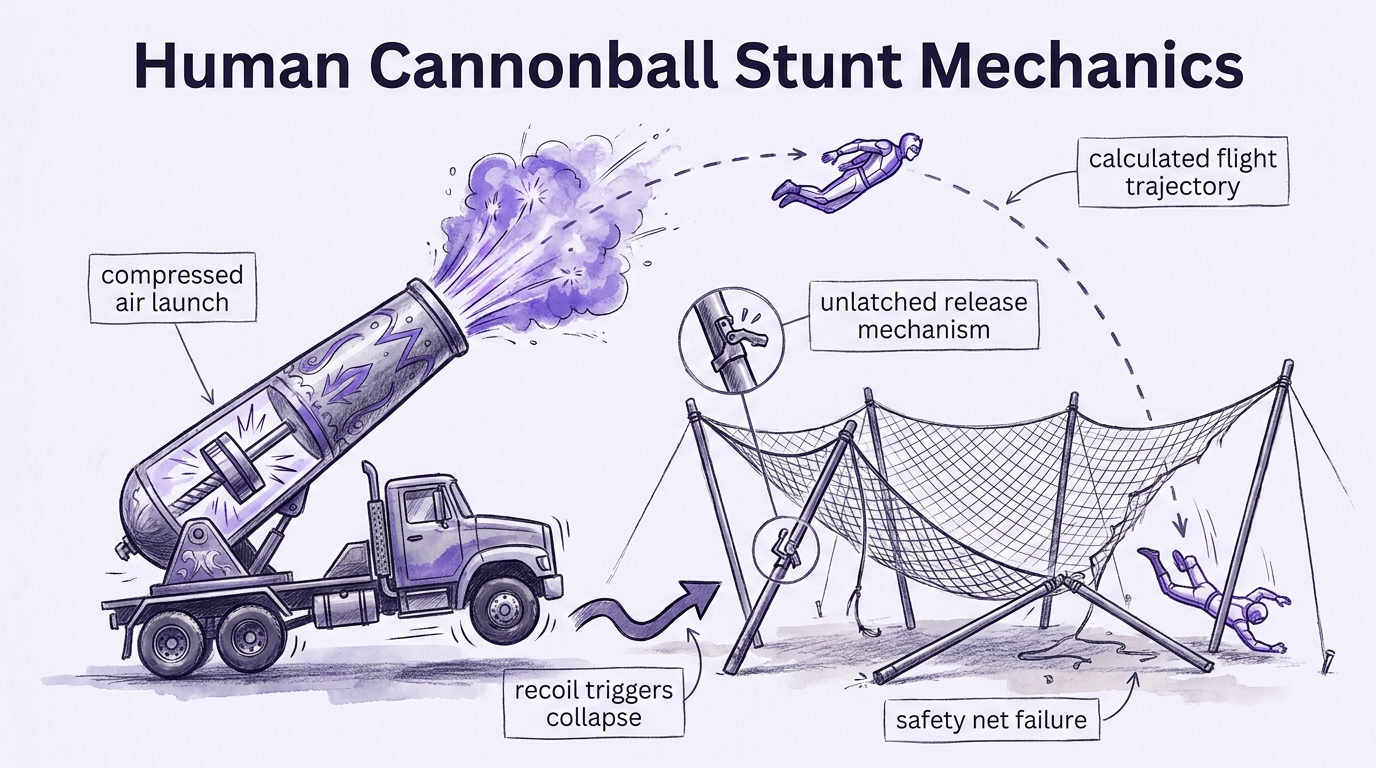
- 10:04Matthew Cranch's fatal fall occurred because recoil from the cannon launch triggered an unlatched quick-release mechanism, causing the safety net to collapse while he was mid-air
- 12:30Legal investigations revealed the quick-release mechanism was a known hazard that should have been locked or removed, leading to fines and community service for show management
Tap to enlarge
Most valuable section
For whom
Fans of circus history, true-crime safety investigations, and historical tragedy documentaries.
The 2011 Tragedy & Mechanism Failure6:54
It offers a clear, step-by-step breakdown of how a small mechanical oversight during recoil caused a fatal catastrophic failure in front of thousands of spectators.
Detailed summary
1. Introduction to the Human Cannonball
0:00The human cannonball is one of the most famous and thrilling acts in circus history, creating the illusion of a human being launched into the air by an explosive blast. In reality, modern stunts use mechanical propulsion like compressed air pistons or heavy-duty springs, using pyrotechnics and smoke effects purely for dramatic theatrical flair.
Precise mathematical calculations determine the trajectory and landing point so a large safety net can catch the performer. Despite high safety standards in modern shows, the inherent risks of aerial acrobatics mean even routine stunts can turn catastrophic if equipment fails.
2. Origins and History of the Act
2:35The stunt was conceived in the 1870s by Canadian daredevil William Leonard Hunt (known as Farini) after his aerial catapult act resulted in his adopted son's injury. Seeking a safer, more dramatic alternative, Hunt patented a cannon-shaped launcher that hid a internal spring-and-piston catapult.
In 1877, 14-year-old Rossa Matilda Richter became the first human cannonball under the stage name 'Zazel' at London's Royal Aquarium. Despite multiple minor injuries caused by net failures during her career, the act became a global spectacle and a mainstay of traveling circuses for over a century.
3. Scott May's Daredevil Stunt Show & Matthew Cranch
5:49Scott May's Daredevil Stunt Show was a popular UK touring production established in 1991, featuring monster trucks, motorcycle jumps, and a human cannonball act that had been performed safely over a thousand times. In early 2011, 24-year-old thrill-seeker Matthew Cranch joined the crew as their new cannonball performer.
Cranch was passionate about outdoor adventures and was thrilled to land his dream job. Having successfully completed five previous launches without incident, he prepared for another standard routine show in Kent on April 25, 2011.
4. The Fatal Accident in Kent
8:29Before a crowd of roughly 2,000 spectators, Cranch climbed into the lorry-mounted cannon tube. Following a short countdown, the pneumatic system triggered, launching Cranch 40 feet into the air toward the extended safety net.
Simultaneously, recoil from the launch jolted the truck, causing the quick-release mechanism securing the safety net to prematurely trigger. The support poles collapsed to the ground, leaving Cranch with no net to break his fall. He struck the ground at high speed, sustaining fatal injuries despite emergency airlift efforts.
5. Investigation and Legal Outcome
10:51An official investigation revealed the net's quick-release system—designed for rapid dismantling or emergency access—had visually appeared locked but remained unlatched. When the cannon fired, the vehicle recoil jarred the catch open, instantly dropping the net.
Prosecution determined that operating the stunt with an active quick-release mechanism created an unnecessary fatal risk. Show owner Scott May was sentenced to community service, and his company received a £100,000 fine for safety violations. The human cannonball act was permanently retired from the tour.
Questions this video answers
How does a human cannonball stunt actually work?
The stunt does not use real gunpowder or explosions, as that would kill the performer. Instead, it uses a powerful catapult mechanism powered by compressed air pistons or springs inside the barrel to physically propel the actor into the air while pyrotechnics generate fake smoke and noise.
Who was the first human cannonball in history?
The concept was designed by Canadian daredevil William Leonard Hunt in the 1870s after his son was injured in a catapult stunt. The very first performer was a 14-year-old female aerialist named Rossa Matilda Richter (stage name Zazel), who debuted the act in 1877 at London's Royal Aquarium.
Why did Matthew Cranch's safety net collapse in 2011?
The safety net was held up by poles attached to a quick-release mechanism designed to lower the net rapidly after a performance. When the cannon fired, the vehicle recoil jolted the mechanism—which appeared visually locked but was actually unlatched—causing the net to collapse to the ground while Cranch was in mid-air.
Was anyone held criminally responsible for the fatal accident?
Yes. An investigation by Kent Police and local authorities determined that having an unlocked quick-release mechanism during a live stunt breached health and safety laws. The stunt show owner was sentenced to 150 hours of community service, and his company was fined £100,000.
Ask a follow-up Premium
About this summary
SumTube AI wrote this recap from the video's words and chapters. Credit and the original belong to Fascinating Horror.