
Free AI summary of this YouTube video by SumTube
How To Start Day Trading As A Beginner In 2026 (Full Course)
TL;DR
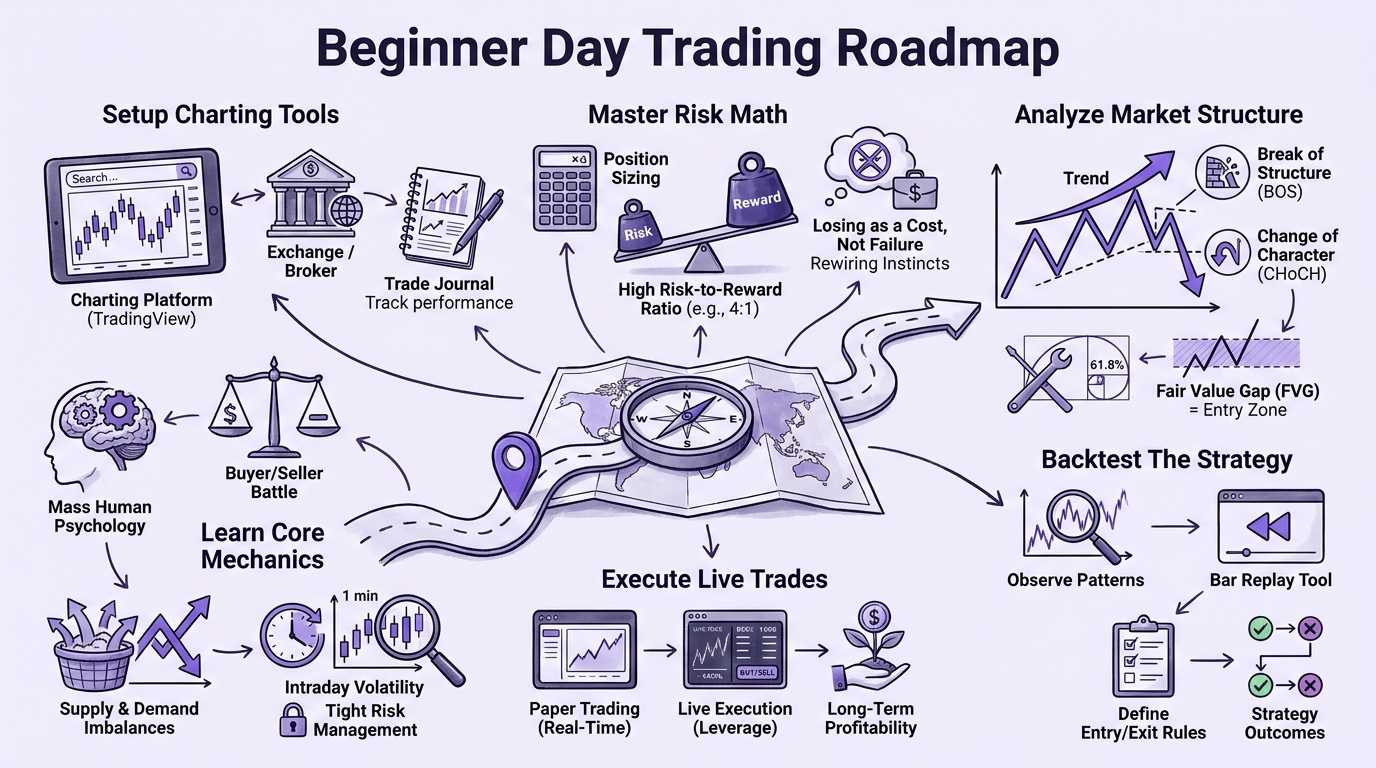
This comprehensive guide outlines a complete roadmap for starting a day trading career, covering core market mechanics, technical analysis, risk management, and trading psychology. The creator breaks down essential tools, price action concepts like Market Structure and Fair Value Gaps, and provides a step-by-step strategy for backtesting and paper trading. By focusing on strict risk-to-reward ratios and systematic execution, traders can build a profitable edge regardless of win rate.

Key takeaways
- Trading success depends on maintaining positive risk-to-reward ratios rather than having a high win rate
- Understanding market structure changes (Change of Character) helps identify trend reversals early
- A structured testing pipeline—from chart observation to paper trading—validates a strategy without risking real capital
Tap to enlarge
Most valuable section
For whom
Aspiring traders looking to build a structured, risk-managed day trading strategy from scratch.
Building a Trading System28:42
It breaks down practical technical analysis concepts like Change of Character, Fibonacci retracements, and Fair Value Gaps into an actionable trading model.
Detailed summary
1. Introduction & Roadmap
0:00The creator introduces his background as a full-time day trader with seven years of experience. He outlines the exact learning path he would take if starting over today, aiming to save beginners time and capital.
The roadmap covers core market mechanics, trading software, psychology, risk management math, technical analysis, strategy development, and real-time execution examples.
2. Core Trading Mechanics
1:46Trading charts represent mass human psychology and the constant battle between buyers and sellers seeking equilibrium. Price moves are dictated by supply and demand imbalances, which create predictable price action patterns over time.
While long-term investing focuses on multi-month trends with full capital risk, day trading leverages shorter timeframes (like the 1-minute chart) to capitalize on intraday volatility while tightly managing downside risk.
3. Essential Tools & Software
5:25Getting started requires three main tools: a charting platform like TradingView, an exchange or broker for trade execution, and a trade journal to track performance data. Popular broker options include crypto exchanges like Blofin/Bybit and prop trading firms like Topstep for futures/stocks.
TradingView allows traders to analyze price movements using candlestick charts, switch timeframes, and organize custom watchlists of preferred trading assets.
4. Trading Psychology & Math
9:33Successful trading requires rewiring human instincts, as natural tendencies view losing trades as personal failures. In reality, losses are an inevitable cost of business and part of executing a statistical edge.
By enforcing strict position sizing and maintaining a high risk-to-reward ratio (e.g., 4:1 or 5:1), traders can achieve long-term profitability even with win rates as low as 30% or 40%.
5. Building a Trading System
16:15Technical analysis involves identifying market structure, trendlines, and structural shifts. Key concepts include Breaks of Structure (BOS) to confirm existing trends and Changes of Character (CHoCH) to spot potential market reversals.
Traders combine market structure with Fibonacci retracements—specifically the 61.8% golden ratio—and Fair Value Gaps (FVGs) to identify high-probability entry zones with defined stop-loss risk.
6. Backtesting & Execution
28:42To build a trading business plan, traders must observe chart patterns, define clear entry/exit rules, and evaluate strategy outcomes using a trading journal. TradingView's Bar Replay tool allows traders to practice execution on historical data without financial risk.
Before risking live capital, strategies should progress through four distinct phases: initial chart observation, replay backtesting, real-time paper trading, and finally live execution using leverage to optimize capital efficiency.
Questions this video answers
What tools are essential to start day trading?
To start day trading, you need a charting platform like TradingView to analyze market price action, a reliable broker or exchange to execute trades (such as Blofin, Bybit, or prop firms like Topstep), and a trading journal to track performance and backtest strategies over time.
How can a trader be profitable with a low win rate?
Profitability is driven by the risk-to-reward ratio rather than win rate alone. For example, with a 4:1 risk-to-reward ratio, a trader who only wins 30% of their trades will still remain consistently profitable over time.
How do you backtest a trading strategy with no money?
You can backtest for free by observing historical price action, using TradingView's Bar Replay feature to simulate real-time market movement, and recording outcomes in a trade journal. Once a strategy proves profitable in replay mode, transition to paper trading on a live market feed before committing real funds.
Ask a follow-up Premium
About this summary
SumTube AI wrote this recap from the video's words and chapters. Credit and the original belong to Craig Percoco.