
Free AI summary of this YouTube video by SumTube
How To Reverse a Cavity at Home | Cure Tooth Decay
TL;DR
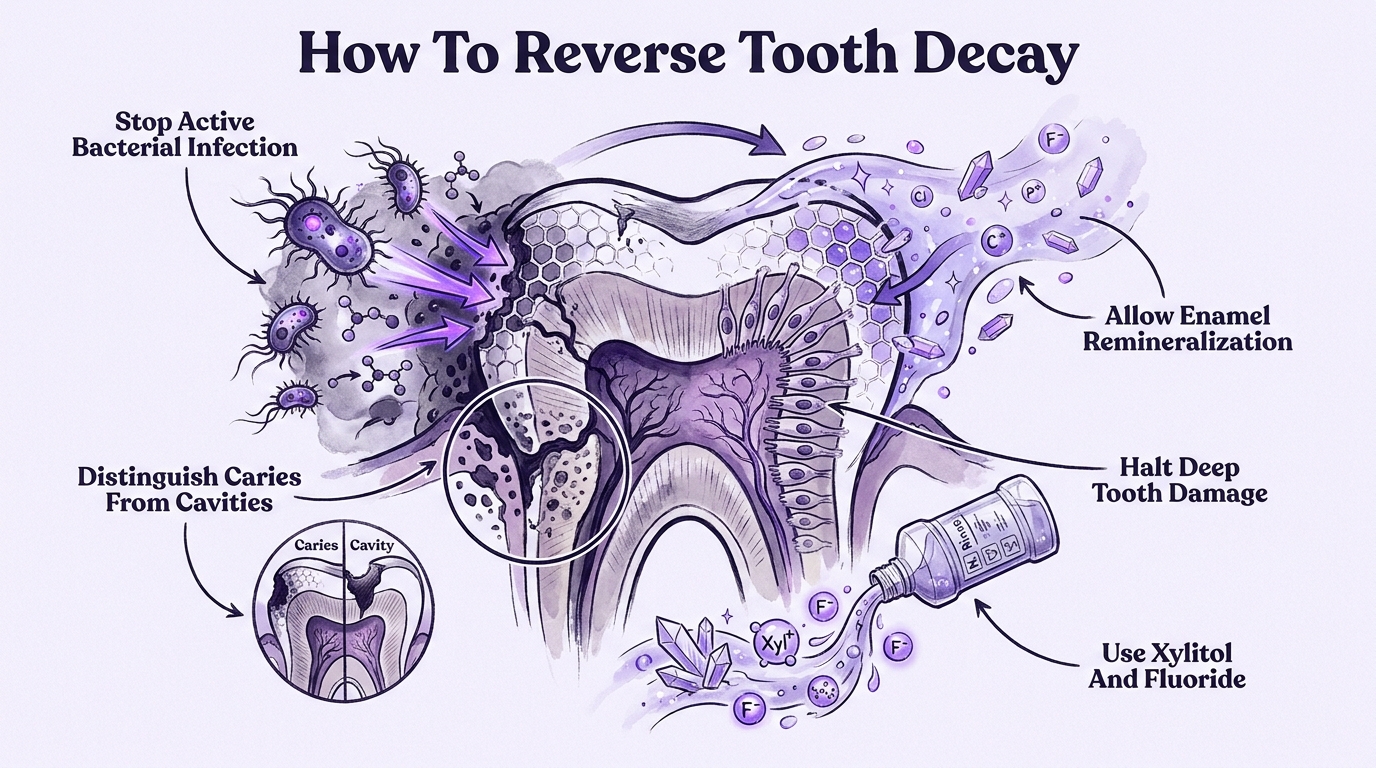
Reversing dental decay at home is achievable by stopping the active bacterial infection and allowing the body's natural processes to remineralize the teeth. While large structural holes will not physically vanish, the surrounding enamel can harden in three to four months, and deeper decay in the dentin can be halted and mineralized over one to two years using specific oral care routines. A combination of xylitol, dilute sodium fluoride rinses, sugar limitation, and properly timed saliva contact creates the necessary environment for complete oral health recovery.

Key takeaways
- 7:09A physical cavity is merely the final structural collapse caused by an underlying bacterial infection called caries
- 23:35Decay extending into the dentin can be halted and internally repaired by odontoblast cells over 1 to 2 years if external bacteria are cut off
- 8:35Hardening soft caries before a dental visit makes necessary fillings cleaner, less damaging, and less invasive to the nerve
Tap to enlarge
Most valuable section
For whom
Individuals with early-stage tooth decay or deep enamel damage looking to avoid invasive dental fillings.
Reversing Dentin Decay and Internal Healing20:04
This section directly challenges conventional dental beliefs by explaining the biological mechanism of how odontoblasts repair internal tooth structure over 1 to 2 years once external bacteria are eliminated.
Detailed summary
1. Understanding How Cavities Form
0:00Tooth decay begins when enamel loses its structural mineral density through exposure to acidity from food or bacteria. Enamel acts as a mineral-packed honeycomb, and demineralization creates tiny gaps where destructive bacteria enter and multiply.
2. The Role of Bacteria and Plaque
2:35Streptococcus mutans feeds on dietary sugars to generate energy and create sticky tendrils that adhere to teeth. As S. mutans accumulates and forms plaque, it secretes acid directly into the tooth, causing ongoing demineralization and progressive structural damage.
3. Distinguishing Caries from Cavities
5:39Caries refers to the active bacterial infection and softened tooth material, whereas a cavity is the final physical collapse of the weakened tooth structure. Understanding this distinction clarifies why stopping the underlying infection is the key to preserving the tooth.
4. Managing Deep Tooth Damage at Home
8:23Even when a visible hole exists, proper hygiene hardens soft, carious tissue and prevents infection from reaching the nerve. Halting disease progression makes eventual dental fillings far less invasive and protects surrounding enamel.
5. The Science of Enamel Remineralization
11:40Enamel remineralizes like a crystal when exposed to mineral-rich liquid at the correct pH. Supersaturated saliva provides these vital minerals naturally, provided it is given enough uninterrupted time between meals to interact with the teeth.
6. Using Xylitol and Sodium Fluoride
15:04Xylitol stimulates mineral-dense saliva flow in individuals with dry mouth, while a dilute 0.05% sodium fluoride rinse speeds up enamel hardening. Using these tools daily can shorten enamel maturation from twelve months down to just three months.
7. Reversing Dentin Decay and Internal Healing
20:04Decay in the dentin can be stopped by eradicating surface bacteria that feed internal infection. Odontoblast cells inside the tooth then secrete new dentin to block microscopic tubules, shielding the nerve and remineralizing the tooth internally over one to two years.
8. Working with Your Dentist and Preserving Teeth
27:07Patients can coordinate with their dentists to monitor enamel repair on X-rays over three-month to annual intervals before agreeing to fillings. Retaining natural tooth structure provides unmatched strength, aesthetic quality, and long-term oral health.
Questions this video answers
Can decay that reaches the dentin layer actually be reversed?
Yes, decay in the dentin can be halted and internally remineralized if the external bacterial infection is eliminated. Odontoblast cells inside the tooth produce new dentin to block off tubules and seal the tooth internally, a natural defense mechanism that takes roughly one to two years once sugar and acid exposure are stopped.
What role does xylitol play in reversing tooth decay?
Xylitol stimulates a healthy flow of mineral-rich saliva at an optimal pH, which is essential for natural enamel repair. It is particularly beneficial for individuals suffering from dry mouth due to medications or medical conditions, ensuring the teeth remain bathed in remineralizing minerals.
Why is dilute fluoride recommended over high-concentration prescriptions?
A dilute 0.05% sodium fluoride mouthwash used two to three times daily is more effective for gradual surface remineralization than high-strength prescription fluorides. It accelerates the natural maturation and hardening of enamel, reducing the healing window from a year down to just three months.
Ask a follow-up Premium
About this summary
SumTube AI wrote this recap from the video's words and chapters. Credit and the original belong to Dr. Ellie Phillips.