
Free AI summary of this YouTube video by SumTube
How Did Humans Invent Vaccines?
TL;DR
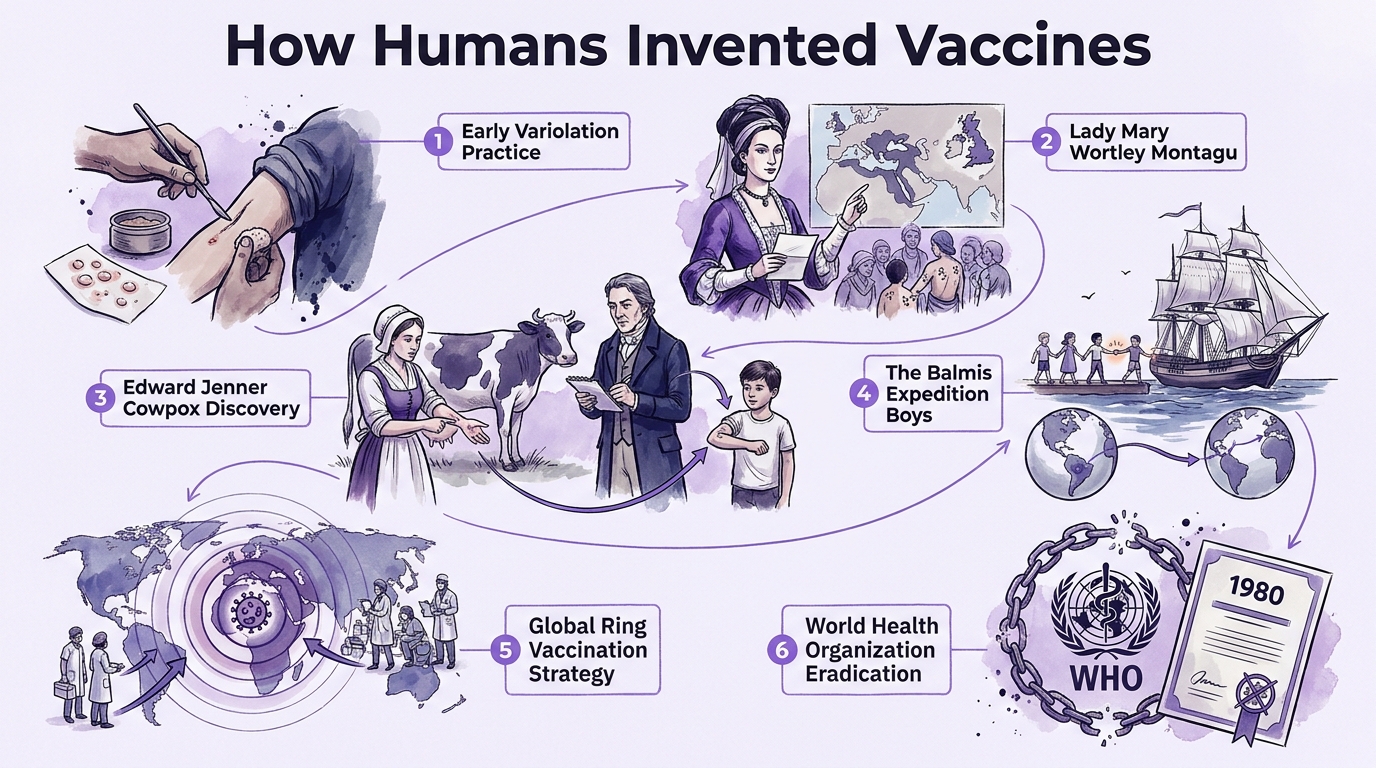
This video recounts humanity's thousands-of-years-long war against smallpox, one of the deadliest viruses in human history. It covers early, dangerous immunization techniques like variolation, Edward Jenner's groundbreaking discovery of cowpox-based vaccination, and the extreme logistical efforts to spread the vaccine worldwide. Ultimately, targeted global health efforts led to the complete eradication of smallpox by 1980.

Key takeaways
- 3:25Before vaccines, ancient healers used 'variolation' by infecting healthy people with real smallpox scabs or pus, taking a deadly gamble to trigger lifelong immunity
- 6:52Edward Jenner developed the first safe vaccine by observing that milkmaids exposed to mild cowpox were immune to smallpox
- 13:26In 1803, the Spanish Balmis Expedition transported the fragile cowpox virus across the ocean using a living chain of 22 orphaned boys
- 17:14Smallpox is the only human disease to be completely eradicated, achieved officially in 1980 through global ring vaccination strategies
Tap to enlarge
Most valuable section
For whom
History and science enthusiasts fascinated by medical breakthroughs and global health triumphs.
It showcases a dramatic and unusual historical moment where a living chain of orphaned boys was used to transport fragile medical science across the Atlantic Ocean.
Detailed summary
1. The Terror of Smallpox
0:00For thousands of years, smallpox was one of humanity's most feared diseases, killing peasants and royalty alike. Victims suffered severe fevers followed by painful, fluid-filled blisters over their entire bodies, often resulting in suffocation, high mortality, or permanent disfigurement and blindness.
In the 20th century alone, the virus claimed an estimated 300 million lives. With a 30% fatality rate, it remained the ultimate microbial apex predator until science found a way to stop it.
2. Early Immunization: Variolation
2:21Long before modern medicine, ancient healers discovered that surviving smallpox granted lifelong immunity. By the 15th century, practitioners in China and the Ottoman Empire developed variolation, an intense practice of blowing ground scabs up healthy people's noses or rubbing pus into small skin cuts.
Although terrifying, variolation reduced the mortality rate from 30% to about 1-2%. It gained widespread adoption in the West after Lady Mary Wortley Montagu introduced it to Britain, and George Washington later mandated it for the Continental Army during the American Revolution.
3. Edward Jenner and the Milkmaid's Secret
6:47In the late 1700s, English country doctor Edward Jenner investigated local folklore claiming milkmaids were immune to smallpox after contracting cowpox. Cowpox was a mild animal disease that caused minor sores on cows' udders and human hands but left no severe lasting harm.
Jenner theorized that exposure to the mild cowpox virus could act as a harmless decoy to train the human immune system against the deadly smallpox virus.
4. The World's First Vaccine Experiment
8:34In May 1796, Jenner tested his theory by scraping pus from a milkmaid's cowpox lesion and inoculating eight-year-old James Phipps. Weeks later, Jenner took a radical risk by deliberately exposing the boy to live smallpox virus.
The boy developed no symptoms, proving that cowpox provided complete protection against smallpox. Jenner coined the term 'vaccination' from the Latin word for cow, though he initially faced heavy skepticism and mockery from the medical elite.
5. The Balmis Expedition
12:19Without refrigeration or modern transport, shipping the fragile cowpox virus across the ocean to Spanish colonies presented a massive logistical challenge. In 1803, Dr. Francisco Javier de Balmis solved this by using 22 young orphaned boys as a living chain of immunity aboard a ship.
By inoculating the children two by two in sequence across the Atlantic journey, fresh virus was continuously extracted from active blisters. This clever and daring strategy successfully brought the vaccine to the Americas and helped protect entire populations.
6. Global Eradication of Smallpox
15:25Over the next century and a half, smallpox vaccination techniques were standardized with tools like the bifurcated needle. In 1967, the World Health Organization launched an aggressive global eradication campaign using ring vaccination to isolate cases and vaccinate surrounding communities.
The last naturally occurring case was identified in Somalia in 1977. By 1980, the WHO officially declared smallpox completely eradicated from Earth, marking one of humanity's greatest achievements in medical science.
Questions this video answers
What was variolation and how did it differ from modern vaccination?
Variolation was an early immunization method where doctors intentionally infected healthy people with active smallpox scabs or pus. While it dramatically reduced the death rate compared to natural infection, it was still dangerous because it used the live, lethal smallpox virus and could occasionally kill the patient or trigger new outbreaks.
How did Edward Jenner test his smallpox vaccine hypothesis?
Jenner took pus from a milkmaid's cowpox blister and inoculated an eight-year-old boy named James Phipps. After the boy recovered from a mild fever, Jenner repeatedly exposed him to live smallpox virus; the child suffered no illness, proving cowpox conferred immunity against smallpox.
How was the smallpox vaccine transported globally before refrigeration?
During the 1803 Balmis Expedition, Spanish doctors preserved the live virus during an Atlantic voyage by passing it arm-to-arm through a chain of 22 orphaned children. Two boys were infected at a time, and as fresh blisters appeared, the pus was transferred to the next pair throughout the journey.
Ask a follow-up Premium
About this summary
SumTube AI wrote this recap from the video's words and chapters. Credit and the original belong to Suho Pulse.