
Free AI summary of this YouTube video by SumTube
How a Steel Box Changed the World: A Brief History of Shipping
TL;DR
This video explores how container shipping evolved into a crucial backbone of the global economy, moving 95% of manufactured goods today. It details the historical shift to standardized metal containers pioneered by Malcom McLean, the resulting boom in global trade, and recent challenges like consolidation and environmental concerns. Finally, it highlights modern advancements such as refrigerated shipping and the future of autonomous, electric cargo vessels.

Key takeaways
- 3:21As trade expanded globally, the broadening of key maritime routes like the Panama and Suez Canals allowed massive vessels to transport thousands of containers at incredibly low costs per item
- 3:21However, overcapacity triggered severe price wars, forcing the market to consolidate as major ocean carriers merged or went out of business
- 3:21Environmental concerns have also prompted the industry to adopt cleaner alternative fuels like natural gas
Tap to enlarge
Most valuable section
Globalization, Industry Challenges, and Modern Advancements3:21
Today, container ships have reached immense scales, carrying over 20,000 units per ship with precise climate control for perishable items through refrigerated containers.
Detailed summary
1. The Evolution and Invention of Container Shipping
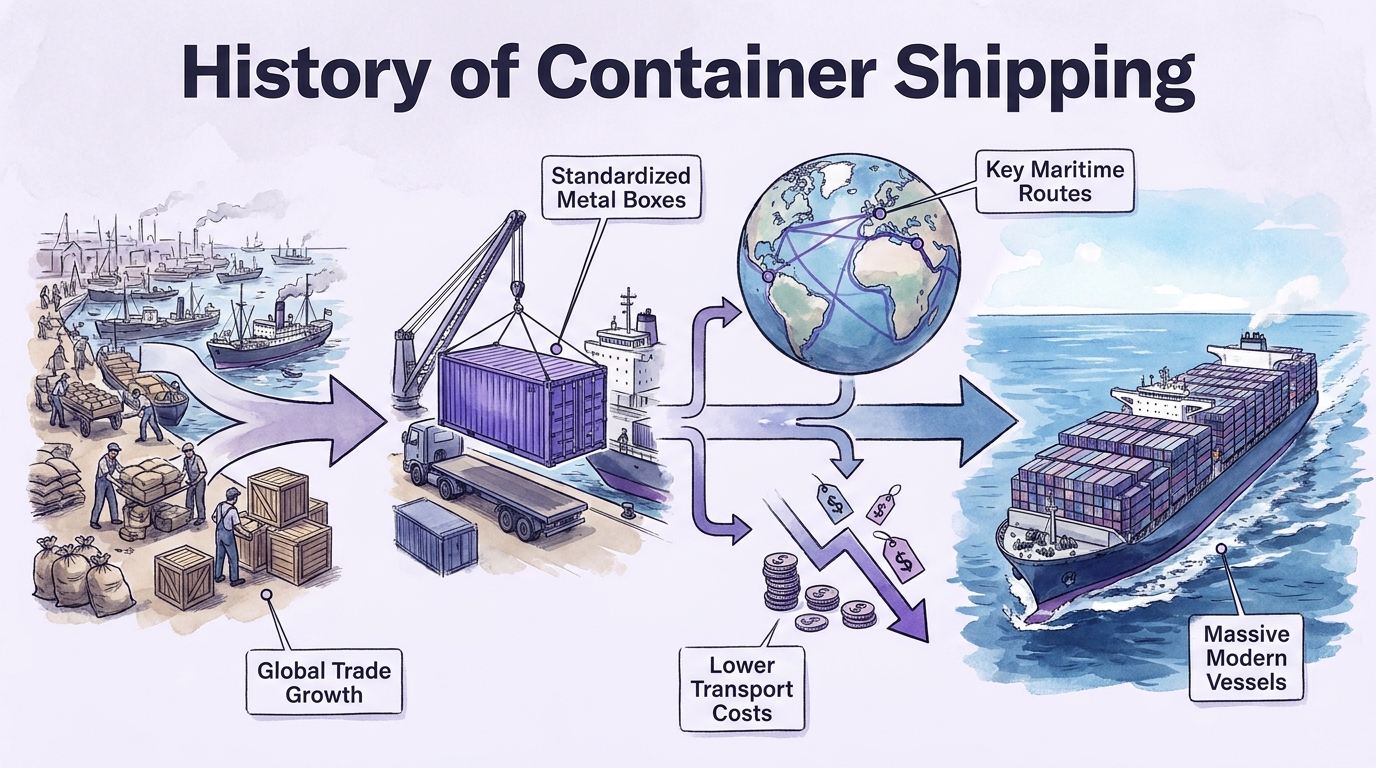
0:00Container shipping is vital to the global economy, responsible for transporting 95% of manufactured products around the world. Before the mid-20th century, maritime trade relied on manual labor to load individual sacks, barrels, and crates onto ships, leading to long, inefficient stays in port. This changed dramatically in 1956 when American truck driver Malcom McLean stacked standardized metal boxes on a vessel, revolutionizing how cargo was moved.
The adoption of standardized containers allowed cargo to seamlessly transition between ships, trucks, and trains without repackaging, cutting transport costs by at least 75%. Modern containerized shipping rapidly expanded through the 1960s and 1980s, enabling global behemoths to carry almost every type of consumer and industrial product worldwide.
2. Globalization, Industry Challenges, and Modern Advancements
3:21As trade expanded globally, the broadening of key maritime routes like the Panama and Suez Canals allowed massive vessels to transport thousands of containers at incredibly low costs per item. However, overcapacity triggered severe price wars, forcing the market to consolidate as major ocean carriers merged or went out of business. Environmental concerns have also prompted the industry to adopt cleaner alternative fuels like natural gas.
Today, container ships have reached immense scales, carrying over 20,000 units per ship with precise climate control for perishable items through refrigerated containers. Looking ahead, the shipping industry is embracing automation, electric power, and digital tracking technologies to eliminate paperwork, lower costs, and reduce reliance on land-based trucking routes.
Questions this video answers
What does this video say about The Evolution and Invention of Container Shipping?
Container shipping is vital to the global economy, responsible for transporting 95% of manufactured products around the world. Before the mid-20th century, maritime trade relied on manual labor to load individual sacks, barrels, and crates onto ships, leading to long, inefficient stays in port. This changed dramatically in 1956 when American truck driver Malcom McLean stacked standardized metal bo
What does this video say about Globalization, Industry Challenges, and Modern Advancements?
As trade expanded globally, the broadening of key maritime routes like the Panama and Suez Canals allowed massive vessels to transport thousands of containers at incredibly low costs per item. However, overcapacity triggered severe price wars, forcing the market to consolidate as major ocean carriers merged or went out of business. Environmental concerns have also prompted the industry to adopt cl
Ask a follow-up Premium
About this summary
SumTube AI wrote this recap from the video's words and chapters. Credit and the original belong to The Wall Street Journal.