
Free AI summary of this YouTube video by SumTube
Health Unit 1 - The Patient-Practitioner Relationship (9990 Psychology)
TL;DR
This Health Psychology lecture explores the dynamics of the patient-practitioner relationship, focusing on how doctor attire, communication styles, and jargon influence patient trust and recall. It evaluates landmark psychological studies by McKinstry and Wang, McKinlay, Ley, and Safer et al., detailing how factors like medical jargon, directive versus sharing consultation approaches, and diagnostic errors shape healthcare experiences. Additionally, the lesson covers patient delays in seeking treatment, the Health Belief Model, and psychological conditions involving the misuse of health services, such as malingering and Munchausen syndrome.

Key takeaways
- Patients tend to perceive doctors wearing traditional, formal attire (such as dark suits for men and white coats for women) as more professional due to script theory and visual heuristics
- Medical professionals frequently underestimate their patients' understanding of medical jargon, leading to potential condescension or poor communication during consultations
- Diagnostic errors in clinical settings often present as Type 1 (false positive) or Type 2 (false negative) errors, as famously demonstrated in David Rosenhan's hospital experiment
- Treatment delays fall into distinct stages—appraisal, illness, and utilization delay—which are influenced by symptom severity, financial costs, and self-researching symptoms online
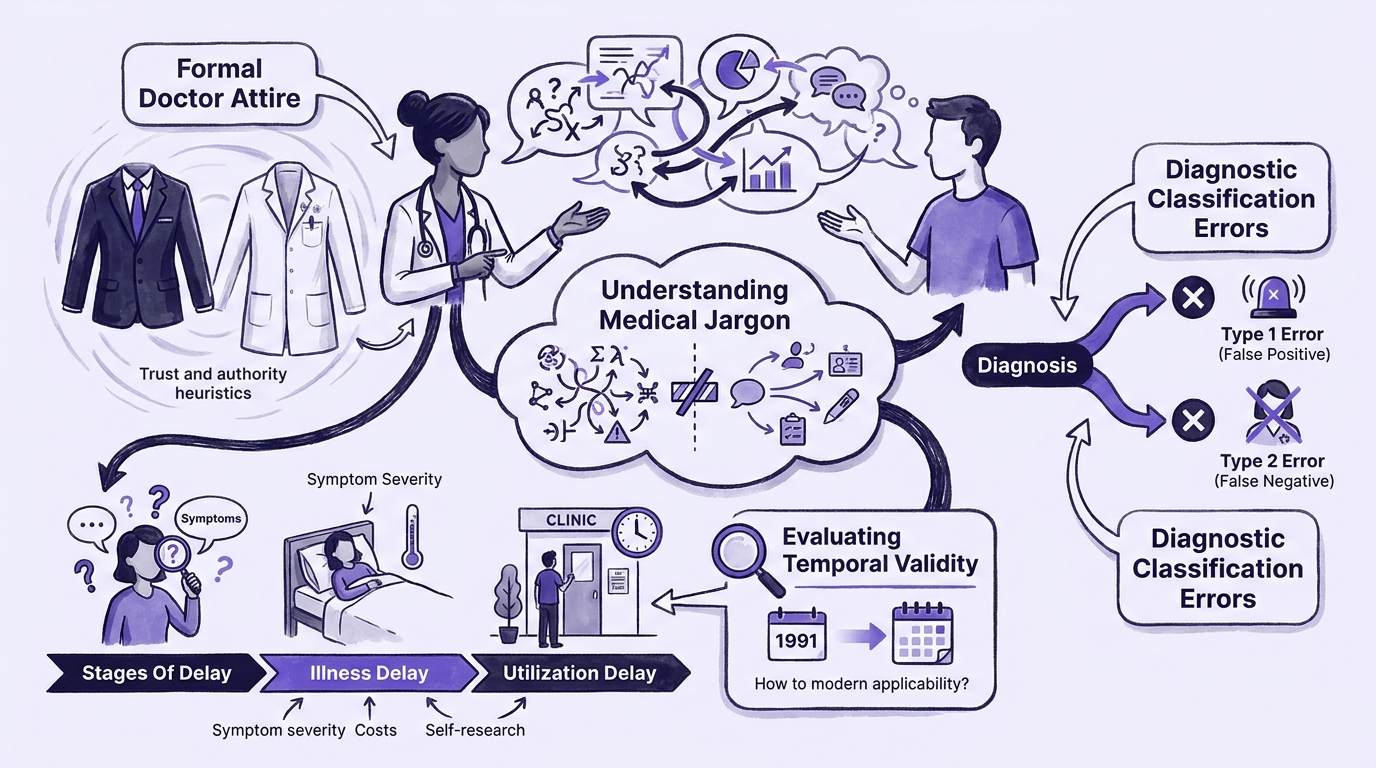
Tap to enlarge
Most valuable section
For whom
Students studying A-Level or introductory health psychology who want a clear breakdown of diagnostic errors and classic clinical studies.
Diagnostic Errors and David Rosenhan's Study12:15
It clearly explains false positives and false negatives without complex math by detailing David Rosenhan's famous psychiatric study 'On Being Sane in Insane Places.'
Detailed summary
1. Part 1
0:00This introductory segment for the Health Psychology unit focuses on the patient-practitioner relationship, addressing how communication and appearance influence patient expectations of medical professionals. The instructor notes that this material serves to cover content missed due to an international conference. A central discussion point begins with what patients expect from their doctors, particularly highlighting the need for clear verbal communication using plain language rather than complex jargon, alongside non-verbal cues. The lesson establishes that practitioners encompass various medical professionals, though the focus remains largely on doctors.
The lecture transitions into examining formal studies on patient expectations, beginning with research regarding a doctor's physical appearance and attire. The instructor introduces a 1991 study exploring preferences for male and female doctors' dress, acknowledging that while the topic may seem straightforward, it highlights how expectations can vary across different cultures and eras. To ground these findings in psychological theory, the instructor introduces the concept of the representative heuristic, which explains the mental shortcuts people use when expecting individuals or objects to conform to specific visual stereotypes.
2. Part 2
4:06This chapter details a study examining how patients perceive different styles of doctor attire and whether these styles influence respect for a doctor's opinion. The research involved 475 participants across five clinics in Scotland who evaluated 30 different doctors using photographs of one man in five clothing styles and one woman in three styles. The researchers attempted to control situational variables by keeping postures identical across photos, though subtle variations in facial expressions remained a potential factor. Using a rating scale from 0 (not acceptable) to 5 (acceptable), the study set the doctor's dress style as the independent variable and the patients' ratings of acceptability and professionalism as the dependent variable.
The results revealed clear preferences among the participants regarding appropriate medical attire. The male doctor received the highest appropriateness rating when wearing a dark-colored suit, whereas his lowest-ranked outfit was jeans, which was preferred by only 60 participants. Conversely, the female doctor received her highest ratings when wearing a white lab coat. The contrast between the preferred attire for male and female doctors has led some commentators to suggest potential gender biases, speculating that female physicians might be expected to use more overt non-verbal symbols, such as a lab coat, to establish their professional authority.
3. Part 3
8:58The chapter discusses specific demographic findings and psychological interpretations from a 1991 study on patient expectations of doctor dress codes. Demographic data revealed that older patients placed greater importance on formal attire due to long-held expectations, while individuals from upper social classes were more likely to object to doctors wearing earrings. Additionally, male participants showed a stronger preference for female doctors to wear white coats, hinting at subtle biases. To explain these findings psychologically, the concept of script theory is introduced, which posits that people hold specific social scripts for how professionals, such as doctors, should present themselves.
A significant portion of the analysis focuses on evaluating the study's temporal validity, questioning whether these findings still apply today. Because the research was conducted in 1991, cultural norms around professional appearance have shifted substantially over time. The speaker notes modern observations of healthcare workers possessing visible tattoos and nose piercings, suggesting that traditional dress expectations may no longer hold the same weight. Consequently, this change in societal standards serves as a strong evaluative point against the study's current relevance and external validity.
4. Part 4
13:47This section evaluates the methodology and ethical considerations of the McKinstry and Wang study on doctor attire. The study involved a minor level of deception to elicit spontaneous responses and reduce demand characteristics, thereby enhancing validity without raising severe ethical concerns. To improve generalizability across various ages and occupations, researchers conducted the study at different locations and times of day. Additionally, the researchers attempted to control extraneous variables by having male and female models maintain similar postures during the experiment.
The text also highlights how examination boards, such as Cambridge, evaluate the strengths of this research. Key strengths include a large sample size spanning thirty doctors across five practices, effective control of situational variables, ease of scoring, a variety of measurement tools, and a high proportion of follow-up interviews with patients. Finally, the chapter concludes by transitioning from the McKinstry and Wang study to the next health psychology study in Scotland, conducted by McKinlay.
5. Part 5
18:42The chapter focuses on McKinlay’s Scottish study examining patients' understanding of verbal medical jargon in a maternity context. The aim was to measure what percentage of medical terms pregnant women comprehended and determine if their level of understanding aligned with doctors' expectations. The study evaluated 81 women at a Scottish prenatal clinic using a list of medical words relevant to pregnancy, such as "breech," "umbilicus," and "purgative." Participants were categorized into "utilizers" (women with nine or more doctor visits) and "under-utilizers" (those with under nine visits), as well as by whether they were having their first child (primiparae) or had previously given birth (multiparae), under the assumption that first-time mothers would be less familiar with medical terms due to less consultation exposure.
The underlying question of the research is whether doctors should simplify or translate their language to ensure patients truly grasp their diagnosis and treatment. For example, using clearer phrasing like providing pills to help use the toilet instead of prescribing a "purgative" allows patients to leave with a deeper comprehension. Ultimately, the results indicated that the women were fairly proficient at understanding specific medical words, particularly those terms directly essential to their own health or the health of their baby, such as "breech."
6. Part 6
23:41In this chapter, the speaker discusses a study examining the disconnect between pregnant women's actual understanding of medical terminology, such as the word "breech," and their doctors' perceptions of their understanding. While all women who regularly visited the doctor understood the term breech, doctors grossly underestimated their patients' medical literacy, projecting that only 22 percent would comprehend the word. The study revealed a potential condescension from medical professionals, who consistently assumed their patients possessed little to no understanding of various medical terms.
Despite believing that their patients would not grasp these terms, doctors continued to use complex medical jargon during consultations. The speaker suggests this behavior might stem from a desire to project professionalism and highlight their advanced education. However, the speaker also notes that the study's findings might face issues with temporal validity today, as modern patients frequently research symptoms on websites like WebMD before appointments. Additionally, it was highlighted that the doctors' survey data was gathered a year after the women's data was collected, which is a key evaluative detail of the research.
7. Part 7
28:40The study discussed features a Nomothetic approach due to its large sample size of 81 working-class patients categorized into groups to identify general trends. While generalizability is somewhat limited by the participants' shared socio-economic background, the research boasts strong ecological validity because it evaluates real pregnant women receiving actual clinic care. Practically, doctors can apply these findings to adjust their communication strategies and ensure patients clearly understand their future care instructions.
The second half of the excerpt transitions to an overview of a Paper 4, Section B exam question. Students are advised on how to design their own study for Part A, which requires addressing specific prompt bullet points such as utilizing an opportunity or volunteer sampling technique and detailing an interview method. Unlike previous AS-level requirements, students must now explicitly incorporate ethical considerations and effective sampling methods into their designs, while also preparing for Part B's standardized questions on the underlying psychological knowledge.
8. Part 8
33:34In this section, the speaker clarifies the distinction between parts one and two of a study planning assignment. Part one requires a third-person perspective, focusing on existing content, theories, or research by other scholars, such as McKinlay's work on how children understand medical jargon. In contrast, part two demands a first-person perspective, where students explain how they personally adapted specific features of that existing psychological knowledge to fit their own research study. For example, while students would need to modify the age-inappropriate medical vocabulary used in the original study, they might retain the original apparatus's lettered rating system to evaluate subject comprehension.
The discussion then transitions to an introduction of Type 1 and Type 2 errors as they relate to clinical diagnosis rather than complex mathematics. To illustrate these diagnostic errors, the speaker introduces David Rosenhan's famous 1970s study, "On Being Sane in Insane Places," which helped spark the anti-psychiatry movement by highlighting diagnostic shortcomings. In this experiment, Rosenhan instructed healthy individuals to seek hospital admission by falsely reporting that they heard voices saying words like "empty," "hollow," and "thud." Based solely on these brief auditory hallucinations, the participants were admitted to psychiatric facilities and diagnosed with severe mental illnesses like schizophrenia, demonstrating how easily diagnostic errors can occur.
9. Part 9
38:39This chapter discusses David Rosenhan's landmark psychiatric study, which illustrates the concepts of Type 1 and Type 2 errors through two distinct experiments involving mental hospital admissions. In the first study, pseudo-patients—including Rosenhan himself—gained admission to 12 different US hospitals by claiming to hear three specific words. Once admitted, the participants acted completely normal to see how long it would take staff to realize they were healthy. Despite their normal behavior, the pseudo-patients were kept in the hospitals for an average of 19 days, with one individual held for 52 days. This outcome represents a Type 1 error, or a false positive, where individuals were falsely diagnosed with a mental illness they did not actually have.
Following the embarrassing results of the initial experiment, staff at the hospitals claimed they would easily spot any future pseudo-patients sent by Rosenhan. In response, Rosenhan conducted a second study where he agreed to send fake patients, but cleverly sent no one at all. Hospital staff subsequently identified actual patients as impostors and released them early, demonstrating a Type 2 error, or a false negative, where real conditions were overlooked. Through these two psychological experiments, the video effectively demonstrates how false positives and false negatives manifest in diagnostic settings, using the famous internet meme of a man being told he is pregnant as a non-mathematical example of a Type 1 error.
10. Part 10
10:19The provided segment explains the concepts of Type 1 and Type 2 errors within hypothesis testing, framing them around null and alternative hypotheses. A Type 1 error represents a false positive, while a Type 2 error represents a false negative, as illustrated by a doctor incorrectly telling a visibly pregnant woman that she is not pregnant. The speaker notes that navigating the relationship between accepting or rejecting a null hypothesis can be confusing due to phrasing that often involves triple negatives, such as failing to reject a null hypothesis leading to a specific error type.
To clarify these statistical concepts, the transcript presents practical examples contrasting non-medical and medical scenarios. Using a weather forecasting example, the alternative hypothesis posits that an upcoming weather event will be life-threatening, making the null hypothesis that it will not be dangerous. Rejecting the null hypothesis triggers public warnings and safety preparations; if this turns out to be a Type 1 error (a false positive), people prepare for a severe storm that never occurs. Conversely, committing a Type 2 error in this context is far more dangerous, as failing to warn the public leads to people doing nothing and ultimately being caught unprepared in a severe event like a tornado or hurricane.
11. Part 11
48:53The severity of Type 1 and Type 2 errors often depends on the original hypothesis, particularly in fields like medicine and safety. In a medical context, if the alternative hypothesis states that a patient has a disease, a Type 1 error (false positive) occurs when a healthy person is diagnosed with the illness, potentially leading to unnecessary medication or behavioral changes. Conversely, a Type 2 error (false negative) occurs when a sick patient is declared healthy, which is often far more dangerous as the individual may continue harmful behaviors without receiving necessary treatment. Similarly, in rock climbing, mistaking safe equipment for unsafe gear (Type 1) is inconvenient, but assuming unsafe equipment is secure (Type 2) poses a significantly greater physical risk.
When studying these concepts for exams like the Cambridge 9990, it is important to navigate common simplifications and past textbook inconsistencies. Exam mark schemes often simplify these definitions—treating a false positive simply as having a disease and a false negative as being healthy—even though the exact classification technically relies on the initial hypothesis setup. Students should keep in mind that even official textbooks and older mark schemes have contained errors or incomplete statements regarding these statistical errors, making it helpful to take extra time to process how these hypotheses and potential mistakes interact in different real-world scenarios.
12. Part 12
4:03This section explores errors in medical diagnosis and methods for improving patient-doctor communication. The speaker points out inconsistencies in how Type 1 and Type 2 errors (false positives and false negatives) are defined across different resources, contrasting an older textbook's definition with a March 2026 mark scheme for diagnosing OCD. Despite these conflicting definitions among professionals, the core takeaway for the patient-practitioner relationship is that clear dialogue and accurate information sharing are essential for minimizing diagnostic mistakes.
To improve diagnostic accuracy, patients must provide detailed and truthful information, which can be challenging when discussing sensitive or stigmatized topics like sexually transmitted diseases. The transcript highlights a 1992 study by Robinson and West that evaluated whether patients were more honest during face-to-face physician interviews, paper questionnaires, or computerized interviews. Using the analogy of a Catholic confession screen, the speaker notes that avoiding direct face-to-face contact—such as through computerized reporting—often encourages patients to be more open and candid about their health conditions.
13. Part 13
59:07The way patient-doctor communication takes place significantly impacts the accuracy of medical information gathered and the patient's ability to recall it. Studies demonstrate that patients are more candid about sensitive topics, such as their number of sexual partners and symptoms, when using computerized interviews or written questionnaires compared to face-to-face interactions. Additionally, a practitioner's demeanor plays a crucial role in patient comprehension; for instance, women watching videos of breast cancer results recalled more information when the oncologist displayed a calm, non-worried affect rather than an agitated one.
Cultural norms and ethical considerations also influence how medical information, particularly regarding diagnosis, is communicated to patients. In some cultures, such as in certain Asian traditions, there is a norm of withholding news of a terminal illness from the patient, sparking ongoing ethical debates about whether doctors or family members should disclose a short life expectancy. Finally, effective communication relies on understanding cognitive factors like the primacy effect, highlighted in Philip Ley's work *Communicating with Patients*, which details how the order and presentation of information affect what patients ultimately remember.
14. Part 14
1:04:15The passage addresses common memory limitations and communication barriers within medical settings, highlighting how patients often forget the middle portion of long conversations due to the primacy and recency effects. On average, patients recall only about 55% of the information conveyed by a doctor, though retention improves when patients possess prior medical knowledge or when information is categorized into distinct topics. To improve recall and comprehension, researcher Ley recommends using simple, jargon-free language, visual aids, specific advice, and asking patients to repeat instructions back to ensure understanding.
Additionally, the text explores the root causes of patient dissatisfaction and communication preferences. Patient dissatisfaction is notably higher in hospital environments compared to general practitioner clinics, primarily due to busy conditions that compromise bedside manner and empathetic interaction. Most patients act as information seekers rather than information blunters, meaning they genuinely want clear details about their diagnoses rather than trying to avoid or downplay serious medical news. Ultimately, the primary driver of patient dissatisfaction is not a desire for less information, but rather a lack of emotional support and genuine empathy from healthcare providers.
15. Part 15
1:09:11This chapter introduces the key study on verbal communication in medical consultations, focusing on doctor-centered versus patient-centered approaches. The speaker compares these consultation methods to teacher-centered and student-centered learning styles in an educational setting, illustrating the difference between a top-down, lecture-style interaction dominated by an authority figure and a collaborative, two-way dialogue. In the context of medical care, doctor-centered approaches involve a practitioner dominating the interaction, whereas patient-centered approaches treat the patient as an equal partner in the conversation.
The speaker then details a specific 1990 study based on these concepts, which evaluated two distinct consulting styles: a "directive" style (doctor-centered) and a "sharing" style (patient-centered). In this study, the independent variable was the randomly assigned consultation style—determined by the doctor picking one of two face-down cards before meeting a patient—and the dependent variable was the patient's post-consultation satisfaction. To maintain procedural consistency and quality control, the consultations were audio-recorded to ensure the doctor accurately adhered to the randomly selected directive or sharing approach.
16. Part 16
1:15:01This chapter outlines a medical field experiment conducted in a London medical center comparing two doctor consultation approaches: a directive style, where the doctor simply instructs the patient on what to do, and a sharing style, where the doctor asks questions to involve the patient in interpreting their symptoms. To ensure validity, consultation styles were randomly assigned as patients entered the room, and participants completed a follow-up questionnaire a week later to measure their satisfaction and comprehension.
The study's results revealed that patients reported higher satisfaction and felt more helped when receiving the directive style (48%) compared to the sharing style (42%). Furthermore, patients felt the doctor had a better understanding of their situation under the directive style (53% versus 39%). The speaker notes that these findings, while perhaps surprising, reflect a 1990 context where patients lacked modern internet resources and preferred deferring entirely to the doctor's expertise. Finally, the chapter raises evaluative points regarding the study, questioning whether its single-location setting limits generalizability and whether defining a "sharing style" solely through asking questions is an overly reductionist approach.
17. Part 17
1:19:04This chapter evaluates the limitations of the Savage and Armstrong key study on consultation styles and introduces further context regarding its findings. A primary critique of the study is that it evaluated patient satisfaction based only on how well the doctor was understood, rather than whether the patient felt understood. Additionally, critics point out that Dr. Savage was likely the sole doctor involved, meaning his individual personality and his patients' familiarity with his usual behavior could have influenced the outcomes. Mechanistically, if he temporarily altered his normal consultation style, it may have caused discomfort or confusion among his regular patients.
The chapter highlights several specific details about the study's methodology and findings that are crucial to understand. Out of the original 359 participants, only 200 completed the entire study, which required mailing back a follow-up response a week after the initial consultation; this attrition rate introduces a potential confounder regarding participant willingness and free time. The study also revealed that patient preferences depended on the nature of their ailment: patients preferred a directive style for short-term illnesses, whereas a sharing style was favored for chronic conditions. Finally, the chapter transitions into the next major unit topic, "Misusing Health Services," which begins by examining the reasons why individuals delay or avoid seeking immediate medical attention.
18. Part 18
1:24:04This chapter examines why individuals delay seeking medical treatment despite displaying obvious symptoms, focusing primarily on a study conducted by Safer et al. The researchers identified three distinct stages of delay: appraisal delay (the time taken to realize one is actually ill), illness delay (the gap between recognizing the illness and deciding to seek help), and utilization delay (the time between deciding to seek care and actually attending an appointment). Investigating these stages through interviews with 93 hospital waiting-room patients, the study focused on individuals experiencing previously unreported symptoms to evaluate how symptom severity and patient reactions affect total delay times.
However, the methodology of the Safer et al. study presents potential limitations, as data was collected retrospectively by asking patients to recall when their symptoms first began and when they decided to act. Because memory is not entirely reliable and researchers had no independent way to corroborate patient self-reports, the validity and reliability of the findings could be impacted. Ultimately, the study illustrates that delays are influenced by a wide range of factors specific to each delay stage, including symptom severity (such as visible bleeding), the use of home remedies, a lack of medical awareness, family pressure, and individual financial situations.
19. Part 19
1:28:51This chapter discusses a flowchart created by Safer et al. that maps out the decision-making process an individual goes through when seeking medical treatment. The model outlines four main stages: noticing symptoms and deciding if one is ill, determining if professional care is needed, weighing whether the care is worth the financial cost, and finally entering treatment. The speaker notes that financial cost is a significant factor in deciding whether to seek care, particularly in countries like the United States where public healthcare programs are limited, though the original study failed to explicitly specify the locations of the hospitals used.
The results of the study reveal key factors that influence delays at different stages of the decision-making process. Appraisal delay was shorter when patients experienced severe pain or bleeding, while illness delay decreased if patients experienced brand-new symptoms rather than recurring ones they had previously managed. Financial constraints significantly increased utilization delays, causing patients with financial concerns to wait an average of 10 days to see a doctor compared to just 2 days for those without financial worries. Finally, patients who had read about their symptoms experienced a much longer total delay—averaging 50 days compared to 11.5 days for those who had not read about their symptoms—likely because reading made them feel informed enough to postpone professional care.
20. Part 20
1:33:42The segment evaluates the methodology and ethics of Safer et al.'s research while introducing the Health Belief Model. Evaluatively, the accuracy of Safer et al.'s study is limited because the information relies on retroactively gathered data. Additionally, conducting a 45-minute interview in a hospital waiting room raises ethical concerns, as asking patients who are already in pain or worried about their condition to reflect on distressing topics—such as the potential consequences of their illness or death—can cause significant emotional distress. On a practical level, understanding the reasons behind patient delay offers valuable real-world applications, helping governments and healthcare providers design targeted interventions to reduce patient anxieties regarding medical costs and health education.
Building on Safer et al.'s insights into patient behavior, the Health Belief Model attempts to explain why individuals choose to seek or avoid medical treatment. The model was originally inspired by events in the 1950s, when the U.S. Public Health Service offered free mobile tuberculosis screenings, yet many individuals still failed to participate despite the lack of financial barriers. To understand this response, researchers developed a structured model mapping human decision-making regarding health actions. This framework demonstrates that a person's choice to engage in health-related behaviors is determined by a combination of demographic and sociological variables—such as age, gender, social class, and religion—alongside specific cognitive factors and internal beliefs.
21. Part 21
1:38:42The chapter outlines psychological and social modifying factors—such as personality, living situations, family structure, class, and gender—noting that while these core background elements are largely unchangeable, an individual's cognitions can shift based on new information. These cognitive shifts revolve around four key beliefs that directly influence whether a person takes health-related action or remains inactive: perceived susceptibility, perceived severity, perceived benefits, and perceived barriers.
Perceived susceptibility refers to how vulnerable a person feels to a negative health outcome, ranging from feeling invincible to acknowledging personal risk. Perceived severity addresses the extent to which an individual believes a condition will negatively impact their life, such as viewing minor weight gain as harmless versus seeing it as a risk for major illness like diabetes. Finally, perceived benefits and perceived barriers evaluate the practical outcomes of seeking care; barriers often involve financial costs, but they can also include non-financial obstacles like hospital overcrowding and appointment availability.
22. Part 22
1:43:41This chapter continues the discussion on health behavior determinants by applying concepts like perceived susceptibility and benefits to real-world scenarios, such as COVID-19 precautions and demographic influences. For instance, lower medical intervention seeking among certain African American communities during the pandemic was informed by historical mistrust rooted in events like the infamous Tuskegee experiments. This demonstrates how demographic factors and historical context shape health beliefs beyond basic cost-benefit analyses. Additionally, the chapter touches on evaluating theoretical frameworks like the Health Belief Model, noting that while traditional empirical metrics like validity or reliability are less applicable, the reductionism versus holism debate highlights how holistic models can complicate the isolation of specific cause-and-effect variables.
Moving into the final portion of the presentation, the text introduces the concepts of malingering and Munchausen syndrome to address why individuals might deliberately falsify an illness. Students often relate to this behavior through common examples, such as peers attempting to secure sick leave to avoid academic presentations or assessments. By exploring the underlying motivations behind fabricating health conditions, the chapter transitions into examining the psychological and practical drivers that lead people to feign medical issues.
23. Part 23
8:46Malingering occurs when an individual fakes or exaggerates a medical condition to escape personal responsibilities or to achieve external benefits, such as gaining insurance money, taking advantage of paid sick days, or avoiding school. This behavior is motivated by clear self-interest or gain, as famously depicted by the fictional character Ferris Bueller. It differs from hypochondriasis, in which a person genuinely believes they are physically ill due to an underlying psychological condition rather than deliberately deceiving others for practical rewards.
In contrast to malingering, Munchausen syndrome—classified in medical literature as a factitious disorder—involves individuals faking illnesses or even inflicting self-harm specifically to gain attention, care, and sympathy from others. This condition often stems from psychological factors such as low self-esteem, a history of childhood abuse, or experiencing a serious illness early in life, where receiving care created a conditioned desire for positive attention. Named after the fictional Baron von Munchausen, who was known for telling exaggerated stories, it remains a rare clinical condition within psychological diagnostic systems like the ICD-11.
24. Part 24
13:31The chapter introduces Munchausen syndrome through a set of true and false characteristics regarding those who live with the condition. People who suffer from Munchausen syndrome often possess extensive medical knowledge to better mimic illnesses, tend to have police records, remain unusually calm during medical procedures, and frequently travel from town to town—a practice known as peregrination—to avoid visiting the same hospitals where staff might detect their deception. Additionally, contrary to common assumptions, most individuals with the condition are not female, and their behavior may stem from a lack of attention during childhood rather than receiving an abundance of it.
To illustrate the severity of the disorder, the text highlights a specific case study recommended by Cambridge, titled "Munchausen Syndrome Presenting as Immunodeficiency" by Aleem and Ajarim. The study detail an extreme case where a female patient injected herself with fecal matter using syringes to cause swellings and lumps that mimicked physical symptoms of immunodeficiency or cancer. The deception was eventually uncovered when nurses discovered a syringe, raising concerns over the severe self-harm involved and the significant waste of medical and hospital resources caused by such fictitious illnesses.
25. Part 25
17:36This chapter discusses the practical applications of studying Munchausen syndrome and the broader topic of the misuse of health services. Recognizing the symptoms of Munchausen syndrome has high real-world value for medical professionals, as identifying these patients allows hospitals to save significant time, manpower, and financial resources. The text highlights typical behaviors associated with the disorder, such as "peregrination"—where patients quickly become defensive and leave facilities when discovered, moving frequently from place to place. Patients with Munchausen syndrome often display extensive medical knowledge to effectively mimic genuine medical conditions, setting them apart from other non-genuine illnesses.
The discussion also categorizes various reasons why a person might appear ill without an underlying physical condition, outlining key concepts relevant to psychological syllabi. It distinguishes Munchausen syndrome from malingering, hypochondriasis, and Munchausen by proxy, which involves intentionally making someone else sick to gain attention or foster dependency. Finally, the chapter addresses potential assessment topics regarding the misuse of health services, noting that psychologists classify both delayed treatment-seeking and conditions like Munchausen syndrome under this category. Students are advised to review relevant case studies and prepare for follow-up assessments to confirm their understanding of these concepts.
26. Part 26
2:02:31The speaker reflects on the presentation of the material outlined in this section, emphasizing their dedicated effort to strictly adhere to the designated syllabus. They highlight the importance of following the established curriculum closely to ensure that all planned topics and course requirements are properly addressed for the audience.
Concluding this portion of the video, the speaker expresses their hope that the viewers found the content both informative and enjoyable. They wrap up their concluding thoughts by reinforcing their commitment to delivering a structured, guided learning experience that aligns directly with the overall course plan.
Questions this video answers
How does a doctor's attire affect patient perceptions?
Research shows that patients form immediate expectations about a doctor's professionalism based on their clothing, relying on cognitive shortcuts known as visual heuristics. Studies indicate preferences for formal attire, such as suits for male doctors and lab coats for female doctors, though older patients and higher social classes tend to hold stricter standards regarding formal dress and access
What is the difference between a doctor-centered and patient-centered consultation style?
A doctor-centered (or directive) style involves the practitioner dominating the interaction by directly telling the patient what to do and emphasizing their professional authority. A patient-centered (or sharing) style is collaborative, involving the patient as an equal partner through open question-asking to help interpret symptoms together.
What are Type 1 and Type 2 errors in medical diagnoses?
A Type 1 error is a false positive, occurring when a healthy individual is incorrectly diagnosed with a condition or illness. A Type 2 error is a false negative, occurring when an actual illness or medical condition is overlooked and the patient is incorrectly declared healthy.
What is the key difference between malingering and Munchausen syndrome?
Malingering involves intentionally faking or exaggerating illness to achieve external personal gain, such as avoiding work or securing insurance money. In contrast, Munchausen syndrome is a factitious disorder where individuals feign illness or inflict self-harm solely to gain emotional attention, care, and sympathy from medical staff.
Ask a follow-up Premium
About this summary
SumTube AI wrote this recap from the video's words and chapters. Credit and the original belong to CIE A LEVEL PSYCHOLOGY.