
Free AI summary of this YouTube video by SumTube
Hawking's black hole paradox explained - Fabio Pacucci
TL;DR
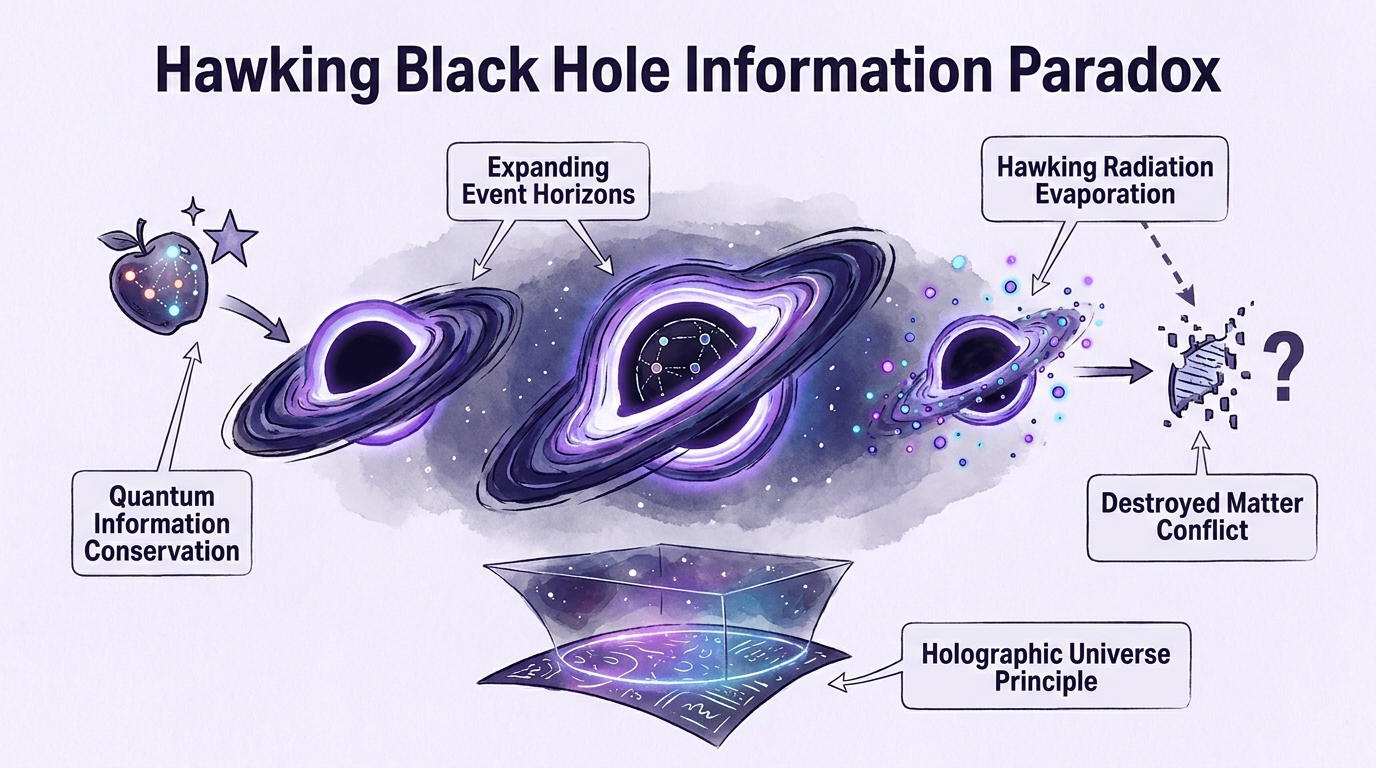
The black hole information paradox challenges a fundamental law of physics: the conservation of quantum information. According to classical physics and quantum mechanics, information about matter cannot be destroyed, yet Hawking radiation demonstrates that black holes evaporate and potentially erase all quantum information within them. Resolving this contradiction could lead to a unified "Theory of Everything" or reveal that our universe functions according to the holographic principle.

Key takeaways
- 2:03The conservation of quantum information is a foundational principle of modern science, asserting that physical information can never be permanently deleted
- 4:53Hawking radiation shows black holes eventually evaporate, creating a conflict between general relativity and quantum mechanics over whether information inside them is destroyed
- 7:13The holographic principle proposes that the 3D universe we experience may be a projection of 2D quantum information stored on the universe's boundary
Tap to enlarge
Most valuable section
For whom
Curious minds interested in cosmology, physics paradoxes, and the fundamental nature of space and reality.
Hawking Radiation and the Paradox4:12
This section clearly explains how Stephen Hawking's discovery created the central contradiction between quantum mechanics and general relativity.
Detailed summary
1. Introduction to Scientific Paradoxes
0:00Scientists operate at the boundaries of human knowledge, where paradoxes often emerge to challenge established beliefs. Throughout history, paradoxes have threatened to undermine existing scientific frameworks while simultaneously opening new pathways to deeper understanding.
Today, one of the most significant paradoxes in physics threatens to unravel the relationship between general relativity and quantum mechanics: the black hole information paradox.
2. Understanding Quantum Information
0:43To understand the paradox, one must first distinguish between everyday information and quantum information. While visible properties like an apple's color or shape describe macroscopic traits, quantum information describes the exact physical properties of its underlying particles, including position, velocity, and spin.
A foundational law of physics dictates that the total amount of quantum information in the universe must be conserved. Even if an object is crushed or burned beyond recognition, its quantum information remains intact within the universe and could theoretically be used to reconstruct the original item.
3. Black Holes and the Event Horizon
2:31When an object falls into a black hole, it seems to vanish from the observable universe. However, this alone does not break physical laws if the quantum information remains stored deep within the black hole's void or encoded on its surface boundary, known as the event horizon.
As a black hole swallows matter, its event horizon expands proportionally. This growth suggests that a black hole could potentially store all the quantum information of the matter it consumes, preserving the conservation law.
4. Hawking Radiation and the Paradox
4:12The problem intensifies when accounting for Hawking radiation, a phenomenon discovered by Stephen Hawking in 1974. Black holes slowly radiate particles and lose mass, eventually evaporating entirely over immense periods of time.
Because the thermal radiation emitted by a black hole appears unrelated to the matter it previously swallowed, the evaporation suggests that all quantum information inside the black hole is permanently erased once it disappears, directly violating quantum mechanics.
5. Potential Solutions and the Holographic Principle
5:44Physicists are exploring several solutions to resolve the contradiction. Some suggest that Hawking radiation does secretly contain encoded quantum information, while others believe our current understanding of general relativity and quantum field theory is incomplete, requiring a unified Theory of Everything.
Another compelling idea is the holographic principle, which proposes that 3D physical reality is a projection of 2D quantum information stored at the boundary of the observable universe. Regardless of which theory proves correct, resolving the paradox will fundamentally reshape modern science.
Questions this video answers
What is quantum information?
Quantum information refers to the fundamental properties of particles that make up matter, including their position, velocity, and spin. Unlike macroscopic properties like color or shape, quantum information defines the precise subatomic composition of an object.
Why can't quantum information be destroyed?
The conservation of quantum information is a mathematical necessity in physics. It states that even if an object is destroyed or transformed, its original subatomic state can theoretically be reconstructed if all its quantum components are tracked.
How does Hawking radiation create the black hole information paradox?
Stephen Hawking showed that black holes slowly emit radiation and lose mass over time until they disappear entirely. If the escaping radiation doesn't carry away the quantum information of everything that fell into the black hole, that information is permanently destroyed, breaking the laws of quantum mechanics.
What is the holographic principle in physics?
The holographic principle suggests that all quantum information contained within a region of space can be encoded on a lower-dimensional boundary surrounding it. Applied to the cosmic scale, it implies our three-dimensional reality might be a holographic projection of two-dimensional information stored at the edge of the observable universe.
Ask a follow-up Premium
About this summary
SumTube AI wrote this recap from the video's words and chapters. Credit and the original belong to TED-Ed.