
Free AI summary of this YouTube video by SumTube
Future Computers Will Be Radically Different (Analog Computing)
TL;DR
This video explores the history and recent resurgence of analog computing, particularly in the context of modern artificial intelligence and neural networks. It explains how physical analog components can perform fast, energy-efficient matrix calculations, potentially bypassing the physical limits and power constraints of digital computers.
Key takeaways
- 1:42Analog computing offers significant advantages in power efficiency, speed, and parallel processing
- 5:41Artificial intelligence concepts date back decades, notably with Frank Rosenblatt’s creation of the Perceptron in 1958
- 13:34AI research saw renewed interest in the 1980s with multi-layer neural networks
- 16:52In the mid-2000s, Stanford researcher Fei-Fei Li spearheaded ImageNet, a massive database of human-labeled images that revolutionized AI training data
- 22:15Running increasingly large neural networks presents severe challenges for digital architecture, including high energy consumption, the Von Neumann memory bottleneck, and the slowdown of Moore's Law as transistor physical
Most valuable section
History of AI and the Perceptron5:41
Critical evaluations by computer scientists Marvin Minsky and Seymour Papert highlighted these flaws, leading to a period known as the first AI winter.
Detailed summary
1. Introduction to Analog Computing
0:00Analog computers were historically used for predicting natural phenomena like eclipses and tides, as well as directing artillery. While modern digital computing replaced analog devices through solid-state transistors, analog hardware is seeing a resurgence due to new computational demands in modern technology.
Demonstrations show an analog computer solving differential equations by mapping physical parameters, such as a mass on a spring or atmospheric convection in the Lorenz system, directly to continuous electric voltages. Rather than processing binary zeros and ones, analog circuits simulate systems in real time using continuous electrical signals.
2. Pros and Cons of Analog Systems
1:42Analog computing offers significant advantages in power efficiency, speed, and parallel processing. Basic operations like addition and multiplication require only simple electrical connections or resistors, whereas digital computers rely on thousands of switching transistors to calculate the same operations.
However, analog computers face major drawbacks, including single-purpose design, non-repeatable calculations, and inexact output due to component variations. These limitations led to their decline once digital computing became scalable and widely available.
3. History of AI and the Perceptron
5:41Artificial intelligence concepts date back decades, notably with Frank Rosenblatt’s creation of the Perceptron in 1958. Designed to mimic biological neurons, the Perceptron calculated weighted sums of inputs to classify simple visual images such as shapes or basic characters.
Despite initial media excitement claiming the device would lead to conscious machines, the Perceptron had severe mathematical limitations. Critical evaluations by computer scientists Marvin Minsky and Seymour Papert highlighted these flaws, leading to a period known as the first AI winter.
4. The Evolution of Neural Networks & ALVINN
13:34AI research saw renewed interest in the 1980s with multi-layer neural networks. Carnegie Mellon University developed ALVINN, an autonomous van navigated by an artificial neural network using hidden layers to process road image pixels and output steering angles.
ALVINN trained by observing human drivers and adjusting its internal weight values via backpropagation. Though successful at low speeds, its performance was bounded by the digital processing speed required for matrix multiplication.
5. ImageNet and the Deep Learning Explosion
16:52In the mid-2000s, Stanford researcher Fei-Fei Li spearheaded ImageNet, a massive database of human-labeled images that revolutionized AI training data. The subsequent ImageNet competitions pushed researchers to scale neural network architectures dramatically.
In 2012, AlexNet demonstrated that deep neural networks trained on GPUs could outperform traditional methods by a wide margin. This spark kicked off modern deep learning, leading to network models that quickly surpassed human-level image classification accuracy.
6. Digital Limits and the Return to Analog
22:15Running increasingly large neural networks presents severe challenges for digital architecture, including high energy consumption, the Von Neumann memory bottleneck, and the slowdown of Moore's Law as transistor physical limits are reached.
Because neural networks primarily perform massive amounts of matrix multiplication and can tolerate slight variability, analog computing is ideally suited for AI inference tasks. Analog hardware can execute these calculations faster and with drastically reduced power demands.
7. Inside Modern Analog AI Chips
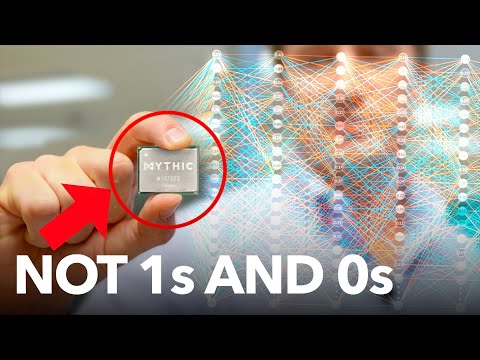
24:57A visit to startup Mythic AI illustrates how modern analog chips repurpose flash storage cells into variable resistors. By storing weights directly inside memory cells as electrical conductance, matrix multiplication occurs in-memory as current flows through the circuit.
This hybrid analog approach allows compact chips to execute tens of trillions of operations per second using only a fraction of the power consumed by standard digital GPUs, opening up new possibilities for edge computing, robotics, and real-time vision processing.
Questions this video answers
What does this video say about Introduction to Analog Computing?
Analog computers were historically used for predicting natural phenomena like eclipses and tides, as well as directing artillery. While modern digital computing replaced analog devices through solid-state transistors, analog hardware is seeing a resurgence due to new computational demands in modern technology. Demonstrations show an analog computer solving differential equations by mapping physica
What does this video say about Pros and Cons of Analog Systems?
Analog computing offers significant advantages in power efficiency, speed, and parallel processing. Basic operations like addition and multiplication require only simple electrical connections or resistors, whereas digital computers rely on thousands of switching transistors to calculate the same operations. However, analog computers face major drawbacks, including single-purpose design, non-repea
What does this video say about History of AI and the Perceptron?
Artificial intelligence concepts date back decades, notably with Frank Rosenblatt’s creation of the Perceptron in 1958. Designed to mimic biological neurons, the Perceptron calculated weighted sums of inputs to classify simple visual images such as shapes or basic characters. Despite initial media excitement claiming the device would lead to conscious machines, the Perceptron had severe mathematic
What does this video say about The Evolution of Neural Networks & ALVINN?
AI research saw renewed interest in the 1980s with multi-layer neural networks. Carnegie Mellon University developed ALVINN, an autonomous van navigated by an artificial neural network using hidden layers to process road image pixels and output steering angles. ALVINN trained by observing human drivers and adjusting its internal weight values via backpropagation. Though successful at low speeds, i
What does this video say about ImageNet and the Deep Learning Explosion?
In the mid-2000s, Stanford researcher Fei-Fei Li spearheaded ImageNet, a massive database of human-labeled images that revolutionized AI training data. The subsequent ImageNet competitions pushed researchers to scale neural network architectures dramatically. In 2012, AlexNet demonstrated that deep neural networks trained on GPUs could outperform traditional methods by a wide margin. This spark ki
Ask a follow-up Premium
About this summary
SumTube AI wrote this recap from the video's words and chapters. Credit and the original belong to Veritasium.