
Free AI summary of this YouTube video by SumTube
feedback inhibition
TL;DR
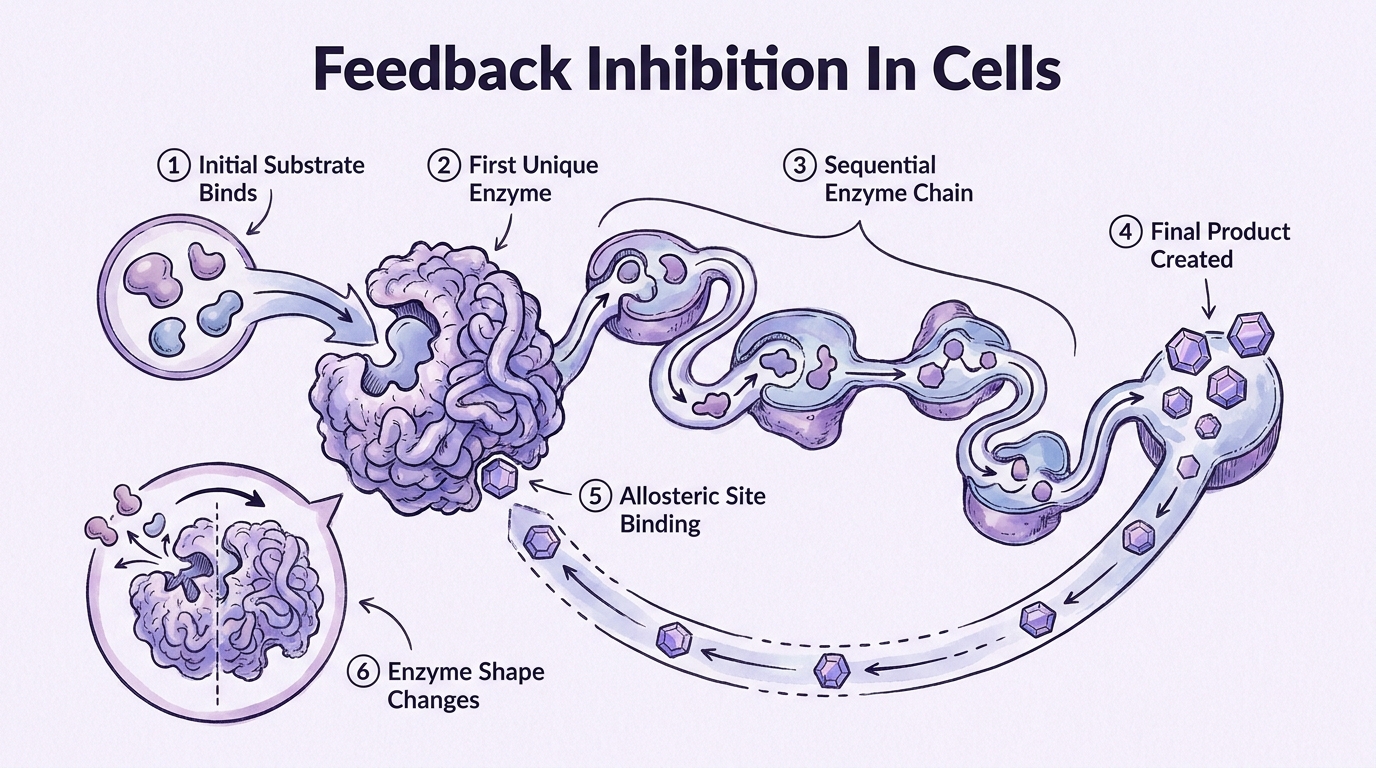
This video explains the process of feedback inhibition in biochemical pathways within cells. It demonstrates how cells regulate production by allowing the end product of a pathway to bind to an allosteric site on an enzyme, halting further synthesis when the product is already abundant.

Key takeaways
- Biochemical pathways operate in a sequential chain where the product of one enzyme becomes the substrate for the next
- 0:34Feedback inhibition prevents cell waste by utilizing end products to allosterically deactivate the pathway's initial enzyme
Tap to enlarge
Most valuable section
For whom
Biology students and anyone learning about enzyme regulation and cellular metabolism
Mechanism of Feedback Inhibition0:34
It visually demonstrates how an end product binds to an allosteric site to change an enzyme's shape and shut down pathway synthesis.
Detailed summary
1. Biochemical Pathways Overview
0:00Biochemical pathways consist of a series of enzyme-catalyzed reactions that occur in a specific sequence inside a cell. In these pathways, such as those involved in the biosynthesis of amino acids, the product generated by one enzymatic reaction serves directly as the substrate for the next step in the chain.
When end products like amino acids become readily available in the cellular environment, continued synthesis becomes unnecessary and wasteful. Cells require an efficient regulatory mechanism to halt production pathways when sufficient levels of the end product are present.
2. Mechanism of Feedback Inhibition
0:34In feedback inhibition, the final product of the pathway binds to the first unique enzyme involved in that pathway. This binding occurs at an allosteric site, which is distinct from the active site where normal substrates attach.
When the product attaches to the allosteric site, it induces a conformational shape change in the enzyme. This alteration prevents the enzyme from reacting with its initial substrate, halting subsequent pathway steps and stopping further end-product synthesis.
Questions this video answers
What is feedback inhibition in cellular biology?
Feedback inhibition is a regulatory mechanism where the final product of a biochemical pathway acts as an inhibitor to an enzyme early in that same pathway. This prevents the cell from wasting resources by synthesizing excess amounts of a product that is already abundantly available.
Where does the inhibiting end product bind on the enzyme?
The end product binds to a specific region called the allosteric site, which is separate from the enzyme's active site. Binding at this location induces a conformational shape change in the enzyme, preventing it from binding its original substrate.
Why is feedback inhibition important for cells?
It helps cells maintain efficiency and conserve energy. Without feedback inhibition, cells would continuously produce amino acids and other molecules even when sufficient quantities are available in the environment.
Ask a follow-up Premium
About this summary
SumTube AI wrote this recap from the video's words and chapters. Credit and the original belong to kven Venderson.