
Free AI summary of this YouTube video by SumTube
反彈三部曲|【浦男搜股】EP.429
TL;DR
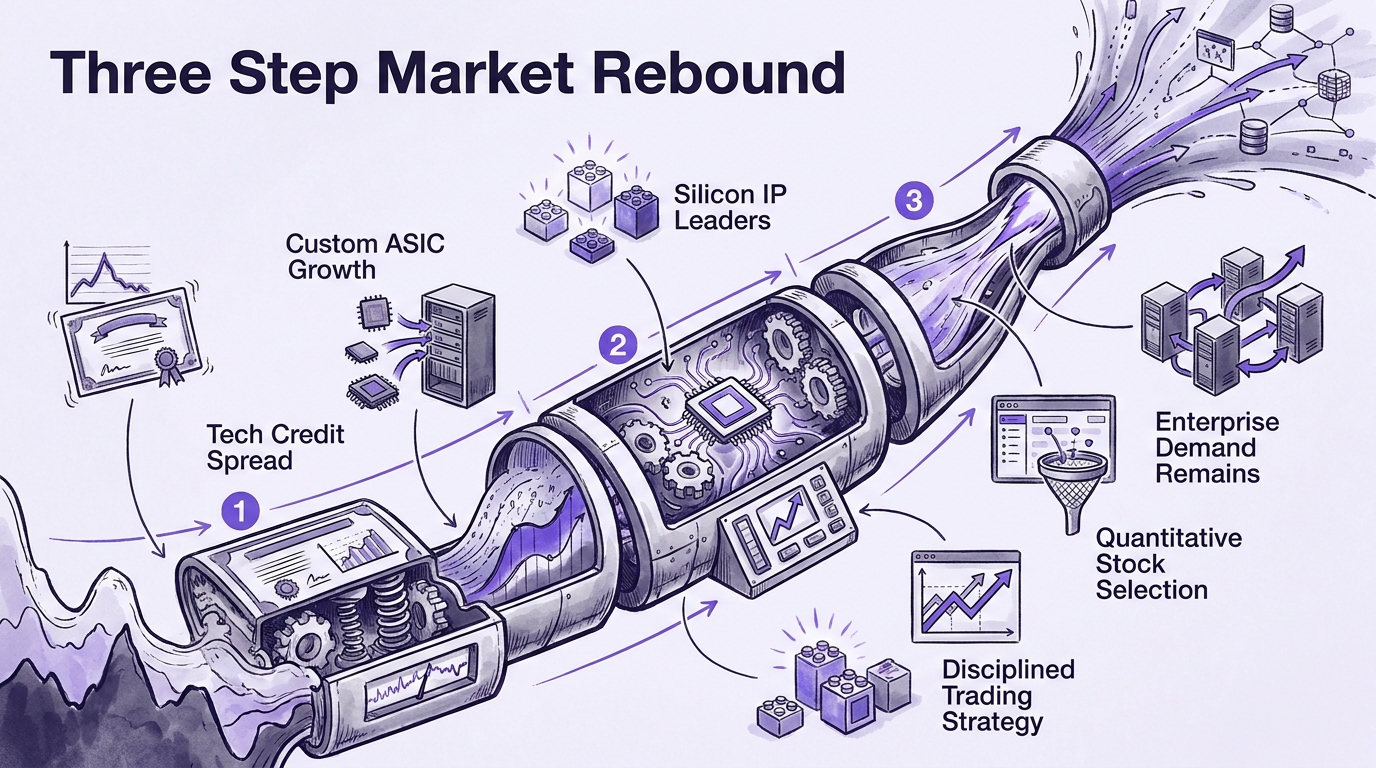
In this market analysis session, analysts discuss key trends in Taiwanese stocks, global semiconductor sentiment, and AI infrastructure. They examine credit default swap (CDS) concerns surrounding major tech names like Oracle while highlighting potential counter-trend strength in ASIC design houses and IP providers like Alchip, Creative, and MediaTek. Additionally, the experts detail market turnaround strategies—emphasizing phased buying, capital allocation, and risk management—and review Dell's strong AI server backlog to reinforce long-term confidence in AI fundamentals.

Key takeaways
- Even when GPU giant Nvidia faces near-term headwinds, custom ASIC developers and IP providers offer defensive and growth potential
- 15:03Oracle's elevated CDS spreads reflect long-term financing costs rather than an imminent insolvency or AI bubble collapse
- Technical turnaround strategies require disciplined, step-by-step capital deployment across key moving averages rather than all-in bets
- Robust AI server backlogs at major hardware vendors show that real enterprise demand remains strong despite market noise
Tap to enlarge
Most valuable section
For whom
Investors looking for technical turnaround signals and capital management frameworks during volatile market dips.
Market Bottoming Strategies and Capital Allocation35:21
It outlines actionable risk management principles, explaining how to systematically build positions using moving averages and technical indicators.
Detailed summary
1. Introduction and Tech Credit Concerns
8:36The show opens with an analysis of recent financial market jitters, focusing on elevated Credit Default Swap (CDS) spreads for tech giants like Oracle and CoreWeave. Analysts explain that elevated CDS values reflect long-term borrowing costs and risk perception rather than an impending short-term credit default.
Comparing current conditions with historical financial distress events shows that major AI players maintain healthy cash balances relative to their short-term debt obligations. As market panic subsides during holiday trading lulls, conditions may stabilize for low-valuation technology equities.
2. ASIC Dynamics and Cloud Compute Demonstration
17:25Attention shifts to alternative AI hardware opportunities, specifically Application-Specific Integrated Circuits (ASICs). Cloud service providers are heavily promoting custom silicon capabilities to demonstrate computational reliability and cost efficiency alongside standard GPU setups.
Although supply chain delays previously shifted revenues outward, major ASIC design vendors are positioned to capture deferred demand. This operational shift provides significant revenue visibility extending into upcoming fiscal years.
3. Silicon IP Leaders: MediaTek, Creative, and Alchip
25:46The discussion turns to top IP design houses, examining near-term financial catalysts for MediaTek, Creative, and Alchip. Analysts highlight how expanding custom chip orders for enterprise and automotive applications support multi-year earnings expansion.
While short-term accounting entries or minor shipment delays have temporarily weighed on individual stock prices, baseline fundamentals remain intact. Low comparative valuations make these IP leaders attractive candidates for upside participation when market momentum resumes.
4. Market Bottoming Strategies and Capital Allocation
35:21The segment details disciplined trading strategies for navigating market volatility and technical dips. Rather than predicting exact market bottoms, investors are advised to execute staged purchases as key moving average thresholds are reclaimed.
Integrating technical indicators like stochastic oversold crosses with underlying institutional buying data allows traders to systematically scale positions while limiting downside exposure through strict stop-loss rules.
5. Financial Metrics and Screening Frameworks
37:02The host presents quantitative stock selection methods focused on fundamental financial health, earnings resilience, and reasonable valuation ratios. Stocks exhibiting strong sales growth combined with modest price-to-earnings multiples offer safer entry points during broad index pullbacks.
Historical performance comparisons demonstrate that screening for consistent return on equity and reasonable valuation buffers helps build resilient portfolios capable of outperforming index benchmarks.
6. AI Hardware Demand and Server Backlog Review
40:47An analysis of recent corporate earnings reports from global server vendors shows robust ongoing demand for enterprise AI infrastructure. Rising order backlogs indicate that hardware back orders continue to outpace immediate production capacities.
This gap between strong end-user demand and supply constraints refutes claims of an AI spending bubble. Enterprise expansion beyond primary hyperscalers reinforces a stable long-term outlook for power, cooling, and component suppliers.
Questions this video answers
Is Oracle at risk of defaulting due to elevated CDS spreads?
While Oracle's Credit Default Swap (CDS) spreads have risen above historical crisis levels, short-term default risk remains low. Unlike firms during past liquidity crises, Oracle possesses sufficient cash reserves to cover short-term liabilities. The elevated spread reflects longer-term financing costs and market caution rather than an immediate liquidity crisis.
Why are ASIC and silicon IP stocks highlighted over GPU leaders?
When market sentiment around GPU suppliers weakens, cloud providers increasingly turn to custom ASICs to optimize costs and workloads. Silicon IP firms like MediaTek, Creative, and Alchip benefit from delayed product revenue shifting into upcoming fiscal periods, offering lower entry valuations and solid multi-year growth trajectories.
How should investors approach bottom-fishing during sharp market pullbacks?
Analysts recommend a disciplined, phased purchasing strategy tied to key moving average recoveries rather than attempting to pick absolute bottoms. Investors should keep initial allocations small, strict stop-loss rules in place, and only scale up position sizes as technical indicators confirm a sustained turnaround.
Ask a follow-up Premium
About this summary
SumTube AI wrote this recap from the video's words and chapters. Credit and the original belong to 老王愛說笑.