
Free AI summary of this YouTube video by SumTube
Elektrischen Kühl-Strohhalm erfinden!
TL;DR
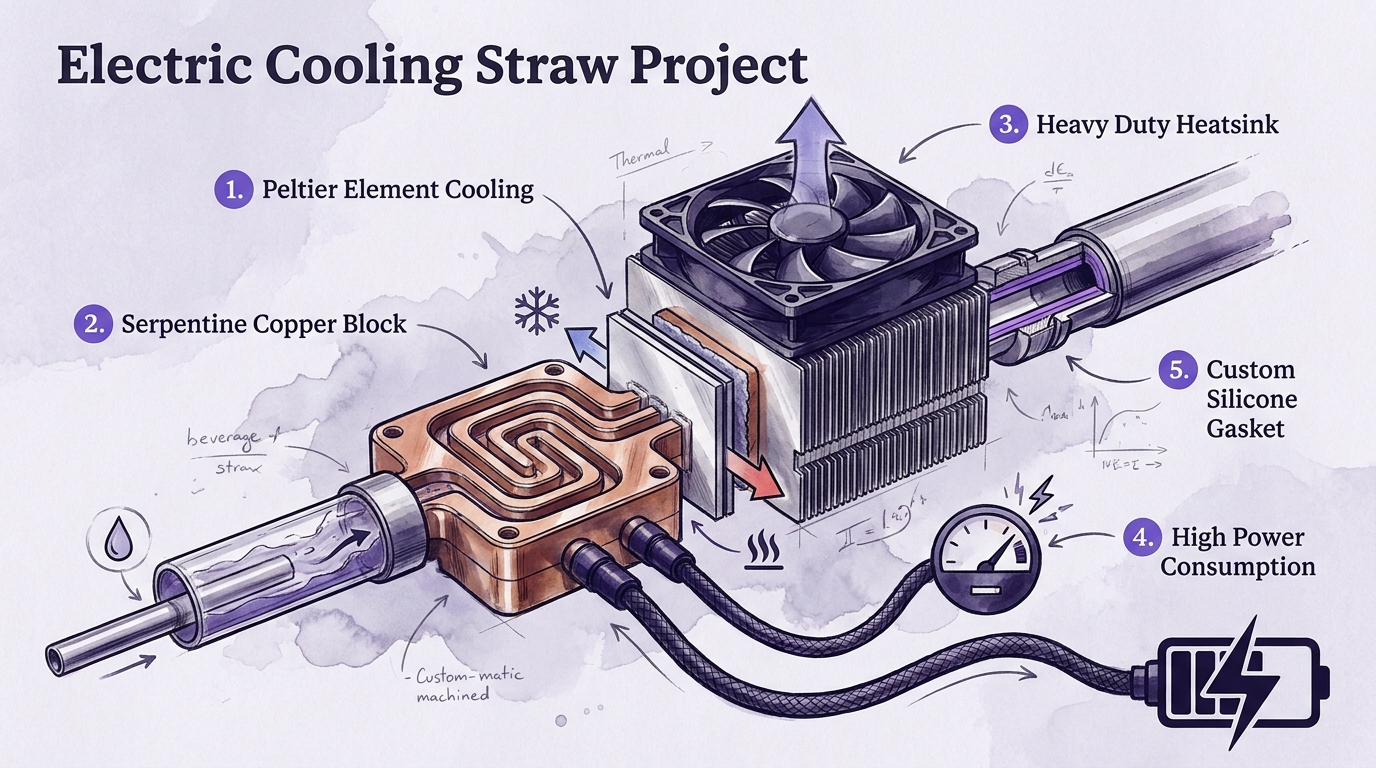
In an ambitious DIY engineering project, the creator sets out to build an active, battery-powered cooling straw that chills drinks in real time as liquid passes through it. By custom-machining a serpentine copper block, mounting thermoelectric Peltier elements, and upgrading to massive heatsinks and high-powered fans, he manages to drop liquid temperatures well below freezing. Although the resulting prototype is far too bulky and power-hungry for commercial production, it successfully proves the real-time drink-cooling concept in a field test.

Key takeaways
- 30:29Peltier elements require extreme heat dissipation on their hot side; without powerful active cooling, thermal equilibrium quickly ruins the cold side
- 40:06High-flow air cooling and heavy-duty CPU heatsinks are essential to handle hundreds of watts of thermal energy needed to instantly chill flowing liquid
- 42:15Over-volting small electronic components like fans beyond their rated limits can lead to catastrophic failure and exploding capacitors
- Portable instant-cooling straws remain commercially impractical due to massive power consumption, limited battery life, and high bulk
Tap to enlarge
Most valuable section
For whom
DIY builders, hardware hackers, and curious engineers interested in thermal management experiments.
Extreme Cooling & Explosive Overvolting40:06
This is the turning point of the project where massive CPU coolers and high-powered turbine fans are added, leading to sub-zero temperature drops and a dramatic capacitor explosion.
Detailed summary
1. Concept & The Peltier Effect
0:00The creator introduces the ambitious goal of inventing a portable, battery-powered cooling straw that can instantly chill beverages as they are drawn through. Traditional solutions like reusable frozen straws decay quickly in performance and lack portability, so he explores thermoelectric Peltier elements that create an extreme temperature differential when powered.
2. Machining the Copper Cooling Block
5:01To maximize thermal conductivity and surface contact with the passing liquid, a serpentine internal path is designed and machined out of a raw copper block using a CNC mill. The process requires precise metalworking, custom-tapped threads for stainless steel tubes, and manual hand-finishing.
3. Sealing and Leak Testing
15:04Attaching the stainless steel straw ends and top plate requires tapping multiple tiny holes and inserting a custom laser-cut silicone gasket. When initial vacuum tests reveal air and water leaks, traditional plumbing hemp and mechanical flattening of the copper housing are used to ensure a food-safe, watertight seal.
4. Thermal Management & Freezing Water
20:50Initial tests with basic thermal paste demonstrate that heat built up on the hot side of the Peltier module rapidly degrades cooling efficiency. After applying high-grade thermal compound and improving heatsink contact, the thermal camera captures a water drop freezing solid on the cold surface down to minus five degrees Celsius.
5. Initial Assembly & Heat Dissipation Issues
25:44The internal liquid channels, Peltier module, aluminum heat sinks, dual micro-fans, and insulation are assembled inside a prototype framework. However, thermal imaging reveals that small heat sinks cannot dissipate the intense thermal energy fast enough, causing heat to bleed back into the cold side within seconds.
6. Upgrading to a PC CPU Cooler
31:53Realizing that standard electronic heatsinks are insufficient, the builder adapts a heavy-duty computer CPU heatsink to handle the heat output. Initial tests with this configuration drop the cold side down to four degrees Celsius, proving that aggressive active cooling is required for liquid flow.
7. Extreme Cooling & Explosive Overvolting
35:38To handle higher current and reach sub-zero temperatures faster, a 18-watt turbine fan and a massive server-grade heatsink are installed. While pushing nearly 400 watts through the setup drops temperatures to minus 17 degrees Celsius, over-volting the fan circuitry leads to a sudden capacitor explosion.
8. Stabilizing the High-Power System
43:56After replacing damaged components and adjusting the voltage supply to safe parameters, the system successfully runs at roughly 300 watts without dangerous overheating. Thermal cameras confirm stable sub-zero operations while warm ambient water is drawn through the internal copper serpentines.
9. 3D-Printing the Enclosure
46:46With the cooling loop fully functional, a custom ergonomic housing is designed in CAD and printed on a 3D printer. Threaded brass inserts are heat-set into the plastic casing to securely mount the heavy battery, fans, and CPU cooler internal assembly.
10. Park Field Test & Final Evaluation
47:17The finished prototype is taken outside for a real-world test on warm beverages, successfully delivering eiskalt drinks within seconds of continuous sipping. Despite the functional success, the creator reflects on the practical drawbacks: the massive size, high battery consumption limit of three drinks, and extreme power requirements explain why commercial versions do not exist.
Questions this video answers
How does the active cooling straw freeze drinks instantly without ice?
The device uses a thermoelectric Peltier element mounted directly onto a custom-milled copper block with internal serpentine pathways. When electricity runs through the Peltier element, one side drops to sub-zero temperatures, transferring extreme cold into the copper channels to cool the liquid instantly as it is sucked through.
What main engineering challenges were encountered during construction?
The project faced several major hurdles, including snapping fragile taps inside the copper block, achieving food-safe watertight seals across custom fittings, and managing the intense heat produced on the Peltier's warm side. Standard heatsinks failed, requiring massive CPU coolers and high-wattage fans to prevent the system from overheating.
Why aren't battery-powered cooling straws sold commercially?
The physics of real-time cooling require massive amounts of energy—around 300 to 400 watts—which requires heavy heatsinks, high-speed turbines, and large batteries. A portable setup of this power level currently only lasts for about three full drinks before draining the battery, making it unfeasible as a everyday compact product.
Ask a follow-up Premium
About this summary
SumTube AI wrote this recap from the video's words and chapters. Credit and the original belong to Tomary.