
Free AI summary of this YouTube video by SumTube
Eigene Sauna ins Wohnzimmer bauen!
TL;DR
In this video, a creator builds a custom, two-person indoor sauna from scratch to fit a tight alcove in his apartment. He details the step-by-step construction process—from building a mobile base and timber frame to installing insulation, a vapor barrier, wood panelling, and a standard socket-powered electric heater. He finishes by testing its performance, monitoring temperature and humidity levels, and breaking down the total project costs.

Key takeaways
- 16:58A standard household electrical outlet (230V) can power a 3.5 kW sauna heater, heating a small custom-built indoor cabin up to 80–90°C.
- 18:48Custom DIY sauna builds can easily double initial budget estimates once specialized materials like sauna doors, heat-resistant silicone cables, and quality timber are factored in
- 18:01Proper insulation, a complete vapor barrier, and adequate ventilation space behind the unit prevent humidity and heat from damaging surrounding apartment walls
Tap to enlarge
Most valuable section
For whom
DIY enthusiasts and apartment dwellers looking to build a custom indoor sauna on a limited footprint.
Testing the finished sauna15:05
This segment shows the real-world performance, showing how quickly the tiny sauna reaches 80°C and proving the effectiveness of the thermal insulation and vapor barrier.
Detailed summary
1. Concept and Design Plan
0:00The creator introduces the health benefits of regular sauna use, including reduced risks of stroke and dementia, and outlines his plan to build an affordable two-person sauna inside his apartment. Facing space, budget, and electrical constraints, he sets out to build a compact unit that operates off a standard household power outlet.
He uses 3D design software to map out the dimensions, ensuring the structure fits under a sloping attic ceiling. After ordering timber, insulation, and sauna accessories online, the team picks up the materials from a hardware store and transports them back to the workshop for pre-cutting.
2. Building the Rolling Base
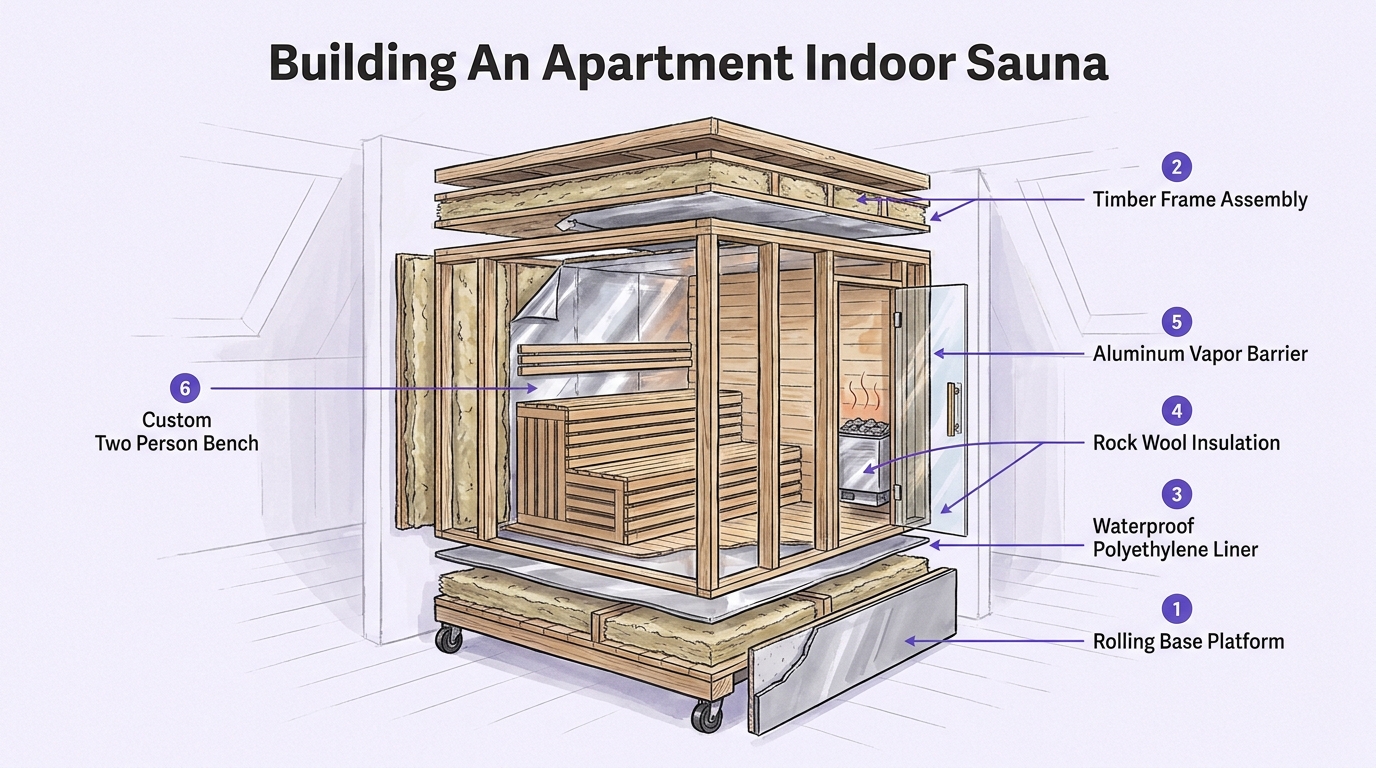
3:08Construction begins with assembling the wooden base platform. Heavy-duty caster wheels capable of supporting up to 800 kg are installed on the underside, allowing the entire sauna structure to be moved easily within the apartment.
After testing the platform's load capacity, rock wool insulation is cut and fitted into the base frame. A protective cover panel is nailed over the insulation to prevent dust and fibers from escaping into the room.
3. Assembling the Timber Frame
5:01The wall frames are assembled out of timber studs, pre-drilled, and screwed together on the floor before being uprighted onto the mobile base. The heavy glass sauna door is positioned into the front frame to ensure precise alignment.
Once the main frame is anchored, a sturdy top frame is added to square off the structure. This structural top panel helps pull the front wall into alignment, allowing the magnetic door latch to seal properly.
4. Flooring, Waterproofing, and Outer Cladding
7:05To protect the apartment floor from moisture and water spills during steam sessions, a waterproof polyethylene liner is installed at the bottom, creating a sealed tray capable of holding liquid. Thin wooden battens secure the liner along the lower interior frame.
Next, tongue-and-groove wooden planks are installed along the exterior walls using stainless steel screws. The outer cladding gives the structure its finished cabin appearance while reinforcing the overall frame stability.
5. Thermal Insulation and Vapor Barrier
10:04Work moves to the interior where rock wool insulation mats are fitted into the wall cavities and ceiling frame using adhesive spray. Wearing protective gear, the creator ensures every gap is filled to maximize heat retention.
An aluminum-backed paper vapor barrier is applied over the insulation across all internal walls and the ceiling. Heavy-duty aluminum tape is used to seal every seam and screw hole, creating an airtight thermal envelope.
6. Interior Wood Panelling and Bench
11:31Wooden spacer battens are attached over the vapor barrier to allow proper air circulation behind the interior walls. Tongue-and-groove timber boards are then installed over the battens across the walls and ceiling.
A custom wooden bench measuring 1.2 meters is built to fit two people comfortably. Additionally, a removable wooden floor grate is crafted to sit over the waterproof tray, making future cleaning straightforward.
7. Heater Installation and Electrical Setup
14:17A 3.5 kW electric sauna heater is mounted on the interior wall at an optimal height. A certified electrician connects the heater using heat-resistant silicone cable capable of handling temperatures up to 170°C, routed safely to a standard wall socket.
Sauna stones are rinsed to remove dust and packed into the heater element. A thermometer/hygrometer is mounted on the inner wall, and the heater is turned on for its initial test run.
8. First Heat Test and Performance Analysis
15:05During the first test, the temperature reaches 60°C in 40 minutes and climbs to 80°C within 1.5 hours. Thermal imaging reveals that the insulated walls retain heat effectively with minimal external surface warming, though the glass door allows some heat loss.
The creator tests water steam infusions on the hot stones, confirming that humidity rises as intended. Post-session ventilation tests show that ambient room humidity returns to baseline levels quickly after opening the door.
9. Cost Breakdown and 3-Month Long-Term Review
18:48The creator breaks down the total expenditure, revealing a final cost of €2,060—roughly double the initial €1,000 estimate—primarily due to wood prices, the glass door, and electrical components.
After three months of regular use (3–5 times per week), the sauna remains fully functional and structurally sound. The creator concludes with minor design adjustments, such as adding a small fan for air circulation, and reflects positively on the build.
Questions this video answers
Can you build a sauna that plugs into a regular power outlet?
Yes, a 3.5 kW sauna heater can run on a standard 230V household socket without requiring a high-voltage connection. This provides enough heating power for a compact, insulated two-person indoor sauna.
Does an indoor apartment sauna cause mold or high humidity?
If properly constructed with an aluminum vapor barrier and insulated walls, humidity remains contained inside during use. Airing out the sauna after a session quickly normalizes indoor humidity levels without long-term moisture buildup in the room.
How much does it cost to build a DIY indoor sauna?
While initial estimates may aim below €1,000, high-quality timber, the glass door, insulation, electric heater, specialized wiring, and accessories brought the final cost of this project to approximately €2,060.
Ask a follow-up Premium
About this summary
SumTube AI wrote this recap from the video's words and chapters. Credit and the original belong to Tomary.