
Free AI summary of this YouTube video by SumTube
Echtes U-Boot selber bauen aus Brotbox! (+Kamera)
TL;DR
After suffering eye pain during a scuba diving attempt, the creator decides to construct a custom remote-controlled submarine using everyday components like a Tupperware container, power tool batteries, and a custom ballast system. Overcoming several leaks, buoyancy imbalances, and a failed membrane design, he successfully maneuvers the vehicle in a test pool with live camera feedback. Although a final structural seal failure under pressure eventually floods the electronics, the project demonstrates a functional prototype and sets the stage for a refined second version.

Key takeaways
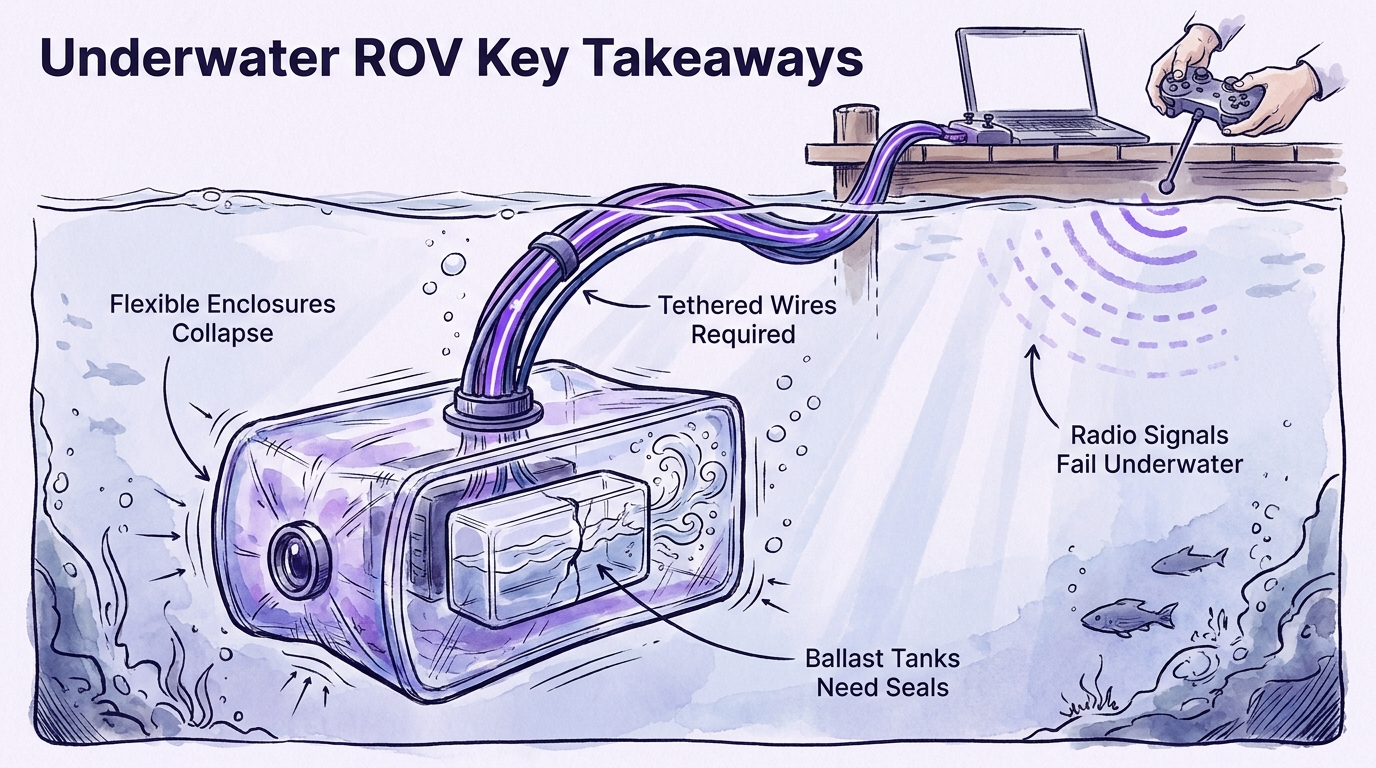
- 30:05Flexible enclosures like Tupperware collapse under water pressure, reducing volume and breaking buoyancy control
- 30:54Custom ballast tanks require precise pressure-resistant seals; simple clear plastic glued together easily fails deep underwater
- 11:52Tethered wired connections are essential for underwater ROVs because wireless radio signals do not penetrate water well
Tap to enlarge
Most valuable section
For whom
DIY mechanics and engineering enthusiasts interested in underwater ROV design and practical troubleshooting
Successful Underwater Drive with Live Camera Feed24:09
This segment shows the submarine fully operational, driving around the pool floor while transmitting a clear live video stream to the laptop cockpit.
Detailed summary
1. Motivation and Submarine Mechanics
0:00After experiencing severe eye pain at a depth of five meters while scuba diving, the creator abandons conventional diving and decides to build a remote-controlled submarine. He researches the basic engineering concepts behind submarines, focusing on ballast tanks, electric thrusters, and control surfaces. Because internal combustion engines cannot receive oxygen underwater, electric motors powered by cordless screwdriver batteries are selected for propulsion.
He gathers various components including silicone tubing, electric valves, Tupperware containers, epoxy resin, and a custom game controller for steering. To monitor the vehicle from above, a GoPro camera is wired to pass a live video feed to a laptop via a thin cable. This setup ensures continuous visual feedback without relying on wireless signals, which degrade quickly in water.
2. Constructing the Ballast Tank and Air Valve
3:43Building the ballast mechanism requires precise drilling into an acrylic and plastic container to connect intake and exhaust lines. The creator attaches custom fittings using epoxy adhesive while a CNC machine cuts additional structural components out of acrylic glass to keep the system sealed.
To power the pump and electronic valves, custom aluminum contacts are soldered onto power tool batteries. Initial dry tests confirm the electronics function without short-circuiting, allowing the pump to draw in and vent water reliably on command.
3. Solving the Buoyancy Vent Problem
7:21When attempting to pump water out underwater, the system runs into an airflow problem that risks creating a vacuum and collapsing the container. Initial tests with a carbon membrane fail to seal out incoming water when suction is applied.
After ordering specialized waterproof membrane components, the creator integrates a valve that allows air to vent outward without letting water enter. The updated assembly successfully submerged and passed pressure testing without taking on unwanted water.
4. Housing Electronics and Balancing Weight
10:44All internal components, including the camera, pump, and control circuit boards, are fitted into a Tupperware plastic box. To maintain waterproof integrity while routing control wires and air tubes, specialized sealed cable glands and custom aluminum plugs are installed through precise drill holes.
Since the submarine housing displaces about 2.4 liters of water, it requires precise weight distribution to achieve neutral buoyancy. Lead weights are added inside the hull to bring the overall mass up to roughly 2.4 kilograms so the submarine floats just barely above the surface when empty.
5. Initial Pool Testing and Waterproofing Repairs
16:40The submarine undergoes its first full submersion test in a swimming pool to check for leaks and proper diving mechanics. While the vehicle initially sinks when filling its ballast tank, it tilts heavily and slowly starts taking on water inside the main compartment.
The creator retrieves the electronics before damage occurs and uses a vacuum pump with soapy water in the workshop to locate the leak. Tightening loose structural screws restores the seal, preparing the submarine for the addition of external propulsion thrusters.
6. Adding Thrusters and First Driven Tests
20:09To give the vehicle mobility, two powerful electric thrusters are mounted to the sides of the Tupperware hull using 3D-printed adapter plates. The motor cables are sealed into flexible tubing filled with epoxy resin before entering the main enclosure.
In the pool, the newly motorized submarine demonstrates impressive speed and maneuverability. The ballast tank successfully submerges and resurfaces the craft while the dual motors allow full directional control across different speed levels.
7. Live Camera Mission and System Failure
24:09The ultimate test combines speed control, dynamic diving, and a live video transmission from the internal camera back to the operator's laptop station. The vehicle navigates the bottom of the pool smoothly, providing clear footage of underwater obstacles and stable depth holding.
During high-speed deep runs at two meters depth, the flexible Tupperware enclosure deforms under water pressure, reducing buoyancy control. Shortly after, the internal ballast tank ruptures and floods the main electronics chamber, bringing the test to a halt.
8. Post-Mortem and Future Improvements
31:40Reflecting on the prototype's performance, the creator outlines key engineering upgrades needed for version two. These include using a rigid housing that will not deform under water pressure, an opaque and stronger ballast tank, and externally adjustable trim weights.
Despite the final electronic short-circuit, the test proved the core ballast and propulsion principles work effectively, laying the groundwork for a more durable future iteration.
Questions this video answers
Why did the creator build a custom remote-controlled submarine?
He experienced severe eye pain from underwater pressure at a depth of 5 meters while scuba diving, preventing him from diving deeper. Instead of giving up on underwater exploration, he decided to build a remote-controlled submarine to explore under water safely.
How does the submarine control its depth and buoyancy?
The submarine uses an internal ballast tank equipped with a pump and an electronically controlled valve to draw in or expel water. Filling the tank makes the vehicle heavier so it sinks, while pumping the water out makes it lighter to float back up.
What caused the submarine to flood during its final test run?
The clear plastic ballast tank ruptured under pressure and flooded the internal electronic housing. Additionally, the flexible Tupperware shell deformed under water pressure at greater depths, negatively affecting its displacement.
Ask a follow-up Premium
About this summary
SumTube AI wrote this recap from the video's words and chapters. Credit and the original belong to Tomary.