
Free AI summary of this YouTube video by SumTube
Dragonflies Are Not What You Think
TL;DR
Dragonfly nymphs are formidable freshwater predators that use advanced biological mechanisms to hunt and navigate underwater. Their unique anatomical features include a hydraulic jet-propulsion system for respiration and rapid escape, an asymmetrical tri-leaflet rectal valve that controls fluid dynamics, and a catapult-like labial mask that strikes prey at incredible speeds. Understanding these complex adaptations provides valuable insights into fluid mechanics and offers potential bio-inspired applications, such as improving human prosthetic heart valves.
Key takeaways
- Dragonfly nymphs use rectal ventilation for both breathing and high-speed underwater jet propulsion
- 8:17The nymph's asymmetrical tri-leaflet valve creates jet vectoring that refreshes water around its gills during respiration
- 13:53The prehensile labial mask uses a dual-catapult mechanism to strike prey in as fast as 15 milliseconds
- Studying the nymph's adjustable tri-leaflet valve could help design more effective, tailored prosthetic human heart valves
Most valuable section
For whom
Anyone interested in biomechanics, evolutionary biology, and nature-inspired engineering.
It features detailed high-speed camera footage and 3D biomechanical animations demonstrating how the nymph's spring-loaded jaw catapults forward to capture prey in milliseconds.
Detailed summary
1. Introduction to the Dragonfly Nymph
0:00Dragonfly nymphs are among nature's most sophisticated aquatic predators, spending up to 90% of their lives underwater before transforming into adult dragonflies. Equipped with compound eyes, specialized body types, and prehensile mouthparts, these nymphs dominate freshwater ecosystems by preying on smaller creatures with incredible precision.
Beyond their hunting prowess, nymphs possess complex mechanical systems at both ends of their bodies. Their hydraulic propulsion and breathing mechanisms have intrigued scientists for decades, revealing evolutionary adaptations that rival modern engineering.
2. Life Cycle and Nymph Types
2:11The dragonfly life cycle begins in fresh water, where eggs hatch into pro-larvae that immediately molt into active nymphs. Throughout their developmental phase, which can last from months to several years, nymphs undergo up to 15 molts—significantly more than most insects.
Nymphs adapt to diverse aquatic habitats and are grouped into four main ecological categories: claspers, sprawlars, hiders, and burrowers. Burrowing species feature extended abdominal structures known as 'tube butts' that function like snorkels to maintain water intake for respiration while buried in silt.
3. Rectal Ventilation and Jet Propulsion
4:58Nymphs practice rectal ventilation, drawing fresh water into an internal branchial chamber to supply their rectal gills with oxygen. In low-oxygen environments, they can stick the tip of their abdomen out of the water to absorb atmospheric oxygen directly.
This same rectal chamber powers a unique hydraulic jet-propulsion system. By compressing abdominal muscles and forcing pressurized water out through the anal valve, the nymph propels itself forward at high speeds to escape predators.
4. The Mechanism of Jet Vectoring
6:09Researchers at Cornell University studied the nymph's rectal valve, which features a tri-leaflet structure similar to human heart valves. High-speed fluid dynamics analysis revealed that the valve opens asymmetrically to control the direction and shape of the ejected water jet.
This fluid redirection creates an entrainment effect, drawing surrounding water into the jet stream. By deflecting the exhaust during normal breathing, the nymph accelerates fluid turnover around its body, ensuring a constant supply of fresh, oxygenated water while staying stationary.
5. Applications for Human Heart Valves
10:02The asymmetrical control demonstrated by the dragonfly nymph's rectal valve offers a compelling model for medical technology. Current prosthetic heart valves are rigid and uniform, which can cause turbulent blood flow, vascular damage, and blood clots.
By designing artificial heart valves capable of dynamic leaflet control inspired by dragonfly nymphs, engineers hope to create custom-fit prosthetics that mimic natural blood flow and reduce long-term medical complications.
6. The Catapult Mask
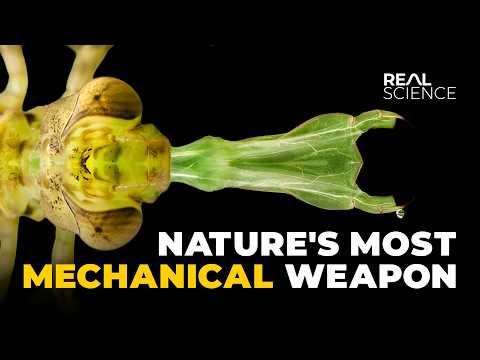
13:53At the front end, the nymph possesses a hinged lower lip called the labial mask, armed with pincer or spoon-shaped palps. Specialized internal structures—the premental and postmental catapults—store elastic strain energy in T-rods and sclerites prior to striking.
When unlocked, the mask snaps forward in 15 to 40 milliseconds, capturing prey without moving the rest of the body. Once locked on, the palps maneuver the prey into the chewing mandibles with precise dexterity.
7. Simultaneous Jetting and Recoil Prevention
15:34High-speed footage reveals that many dragonfly nymphs discharge a small jet of water from their rear at the exact moment they fire their labial mask forward. Unchecked, the explosive forward strike of the heavy mask would create a Newton's third law recoil, pushing the nymph backward.
The simultaneous rearward water discharge counteracts this forward momentum recoil, stabilizing the nymph's position on the substrate so it can land its strike cleanly.
8. Metamorphosis and Eclosure
16:15Unlike insects that undergo complete metamorphosis with a pupal or chrysalis stage, dragonflies experience hemimetabolous development. The transformation into an adult occurs internally during the final larval instar while the nymph remains active and hunting.
When ready, the nymph crawls out of the water onto vegetation for eclosure. Internal fluid pressure splits the larval exoskeleton along the thorax and head, allowing the soft adult dragonfly to pull itself out, expand its wings with hemolymph, and harden before taking flight.
Questions this video answers
How do dragonfly nymphs breathe underwater?
Dragonfly nymphs undergo rectal ventilation, pulling oxygenated water into their rectal chamber to extract oxygen via internal rectal gills. If water becomes low in oxygen, they can extend their abdomen above the water's surface to breathe atmospheric air.
How does a dragonfly nymph's labial mask work?
The labial mask is an extended lower lip equipped with premental and postmental catapult mechanisms that store elastic energy. When triggered, the joint unlatches and propels the mask forward in milliseconds to snatch prey with specialized palps.
How could dragonfly nymphs inspire improvements in human medicine?
The nymph's tri-leaflet valve allows for dynamic control of fluid flow through jet vectoring, similar to human heart valves. Researchers believe this mechanism could inspire adjustable prosthetic heart valves tailored to individual patients, reducing complications like blood clots.
Ask a follow-up Premium
About this summary
SumTube AI wrote this recap from the video's words and chapters. Credit and the original belong to Real Science.