
Free AI summary of this YouTube video by SumTube
Documentation aéronautique
TL;DR
This video presents the structure and standard classification of technical documentation used for aircraft maintenance and repair, governed by the ATA 100 system. It details the main manuals and directives—such as the AMM, IPC, TSM, CMM, WDM, SRM, MTC, Service Bulletins, and Airworthiness Directives—and explains how they guide technicians to ensure flight safety.

Key takeaways
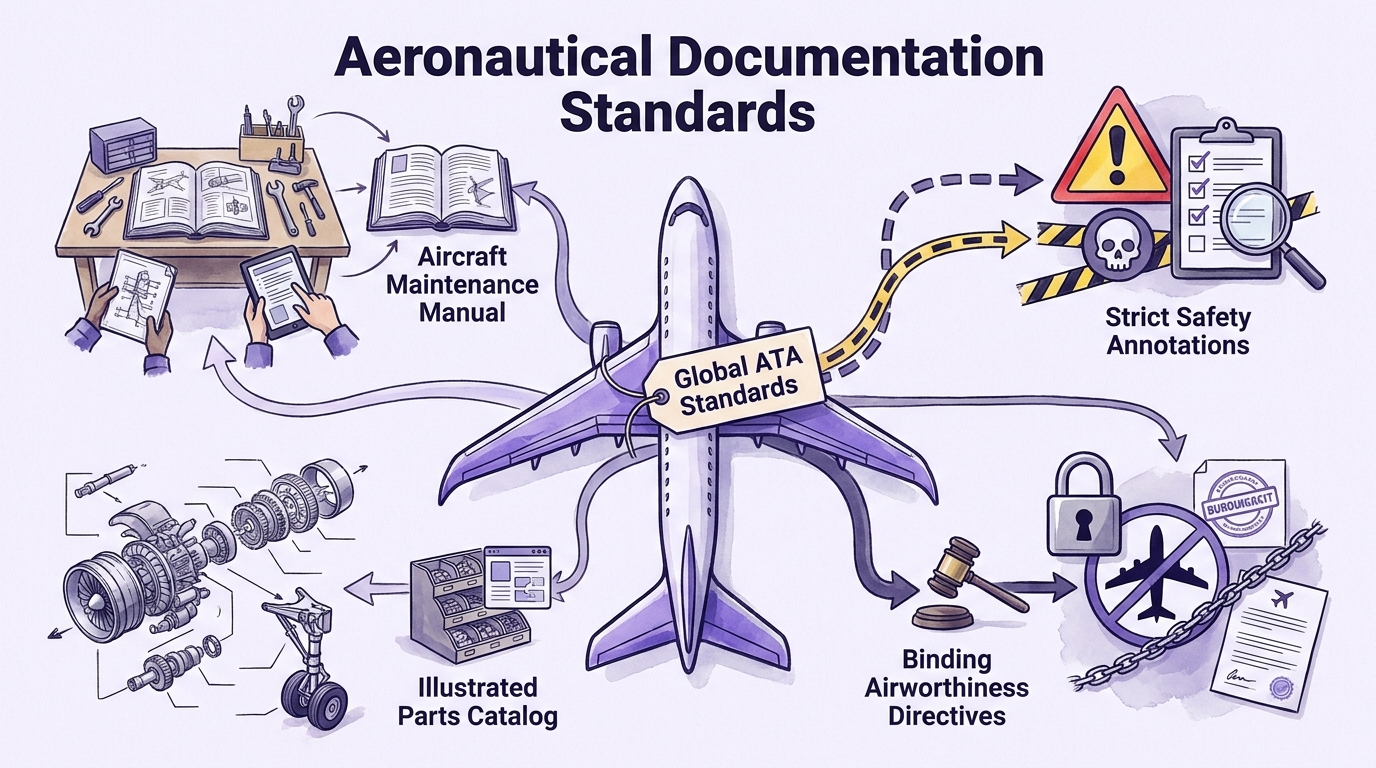
- 0:26The ATA 100 system, established in 1956 and updated through iSpec 2200, standardizes aircraft system numbering across the global aerospace industry
- 10:29Safety annotations in job cards strictly separate fatal risks (Warnings) from equipment damage risks (Cautions) and procedural tips (Notes)
- 30:25Airworthiness Directives (ADs) and Imperative Service Bulletins are legally binding, where non-compliance immediately grounds the aircraft
Tap to enlarge
Most valuable section
For whom
Aeronautical engineering students and newly certified aircraft maintenance technicians needing a clear breakdown of technical manuals.
Manuel de maintenance de l'aéronef (AMM)7:26
It clearly demonstrates how ATA numbering translates into practical job cards, complete with crucial safety warning hierarchies (Warning, Caution, Note).
Detailed summary
1. Introduction to Technical Documentation
0:00Aircraft maintenance and repair operations require rigorous technical documentation to guide technicians through complex procedures. Over time, these documents have been structured into standardized manuals to streamline maintenance tasks and improve operational efficiency across the aviation industry.
2. Standard ATA 100 & History
0:21The ATA 100 standard was first introduced in 1956 by airline technical publishers to unify aircraft maintenance documentation. Before its adoption, manufacturers used disparate manual structures, making maintenance less efficient. The standard has evolved into ATA iSpec 2200 to accommodate digital formats and modern industry practices.
Under ATA 100, numerical codes represent specific aircraft zones and systems. For instance, codes 20 through 50 cover aircraft systems, 51 through 57 cover structural components, 60 through 67 cover propellers and rotors, and 71 through 83 cover powerplant systems.
3. Evolution of Documentation Formats
5:01Aircraft documentation has continuously adapted to technological advancements over the decades. Originally distributed as physical paper manuals requiring manual update insertions, documentation shifted to CD-ROMs and eventually to real-time online web portals maintained by manufacturers.
Modern maintenance environments utilize online platforms with automatic updates, ensuring technicians always access current data. Augmented and virtual reality tools are also emerging to assist technicians during complex repair procedures.
4. Overview of Aircraft Manuals
5:46A comprehensive suite of manuals supports aircraft maintenance. Key manuals include the Aircraft Maintenance Manual (AMM), Illustrated Parts Catalog (IPC), Troubleshooting Manual (TSM), Component Maintenance Manual (CMM), Wiring Diagram Manual (WDM), Structural Repair Manual (SRM), and Standard Practice Manual (MTC).
Additionally, regulatory agencies and manufacturers issue Service Bulletins and Airworthiness Directives to mandate critical updates, safety checks, or structural modifications.
5. Aircraft Maintenance Manual (AMM)
7:26The Aircraft Maintenance Manual (AMM) serves as the primary reference for aircraft technicians, defining required maintenance tasks, schedules, and procedures. Tasks are categorized by ATA chapter, section, subject, and functional code (such as removal/installation).
Job cards in the AMM detail exact procedural steps alongside safety annotations categorized by severity: Warnings highlight conditions that could cause severe injury or death, Cautions mark potential equipment damage, and Notes emphasize key operational tips.
6. Illustrated Parts Catalog (IPC)
12:22The Illustrated Parts Catalog (IPC) enables maintenance personnel to identify, order, and track replacement parts. Structured by ATA chapters, the catalog contains detailed exploded-view diagrams paired with part numbers, part descriptions, vendor codes, and interchangeability data.
Component lists in the IPC use an indented sub-assembly hierarchy (up to seven levels deep). Ordering a top-level assembly automatically includes all nested sub-parts, whereas individual lower-tier parts can be ordered separately if needed.
7. Troubleshooting Manual (TSM)
17:16The Troubleshooting Manual (TSM) provides diagnostic procedures to isolate and resolve aircraft system faults. Available in print, CD-ROM, or online formats, it details system operations, potential fault causes, and step-by-step diagnostic workflows.
Troubleshooting guides are frequently structured as logic flowcharts or decision trees. These diagrams systematically lead technicians through checks and tests under the baseline assumption that all switches are on and circuit breakers are engaged.
8. Component Maintenance Manual (CMM)
20:31The Component Maintenance Manual (CMM) delivers off-aircraft maintenance instructions for specific components such as batteries or pumps. It consolidates elements of the AMM, TSM, and IPC tailored specifically to shop-level bench repairs.
While the main aircraft AMM covers removing and reinstalling a component on the airframe, the CMM provides the internal disassembly, testing, overhaul, and repair instructions required once the part is in the workshop.
9. Wiring Diagram Manual (WDM)
21:59The Wiring Diagram Manual (WDM) contains electrical schematics, harness routing, and connector data required to maintain and repair electrical and avionics systems. It serves as a key resource for electrical troubleshooting and technician training.
The WDM is divided into two primary sub-manuals: the Aircraft Schematic Manual (ASM), which provides high-level system logic diagrams, and the Aircraft Wiring Manual (AWM), which details physical wire connections, pinouts, and junction points.
10. Structural Repair Manual (SRM)
23:38The Structural Repair Manual (SRM) outlines manufacturer guidelines for evaluating structural damage and performing approved field repairs. It covers key airframe sections including doors (ATA 52), fuselage (ATA 53), nacelles/pylons (ATA 54), stabilizers (ATA 55), windows (ATA 56), and wings (ATA 57).
Each section provides structural component identification, allowable damage limits, and standardized repair procedures. If damage exceeds published limits or is unlisted, technicians must directly contact the manufacturer for engineering authorization.
11. Standard Practice Manual (MTC)
26:40The Standard Practice Manual (MTC) defines standardized shop procedures, techniques, and tooling methods applicable across aircraft maintenance. It can exist as a standalone multi-volume set or as dedicated chapters embedded within the AMM, SRM, or CMM.
Topics covered in the MTC include safety wiring, pin locking methods, riveting techniques, torque wrench calibration and application, and the proper use of specialized chemical products like sealants, adhesives, and protective coatings.
12. Service Bulletins & Airworthiness Directives
28:32Service Bulletins (SBs) are issued by manufacturers to notify operators of product modifications, inspections, or improvements. If an SB addresses a critical safety issue, it is designated as an Alert SB, prompting aviation authorities to issue a mandatory Airworthiness Directive (AD).
Airworthiness Directives are legally binding regulations published by governing bodies such as EASA or the FAA. Compliance within specified deadlines is mandatory, and failure to perform required actions results in the immediate grounding of the affected aircraft.
Questions this video answers
What is the ATA 100 standard in aviation maintenance?
The ATA 100 standard is a universal numbering and categorization system developed by airline technical publishers to organize aircraft maintenance documentation. It assigns specific numerical codes to aircraft systems, structural components, rotors, and powerplants, ensuring consistency across different manufacturers and operators.
What is the difference between an AMM and a CMM?
The Aircraft Maintenance Manual (AMM) covers maintenance, inspection, and repair procedures performed directly on the aircraft itself. In contrast, the Component Maintenance Manual (CMM) provides detailed instructions for servicing, overhauling, and repairing individual components once they have been removed from the aircraft.
How do Airworthiness Directives differ from Service Bulletins?
Service Bulletins (SBs) are issued by aircraft or component manufacturers to recommend modifications, repairs, or inspections. Airworthiness Directives (ADs) are mandatory regulations issued by aviation authorities; failure to comply with an AD within specified deadlines legally grounds the aircraft.
Ask a follow-up Premium
About this summary
SumTube AI wrote this recap from the video's words and chapters. Credit and the original belong to Pédro GONZALEZ.