
Free AI summary of this YouTube video by SumTube
Derita Pemerintah Daerah Dua Tahun Prabowo | Bocor Alus Politik
TL;DR
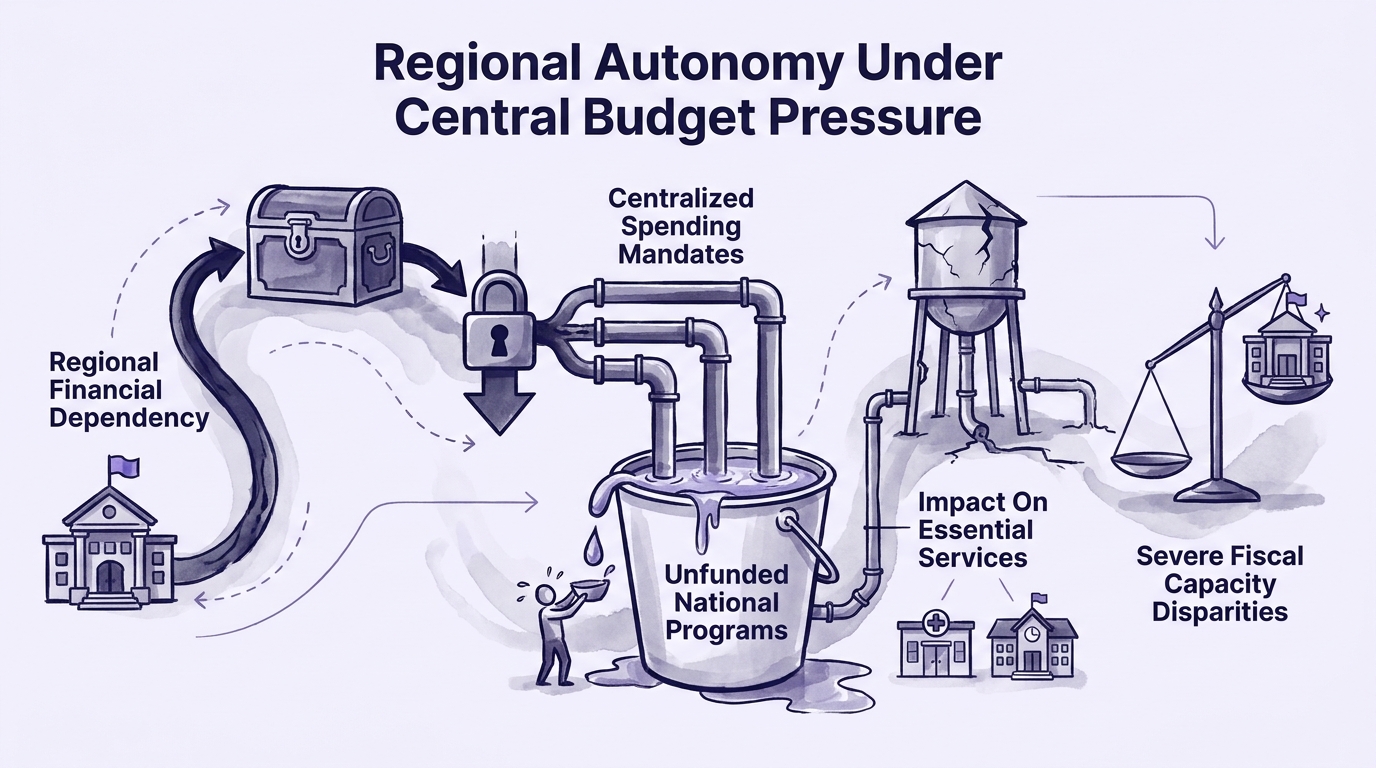
In this episode of Bocor Alus Politik, Tempo journalists discuss the state of regional autonomy and fiscal decentralization alongside Herman N. Suparman, Executive Director of KPPOD. They analyze how central government budget cuts to regional transfer funds (TKD) and Village Funds are crippling local infrastructure, healthcare, and education services, forcing local leaders to alter their original development plans.

Key takeaways
- 12:48Over 90% of Indonesian regions suffer from low fiscal capacity, making them heavily reliant on central transfer funds
- 19:05Centralized spending mandates treat regional governments as mere policy execution operators, violating true autonomy
- 28:13Budget cuts force local governments to shoulder unintended financial risks from national priority programs like Free Nutritious Meals (MBG)
Tap to enlarge
Most valuable section
For whom
Policy analysts, local government officials, and citizens interested in fiscal decentralization and Indonesian regional governance.
Fiscal Capacity Disparities Across Regions12:48
This section breaks down stark official statistics showing how over 90% of Indonesian regions lack independent fiscal strength, exposing the structural vulnerability of current decentralization policies.
Detailed summary
1. Introduction & Special Edition Overview
1:58Tempo journalists Raymundus Rikang, Egi Adyatama, and Eka Yudha Saputra welcome guest Herman N. Suparman, Executive Director of KPPOD, for a special discussion on the state of regional autonomy. The hosts introduce the main focus of Tempo's special report examining central-regional relations, fiscal transfer cuts, and how local governance is affected under the current administration.
They preview key regional cases investigated by Tempo's field reporting network, highlighting growing dissatisfaction among governors, regents, and village heads who feel excluded from national policy discussions despite bearing the financial burden of execution.
2. Local Grievances Over Budget Reductions
4:18The discussion opens with real-world examples of how central budget cuts impact local communities. Eka shares field reports from Bengkulu, where a 12-kilometer agricultural road project ground to a halt after constructing only 3 kilometers because the village head had to pay out-of-pocket due to slashed Village Funds.
Egi describes conditions in Lombok where local tourism villages, previously dependent on village development allocations, are now lying dormant with neglected facilities. These cases demonstrate that budget cuts disrupt long-term local planning and strain local officials.
3. The Core Logic of Regional Autonomy
8:11Herman N. Suparman outlines the conceptual foundation of decentralization, emphasizing that local governments are constitutionally meant to govern according to local citizen priorities. Slashed central transfer funds fail to respect regional planning frameworks like RPJMD and RKPD, effectively overriding local autonomy.
Central government claims of increased funding to regions often mask the fact that those funds are strictly earmarked for central priority programs rather than local initiatives. This shifts regions from autonomous decision-makers into mere implementation branches for national agencies.
4. Fiscal Capacity Disparities Across Regions
12:48Herman presents Ministry of Home Affairs fiscal capacity map data showing that roughly 90% of Indonesia's 546 autonomous regions have low fiscal capacity. Out of 414 regencies, only Badung Regency in Bali maintains a strong fiscal standing due to its thriving tourism and service tax base.
The current Law on Financial Relations Between the Central Government and Regional Governments (UU HKPD) inherently favors service-oriented municipal bases over rural agricultural regencies. Slashed transfers therefore destabilize vulnerable regions while wealthier regions easily absorb the changes.
5. Impact on Public Healthcare and Education
14:08Egi details how budget reductions hit essential public services in Siak Regency, Riau, where local Puskesmas clinics ran out of basic laboratory reagents, forcing pregnant mothers to photocopy prenatal record books themselves. In education, the Siak regency government was forced to cancel school bus purchases and cut teacher incentives by up to 50%.
These cutbacks highlight how fiscal strain at the top degrades the quality of basic rights guaranteed to citizens, particularly in rural and frontier (3T) regions.
6. Regional Self-Reliance vs. Unfunded Mandates
19:05The panel discusses rare cases of village self-reliance, such as Ponggok Village in Klaten, which generates several billion rupiah annually through local eco-tourism and water spring management. However, Herman notes that local revenue generation does not excuse central financial retrenchment, as village development plans remain disrupted.
When central transfers are cut while mandatory spending requirements expand, local governments face 'unfunded mandates' where projects are required by national guidelines but lack the fiscal backing needed to deliver them.
7. Compromised Local Campaign Promises
26:12Raymundus Rikang shares insights from an interview with West Sulawesi Governor Suhardi Duka. Elected leaders enter office with specific campaign promises and five-year development agendas (RPJMD), only to find their budgets overhauled shortly after inauguration by central efficiency directives.
In West Sulawesi, planned regional incentive grants were canceled to align local spending with national priorities like the Free Nutritious Meals (MBG) initiative. Elected officials are forced to abandon their political mandates to cover central government policy directives.
8. Central Oversight and Policy Reforms
30:26The discussion covers responses from Deputy Home Minister Bima Arya Sugiarto, who defended transfer cuts as fiscal optimization measures designed to eliminate wasteful administrative spending like ceremonial events and excessive travel. Bima argued that regions still retain sufficient fiscal space if they restructure spending efficiently.
Herman responds by asserting that central supervision must move beyond procedural compliance toward outcome-based evaluation. Treating all regions with a one-size-fits-all administrative approach ignores local economic realities and worsens regional inequality.
Questions this video answers
How do central budget cuts affect local infrastructure and public services?
Central budget cuts directly reduce physical allocation funds (DAK Fisik) and village funds, halting vital local projects like agricultural road construction and public school transport. Basic public services like Puskesmas clinic supplies and teacher incentives are also severely compromised.
Why are most Indonesian regional governments fiscally weak?
Existing fiscal relations favor regions with strong service- and tourism-based economies like Badung Regency while penalizing agricultural or rural areas. Over 90% of local governments lack sufficient local revenue (PAD) and depend almost entirely on central transfers.
What is 'unfunded mandate' in the context of Indonesian decentralization?
An unfunded mandate occurs when the central government assigns priority national programs to regions without providing matching fiscal support. Local authorities are then forced to reallocate their own limited APBD budgets to cover central policy risks and operational costs.
Ask a follow-up Premium
About this summary
SumTube AI wrote this recap from the video's words and chapters. Credit and the original belong to Tempodotco.