
Free AI summary of this YouTube video by SumTube
Black Belt Goes UNDERCOVER As White Belt (In Japan)
TL;DR
A seasoned karate black belt goes undercover as a complete novice in a Tokyo karate class designed for tourists to test the quality and authenticity of tourist martial arts experiences. Throughout the lesson, he purposefully makes common beginner mistakes—such as wearing his gi incorrectly, asking for water breaks, and forming improper fists—to see how the instructor handles them. The video concludes with a full-contact sparring session where the instructor reveals he recognized the host all along, praising the authentic teaching quality of the experience.

Key takeaways
- 0:31The undercover experiment highlights how authentic Japanese karate classes adapt for tourist beginners while maintaining core technical standards
- 2:13Posing as a beginner reveals an instructor's patience and ability to correct mistakes respectfully and effectively
- 20:00The final sparring session shows that true martial arts mastery combines humility, technical skill, and mutual respect
Tap to enlarge
Most valuable section
For whom
Martial arts enthusiasts, travel vlog fans, and anyone curious about authentic martial arts training in Japan.
Kumite Sparring & The Big Reveal20:00
The intense sparring session shifts from simulated beginner awkwardness to high-level martial arts action, leading right into the hilarious and heartwarming revelation that the sensei knew the truth the entire time.
Detailed summary
1. Introduction & The Undercover Plan
0:00The host introduces his plan to test tourist-targeted karate classes in Tokyo by going undercover as a complete beginner. Despite holding a black belt and practicing karate for over 20 years, he puts on a white belt to see if a former All-Japan Champion instructor can guide a novice through real fundamentals.
Before entering the dojo, he sets up a checklist of intentional mistakes to perform during the lesson, such as putting his uniform on incorrectly, confusing left and right footwork, forming improper fists, asking silly questions, and requesting improper breaks.
2. Arriving at the Dojo & Dressing Wrong
0:39The host arrives at the traditional Tokyo dojo and meets Sensei Ryo. Pretending to be an absolute beginner named Jesse, he claims his only martial arts background is watching UFC on TV. Sensei Ryo hands him a uniform and directs him to the changing area.
Inside the changing room, the host deliberately wraps his gi left-over-right, a tradition reserved for dressing deceased bodies in Japan. When he steps out, Sensei Ryo gently explains the cultural mistake and helps him tie his belt properly without any judgment.
3. Bowing Etiquette & Basic Stances
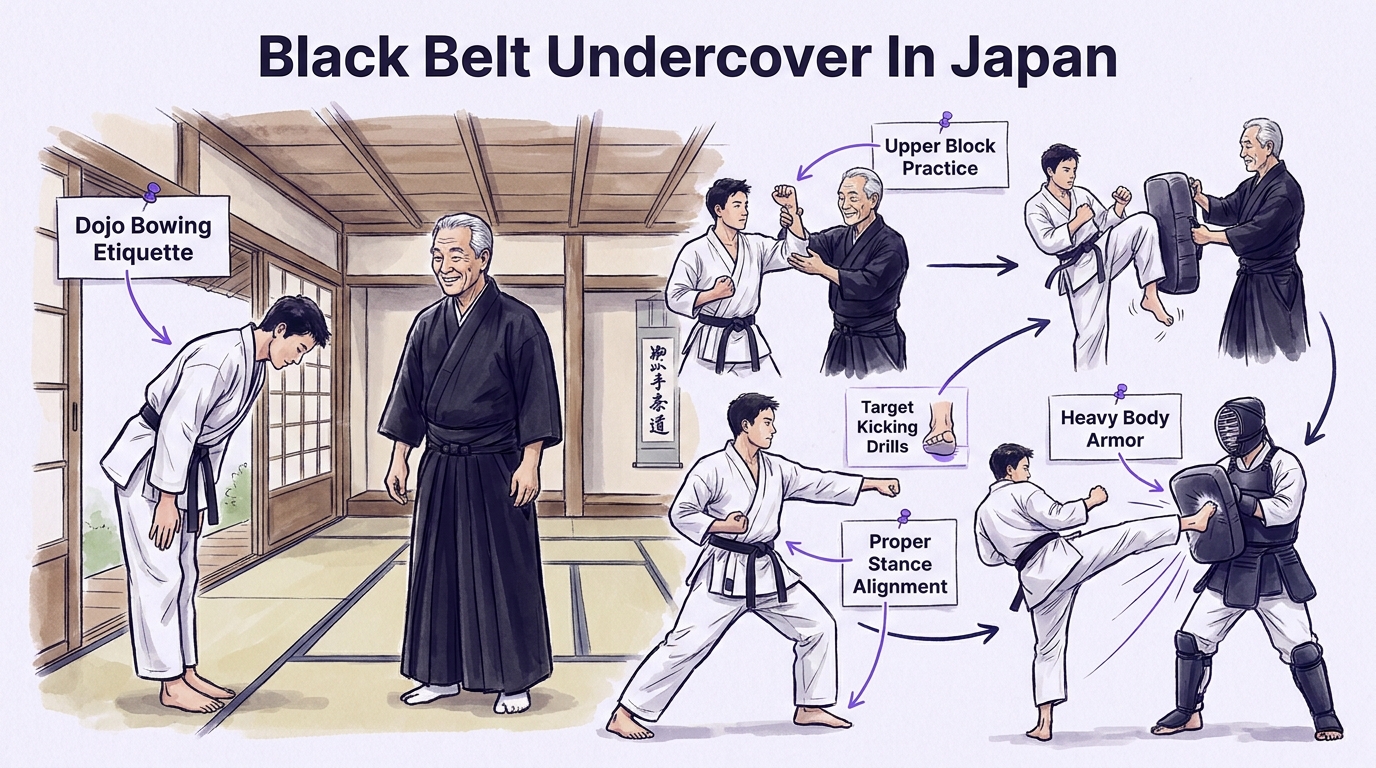
2:27The lesson begins with traditional bow etiquette (seiza). The host pretends his knees are too stiff to sit properly on the tatami mats, blaming gym workouts and Swedish heritage. Sensei Ryo accommodatingly adjusts the requirement and demonstrates the correct way to bow while keeping eyes forward.
Moving to basic stances, Sensei Ryo demonstrates proper foot alignment and lower-belly breathing. The host purposely mixes up his left and right foot placement, prompting the instructor to patiently guide his feet into the correct position.
4. Punching Technique & The Water Break
5:06After asking for an unconventional water break during basic stance practice, the host returns to work on basic punches (choku-zuki). Sensei Ryo explains how to focus power into the first two knuckles and breathe properly upon impact.
During upper-block practice (age-uke), the host intentionally forms an improper fist by tucking his thumb under his fingers. Sensei Ryo immediately notices the flaw and demonstrates why correct thumb placement is essential for wrist stability and safety.
5. Basic Kicks & Questioning Techniques
7:11Sensei Ryo transitions into basic kicking exercises, using knee-to-elbow mobility drills to activate the core. The host acts exhausted and questions whether these drills actually build fighting strength, which the sensei confirms enthusiastically.
The training escalates to target kicking with hand pads. Sensei Ryo demonstrates a spinning hook kick, prompting the host to ask why anyone would turn their back during a fight. The sensei shows competition footage to explain how timing and flow make turning attacks effective.
6. Pad Work & Core Kicking Drills
13:52Sensei Ryo puts on heavy body armor to practice full-power front kicks (mae-geri) and roundhouse kicks (mawashi-geri). He emphasizes driving force directly from the solar plexus rather than just swinging the leg.
The host attempts the kicks, deliberately hitting with the wrong part of his foot and pretending to twist his ankle. Sensei Ryo carefully checks his foot for injury, corrects his strike zone, and encourages him to try again safely.
7. Kata Demonstration & Application
15:28The instructor introduces kata, describing it as the foundational choreography of blocks, attacks, and stances in traditional karate. Sensei Ryo performs an advanced kata with speed and precision while the host watches in awe.
Instead of making the host learn an entire complex routine, Sensei Ryo extracts one self-defense application from the kata: a wrist grab counter combined with a takedown. The host practices throwing the instructor onto the mat, executing the technique surprisingly well.
8. Kumite Sparring & The Big Reveal
18:31The final portion of the class is a light sparring (kumite) session. Both put on protective gloves and shin guards. As the sparring begins, the host naturally slips back into his real high-level footwork, kicks, and combinations, leading to a fast-paced, impressive exchange between both fighters.
After the fight, Sensei Ryo presents the host with a completion certificate written with his real YouTube name, revealing that he knew who the host was the entire time. The video ends with mutual praise for the instructor's patience, humility, and genuine passion for teaching karate to travelers.
Questions this video answers
Why did the host go undercover as a karate beginner?
The host, a long-time karate practitioner and black belt, wanted to test the legitimacy and teaching quality of beginner-friendly karate classes offered to tourists in Tokyo. By wearing a white belt and pretending to have no experience, he evaluated whether the class provided authentic instruction or just a surface-level novelty.
What common beginner mistakes did the host intentionally make?
The host created a checklist of classic beginner blunders, including wearing his gi (karate uniform) backwards like a burial robe, mixing up left and right footwork, forming an incorrect fist with his thumb tucked inside, asking for unnecessary water breaks, and questioning basic techniques like turning one's back during a kick.
Did the karate sensei realize the student was actually an expert?
Yes, at the end of the lesson after the sparring session, the instructor revealed that he was already a fan of the host's YouTube channel and recognized him from the beginning. However, out of respect and humility, the sensei stayed in character to give him a genuine training experience.
Ask a follow-up Premium
About this summary
SumTube AI wrote this recap from the video's words and chapters. Credit and the original belong to Jesse Enkamp.