
Free AI summary of this YouTube video by SumTube
Biologi Kelas 10: Virus, Peranan Virus dalam Kehidupan
TL;DR
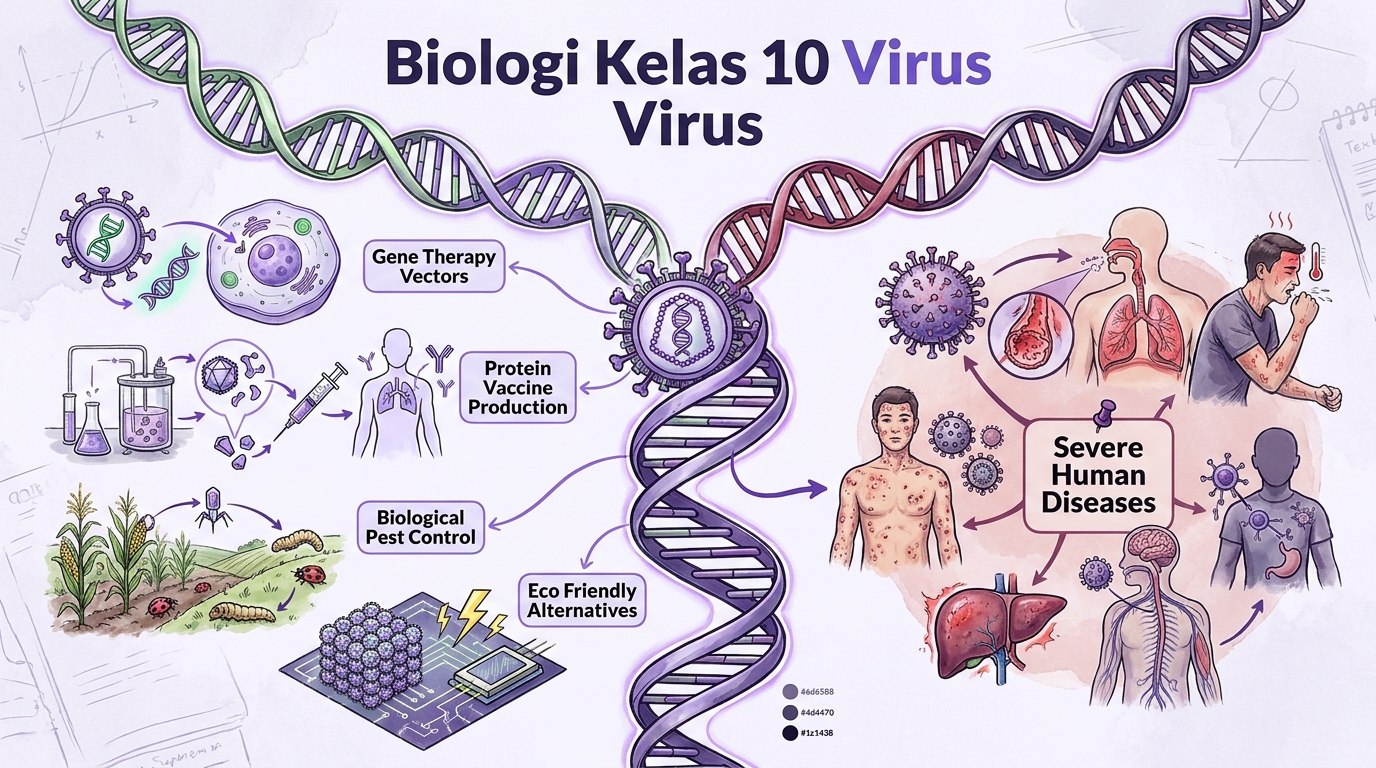
This educational video details the dual roles of viruses in nature and human society, covering both their beneficial applications and harmful impacts. It highlights how viruses are utilized in gene therapy, vaccines, biological pest control, and nanotechnology while also detailing the various viral diseases that affect humans, animals, and plants.

Key takeaways
- 1:44Viruses are key tools in modern medicine, functioning as vectors in gene therapy to treat genetic disorders like adenosine deaminase deficiency
- 13:43Beyond medicine, viruses serve as eco-friendly bio-insecticides against crop pests and act as structural components in nanotechnology
- 19:03Viral pathogens cause severe diseases across humans, livestock, and plants, significantly impacting global public health and agriculture
Tap to enlarge
Most valuable section
For whom
Biology students, educators, and anyone curious about biotechnology applications of viruses.
Beneficial Uses of Viruses1:44
It showcases how viruses can be harnessed for beneficial technological advancements, such as gene therapy and nanotechnology, shifting the common narrative that viruses are strictly harmful.
Detailed summary
1. Introduction to the Role of Viruses
0:00Viruses are widely recognized as infectious agents that cause disease across humans, animals, and plants. By invading living host cells, they can induce cell damage or cell death, leading to various health conditions.
Despite their harmful reputation, viruses also play beneficial roles in human life. Scientists utilize viruses in various innovative fields, making it essential to understand both their helpful and destructive capabilities.
2. Beneficial Uses of Viruses
1:44While most viruses cause disease, specific types can be harnessed to improve human welfare. These applications span medical treatments, agricultural safety, and advanced materials engineering.
Key beneficial uses include gene therapy for genetic disorders, protein vaccine manufacturing, biological treatment using bacteriophages to target bacterial infections, viral bio-insecticides for pest control, and viral scaffolds for creating nano-capacitors.
3. Gene Therapy and Viral Vectors
2:15Gene therapy involves introducing functional genes into host cells to replace defective or mutated genes. Viruses act as precise transport vectors to transfer these corrective genetic sequences through a process known as transduction.
Retroviruses are commonly used as gene therapy vectors due to their ability to convert RNA into double-stranded DNA using reverse transcriptase. This technique helps treat severe conditions like adenosine deaminase (ADA) deficiency, restoring crucial immune system functions.
4. Protein Vaccines and Biological Treatments
8:26Viruses contribute to vaccine manufacturing by utilizing viral capsids or envelopes containing specific antigenic proteins. These protein vaccines trigger protective antibody responses without allowing active viral replication inside the host.
In biological pest control and medicine, viruses like bacteriophages target specific pathogenic bacteria without harming human cells. Bacteriophages infect target bacteria, reproduce inside them, and lyse the bacterial cell walls, effectively controlling bacterial contamination.
5. Viruses as Bio-Insecticides and Nanotechnology
13:43Viruses offer eco-friendly alternatives to chemical pesticides. Baculoviruses selectively target crop-damaging insect larvae through ingestion, multiplying in the insect's gut cells and killing the pest without leaving toxic chemical residues.
In nanotechnology, viral particles with precise geometric shapes—such as cowpea mosaic viruses—are used to structure electrical energy storage devices called nano-capacitors when combined with iron elements.
6. Harmful Viral Roles and Human Viral Diseases
19:03The destructive nature of viruses is evident in their ability to infect host organisms and disrupt normal cellular function. In humans, viral infections cause diverse health problems ranging from mild skin lesions to acute respiratory distress and fatal systemic conditions.
Significant viral diseases in humans include mumps, herpes simplex types 1 and 2, smallpox, chickenpox, shingles, hepatitis strains A through E, influenza, measles, HIV/AIDS, polio, rabies, dengue fever, chikungunya, ebola, bird flu, SARS, and COVID-19.
7. Key Viral Infections: Mumps, Herpes, Smallpox, and Shingles
21:46Mumps is caused by paramyxoviruses affecting the salivary glands, while Herpes Simplex Viruses cause oral or genital lesions through direct contact. Smallpox (variola) induces pustular skin lesions, historically causing high mortality and permanent scarring.
Chickenpox and shingles are both caused by the varicella-zoster virus. Chickenpox represents the initial acute infection, whereas shingles arises later in life when the latent virus reactivates in the nervous system during periods of weakened immunity.
8. Severe Systemic Viruses: Hepatitis, Influenza, Measles, and AIDS
28:56Hepatitis viruses (types A, B, C, D, and E) cause liver inflammation and damage, transmitted through contaminated food, water, or bodily fluids. Influenza viruses infect respiratory tract cells, leading to seasonal epidemics characterized by fever, body aches, and respiratory distress.
Measles (morbilli) produces distinctive skin rashes and severe flu-like symptoms. HIV targets CD4+ T helper cells, weakening host immunity over time and resulting in Acquired Immunodeficiency Syndrome (AIDS).
9. Neurological, Oncogenic, and Vector-Borne Viral Diseases
37:17Poliovirus invades the central nervous system, leading to muscle weakness and paralysis, particularly in young children. Certain viruses exhibit oncogenic properties, such as Human Papillomavirus (HPV), which induces abnormal cell proliferation resulting in warts or cervical cancer.
Vector-borne viruses like Dengue and Chikungunya are transmitted through Aedes aegypti mosquito bites, causing high fevers, joint pain, and severe systemic illness. Ebola virus causes fatal hemorrhagic fevers with internal bleeding.
10. Pandemic Respiratory Viruses: Bird Flu, SARS, and COVID-19
44:10Highly pathogenic avian influenza (H5N1) originates in poultry but can mutate to infect humans, leading to severe pneumonia and high mortality rates. Severe Acute Respiratory Syndrome (SARS) is a coronavirus-induced respiratory disease causing fever, hypoxia, and acute lung injury.
COVID-19, caused by SARS-CoV-2, ranges from asymptomatic transmission to severe respiratory failure. The virus spreads via airborne droplets and poses high risk due to asymptomatic carriers who unwittingly transmit the infection.
11. Animal Viral Diseases
49:11Viruses also affect livestock and wild animals, causing severe economic and ecological damage. Rabies infects the central nervous system of mammals, leading to neurological symptoms and aggressive behavior before becoming fatal.
Foot-and-Mouth Disease (Aphthovirus) affects cloven-hoofed livestock, causing painful vesicles and reduced milk production. Newcastle Disease (NCD) affects poultry, while Rous Sarcoma Virus and Bovine Papillomavirus induce tumors in chickens and cattle.
12. Plant Viral Diseases and Summary
56:57Plant viruses disrupt agricultural production by infecting cash crops. Rice Tungro Bacilliform Virus (RTBV) causes stunting and yellowing in rice crops, transmitted by leafhopper vectors. Tobacco Mosaic Virus (TMV) causes mottled leaf discoloration and stunting in tobacco plants.
Tomato Yellow Leaf Curl Virus (TYLCV) causes curling leaves and reduced yield in tomato plants. In summary, viruses exhibit a dual nature, acting as both destructive pathogens across all domain kingdoms and powerful tools in scientific research and biotechnology.
Questions this video answers
How can viruses be beneficial to human health?
Viruses can be genetically modified to act as vectors in gene therapy, delivering functional genes to repair genetic defects such as adenosine deaminase deficiency. Additionally, viral protein coats are used to produce vaccines that stimulate immunity without causing active viral replication in the body.
How are viruses used in agriculture and pest control?
Certain viruses, such as baculoviruses, infect and destroy specific insect pests without harming the surrounding environment. They serve as safer bio-insecticides compared to conventional chemical pesticides, avoiding toxic side effects on human health.
What major human diseases are caused by viruses?
Viruses cause a wide array of human illnesses ranging from minor respiratory conditions like colds and influenza to severe, life-threatening diseases such as HIV/AIDS, COVID-19, Ebola, rabies, and hepatitis. They can also contribute to the development of specific cancers, such as cervical cancer caused by HPV.
Ask a follow-up Premium
About this summary
SumTube AI wrote this recap from the video's words and chapters. Credit and the original belong to Portal Sekolah.