
Free AI summary of this YouTube video by SumTube
Ball lightning explained?
TL;DR
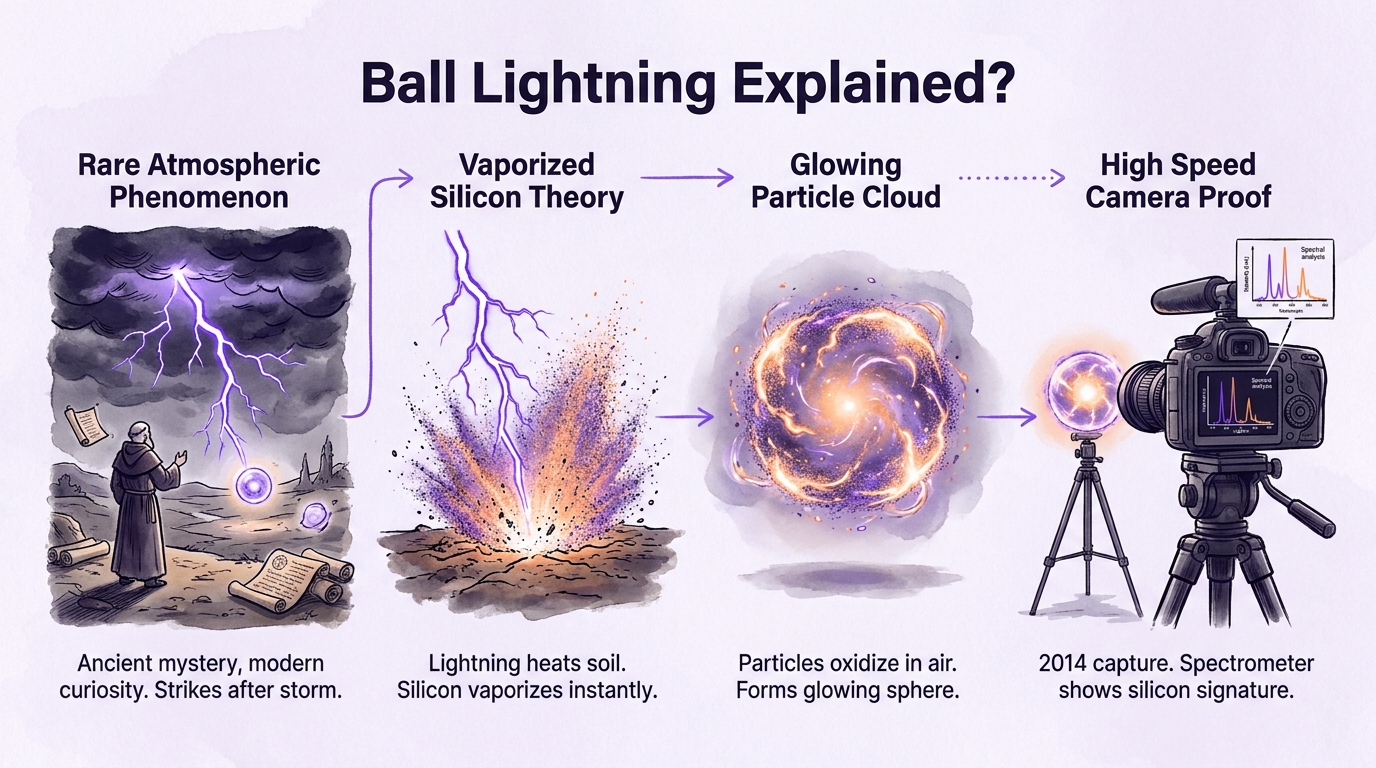
Ball lightning is a rare atmospheric phenomenon involving floating, glowing orbs that persist for up to a few minutes after a thunderstorm. Historical accounts date back centuries, but modern science points to a leading candidate theory: silicon vaporized by lightning strikes. This explanation gained significant support in 2014 when Chinese researchers accidentally captured ball lightning on high-speed video and spectrometer, revealing elemental spectral lines matching burning silicon.

Key takeaways
- 0:45The leading theory for ball lightning involves lightning striking soil, vaporizing silicon into an oxidizing, glowing nanoparticle network
- 2:09High-speed spectrometer footage from 2014 provided real-world evidence confirming the presence of burning silicon in ball lightning
- Because natural occurrences of ball lightning are so rare, scientists still lack enough direct observations to consider the silicon theory fully proven
Tap to enlarge
Most valuable section
For whom
Science enthusiasts interested in rare atmospheric phenomena and real-world scientific evidence
The Silicon Vaporization Hypothesis0:45
It breaks down the complex chemical and physical process of how normal lightning transforms soil into floating, glowing silicon nanostructures.
Detailed summary
1. History of Ball Lightning Observations
0:00Ball lightning has been documented for centuries, with early written records dating back to a 12th-century English monk and various historical texts over the following centuries. However, it was not until the mid-19th century that scientific interest grew, yielding consistent descriptions of glowing, feet-wide orbs floating near the ground during thunderstorms.
These luminous spheres typically travel at slow speeds—around 20 miles per hour—and stay within a few dozen meters of the ground before vanishing within a few minutes. Despite these historical accounts, the exact physical mechanism behind ball lightning remained a mystery for a long time.
2. The Silicon Vaporization Hypothesis
0:45The leading scientific candidate explaining ball lightning involves the vaporization of soil silicon. When a standard lightning bolt strikes ground high in silicon compounds, it vaporizes the soil. As the cloud cools, it forms a network of nanoscale particles held together in a sphere due to electric repulsion among charged particles.
This nanoparticle cloud is lightweight enough to float on ambient wind currents. As the silicon particles oxidize and burn in the air, they release intense heat and light, creating a self-sustaining glowing orb that resembles a light bulb.
3. 2014 Video and Spectrometric Proof
2:06In 2014, researchers from Northwest Normal University in China accidentally captured a natural ball lightning event using a high-speed camera paired with a spectrometer. This marked the first documented video recording of ball lightning where light emissions could be analyzed directly.
The resulting spectral analysis revealed emission lines unique to burning, oxidizing silicon. While lab experiments and this recording strongly support the silicon hypothesis, scientists still urge caution and require further direct observations to fully prove the theory.
Questions this video answers
What is ball lightning?
Ball lightning is a rare atmospheric phenomenon where a luminous, glowing orb roughly a foot in diameter floats low to the ground during a thunderstorm. It moves at slow speeds and usually lasts anywhere from a few seconds to several minutes before exploding or fading.
What causes ball lightning according to the leading scientific theory?
The most widely supported theory posits that a lightning strike vaporizes silicon compounds present in soil. As the vaporized silicon cloud cools, it forms a lightweight nanoparticle network held in a spherical shape by electrical repulsion, which glows brightly as the silicon oxidizes in the air.
Has ball lightning ever been recorded and scientifically analyzed?
Yes, in 2014, researchers in China accidentally filmed ball lightning with high-speed video equipment while studying a thunderstorm. They were able to run spectrometry on the light emission, discovering distinct spectral lines matching burning silicon.
Ask a follow-up Premium
About this summary
SumTube AI wrote this recap from the video's words and chapters. Credit and the original belong to Dr. Blitz.