
Free AI summary of this YouTube video by SumTube
Bài 4_P2
TL;DR
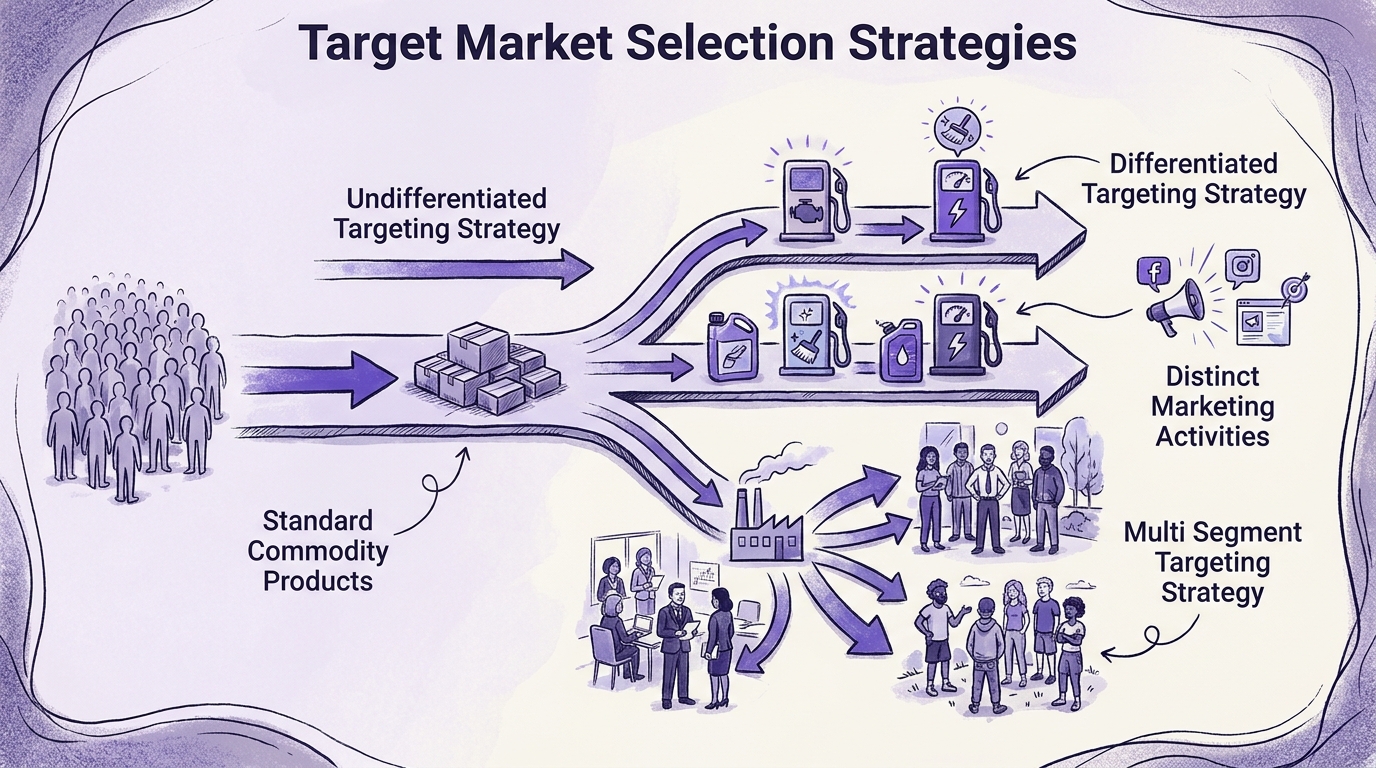
This video explains key target market selection strategies in marketing: undifferentiated, differentiated, concentrated, and multi-segment targeting. The lecturer outlines how companies tailor their marketing mix depending on product characteristics, market demands, and organizational capacity. The lesson also covers the pros and cons of multi-segment targeting, emphasizing revenue potential versus increased operational costs.

Key takeaways
- 0:45Undifferentiated targeting works best for staple commodity products like salt or sugar where consumers view competitors' offerings as identical
- 2:20Differentiated targeting relies on highlighting unique features that are meaningful to the majority of target consumers
- 5:21Multi-segment targeting expands reach and drives higher overall revenue, but requires significantly higher production and marketing investments
Tap to enlarge
Most valuable section
For whom
Marketing students and business strategists evaluating target market reach strategies
It breaks down the trade-off between driving higher sales through segment expansion and managing the elevated marketing and operational expenses required.
Detailed summary
1. Undifferentiated Targeting
0:05Undifferentiated targeting occurs when a marketer designs a single marketing mix for a specific product and applies it across the entire market. This strategy operates on the assumption that all buyers within the market share uniform needs and preferences for the product being offered.
This approach is commonly used for standard commodities like sugar and salt. Because consumers rarely perceive significant differences between competing brands of these staple items, a unified marketing effort is sufficient to cover the entire market.
2. Differentiated Targeting
1:40Differentiated targeting involves persuading consumers that a company's product is superior to competing alternatives. Marketers achieve this by emphasizing specific attributes and functional benefits that stand out to buyers during their decision-making process.
For example, in hard-to-distinguish categories like gasoline, marketers may highlight benefits such as engine protection, cleaning properties, or performance enhancements. To be successful, the chosen differentiating feature must carry real importance for the majority of target consumers.
3. Multi-Segment Targeting
2:35Multi-segment targeting involves delivering distinct marketing activities to two or more market segments simultaneously. This strategy is well-suited for businesses with surplus production capacity seeking to maximize their reach across varied customer bases.
While entering multiple segments boosts overall sales revenue and optimizes operational assets, it comes with trade-offs. Companies face increased production complexity and elevated marketing expenses associated with managing separate campaigns for distinct buyer groups.
Questions this video answers
What is undifferentiated marketing and when is it used?
Undifferentiated marketing involves applying a single marketing mix across the entire market under the assumption that all consumers have identical needs. It is most effective for commodity products such as sugar and salt, where buyers see little to no difference between competing brands.
How do companies differentiate products that seem identical?
For products like gasoline that appear identical to buyers, marketers highlight specific functional benefits, such as enhancing engine efficiency, boosting speed, or keeping fuel systems clean. The key requirement is that the differentiating feature must matter significantly to the majority of target consumers.
What are the advantages and risks of multi-segment targeting?
Multi-segment targeting allows companies to increase revenue by serving multiple distinct customer groups, making full use of excess manufacturing capacity. However, the downside is a substantial increase in production costs and marketing expenses tailored to each specific segment.
Ask a follow-up Premium
About this summary
SumTube AI wrote this recap from the video's words and chapters. Credit and the original belong to FPT Polytechnic PTCT.