
Free AI summary of this YouTube video by SumTube
Atlantis Left Its Technology in Egypt
TL;DR
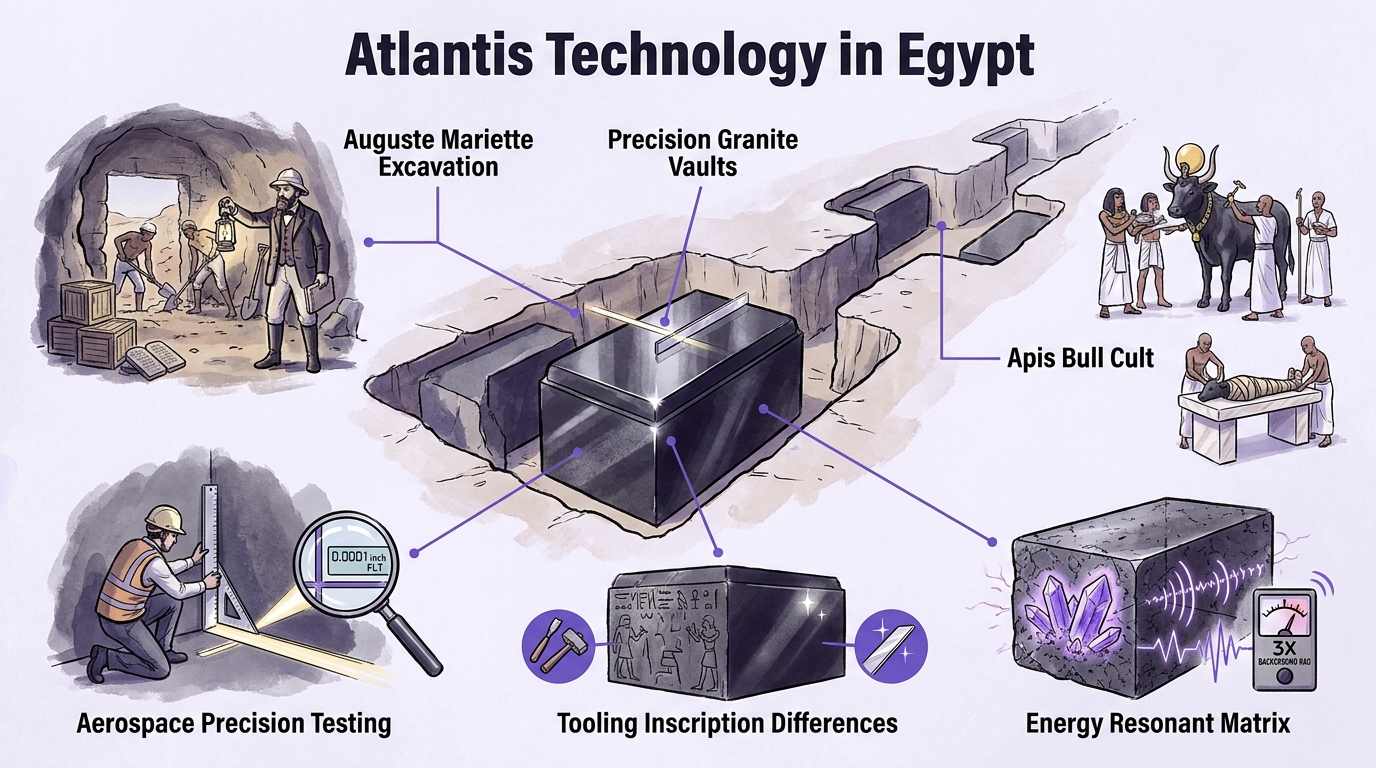
The Serapeum of Saqqara contains 24 massive, highly polished granite vaults whose precise construction and extreme flatness challenge traditional explanations of ancient Egyptian technology. This episode explores the discovery of these underground chambers, the technical anomalies surrounding their production and installation, and the alternative theories proposing they were energy devices created by an advanced pre-flood civilization.

Key takeaways
- 15:34The inner walls of the Serapeum granite boxes exhibit an extreme precision and flatness that modern aerospace engineers state would require heavy machinery to replicate
- 46:48The rough, shallow hieroglyphs carved into a few of the boxes contrast sharply with the mirror-polished surfaces, suggesting later dynastic Egyptians claimed pre-existing artifacts
- 18:31High quartz-content granite combined with acoustic resonance in the chambers suggests the site may have functioned as an energy or acoustic system rather than mere tombs
Tap to enlarge
Most valuable section
For whom
Enthusiasts of ancient mysteries, out-of-place artifacts, and alternative archaeological theories.
The Engineering Anomaly of the Granite Boxes18:01
This section provides detailed technical measurements from aerospace engineers demonstrating the inexplicable mathematical and physical precision of the granite vaults.
Detailed summary
1. Auguste Mariette's Secret Excavation in Saqqara
0:00In 1850, French archaeologist Auguste Mariette ventured into the desert of Saqqara, Egypt, after recognizing a stone sphinx head buried in the sand. Remembering descriptions from the ancient Greek geographer Strabo about an avenue of sphinxes leading to the lost Serapeum temple, Mariette diverted funds provided by the Louvre intended for buying religious manuscripts to hire local workers and secretly excavate the site.
To bypass strict oversight from Egypt's ruler, Abbas Pasha, Mariette orchestrated a covert operation. He created duplicate stone tablets to deceive inspecting officers while digging hidden shafts under cover of night. Over months of digging, his team unearthed hundreds of sphinxes, bronzes, and eventually breached a massive bedrock doorway that led into the underground vaults.
2. Discovery of the 24 Granite Vaults
13:14Crawling through a narrow breach into the rock-cut tunnels, Mariette discovered a series of massive chambers containing giant stone boxes. The main tunnel stretched over 600 feet long with recessed side rooms containing 24 gargantuan boxes carved from solid granite, each measuring up to 13 feet long and weighing nearly 100 tons with their lids.
The granite had been quarried in Aswan, nearly 600 miles away, transported down the Nile, and dragged across the desert before being maneuvered into tight underground chambers with minimal clearance. Intriguingly, nearly all the lids had been pushed aside, and despite the immense effort required to construct them, the boxes were found entirely empty.
3. The Cult of the Apis Bull
19:10Historical records indicate that for thousands of years, Egyptians worshipped a sacred black bull known as the Apis Bull at Memphis as a living incarnation of a god. The bull was identified by 29 specific sacred markings, served as Egypt's highest oracle, and was treated with royal honors throughout its life before being ritualistically buried upon death.
When an Apis bull died, the entire nation went into mourning, and priests preserved the animal on giant alabaster tables before wrapping it in gold and placing it in a subterranean vault. Mainstream Egyptology asserts that the Serapeum was constructed specifically as an underground necropolis to house these sacred animals.
4. Hieroglyphic and Tooling Discrepancies
44:00A major puzzle within the Serapeum is the dramatic quality difference between the boxes themselves and the inscriptions on them. Only four of the 24 granite boxes bear hieroglyphs, and these carvings are rough, shallow, and uneven—looking more like crude scratches compared to the mirror-smooth, precision-polished granite surfaces beneath them.
Because dynastic Egyptians possessed only soft copper chisels and stone hammers, which cannot effectively cut or polish hard Aswan granite, researchers argue that the crude hieroglyphic inscriptions were added thousands of years after the boxes were originally created by a far more technically sophisticated culture.
5. Precision Testing by Engineers
15:34Aerospace engineer Christopher Dunn conducted rigorous inspection tests on the interior walls of the granite boxes using calibrated steel straightedges and precision toolmaker squares. He discovered that the interior surfaces were flat to within a fraction of a thousandth of an inch, with perfectly square 90-degree corners that allowed zero light to pass through.
Subsequent testing by Egyptian engineer Ahmed Adly confirmed Dunn's findings, verifying that the internal geometry displayed flawless parallelism and right angles across massive spans. Modern stone fabricators confirmed that creating hollowed-out granite boxes with such extreme internal precision from a single block of stone is nearly impossible even with current industrial technology.
6. The Energy Resonant Matrix Theory
18:01The high quartz crystal content of Aswan granite possesses piezoelectric properties, meaning it generates electrical charges when subjected to intense pressure or mechanical stress. Combined with the acoustic properties of the hollow chambers—which resonate deeply between 60 Hz and 120 Hz—researchers suggest the Serapeum was designed as an acoustic or electrical power facility rather than a burial vault.
Geiger counter measurements taken inside the granite boxes revealed radiation levels nearly triple the background environment of the main walkway, indicating the vaults may have once contained radioactive material. Proponents argue that an advanced pre-flood civilization built these stone machines, and that dynastic Egyptians later discovered the vacant, mysterious structures and adopted them for religious rituals.
Questions this video answers
What is the Serapeum of Saqqara and what was found inside?
The Serapeum of Saqqara is an ancient underground vault system in Egypt discovered by Auguste Mariette in 1850. Inside, he uncovered long passages containing 24 massive granite boxes, each weighing up to 100 tons with lids included, all found completely empty.
Why do some engineers claim the Serapeum boxes could not be made by ancient Egyptians?
Engineers like Christopher Dunn measured the interior surfaces of the boxes using precision straightedges and toolmaker squares. They found the walls to be flat within thousandths of an inch with exact 90-degree right angles, a degree of precision impossible to achieve manually using copper chisels and stone hammers.
How does the Serapeum connect to the myth of Atlantis?
Alternative historians propose that the Serapeum's 24 granite boxes were power-generating machines created by the advanced pre-flood civilization of Atlantis. According to this theory, after the catastrophic destruction of Atlantis around 9600 BC, later dynastic Egyptians discovered the abandoned ruins and repurposed them to bury their sacred Apis bulls.
Ask a follow-up Premium
About this summary
SumTube AI wrote this recap from the video's words and chapters. Credit and the original belong to The Why Files.