
Free AI summary of this YouTube video by SumTube
Art Restart: Amanda Phingbodhipakkiya
TL;DR
In this episode of Art Restart, host Piercarlo Tolentini speaks with neuroscientist-turned-artist Amanda Phingbodhipakkiya about her participatory art installations. She discusses her work at Lincoln Center, incorporating Southeast Asian cultural rituals to help communities heal and release collective grief. Amanda also reflects on the evolution of her artistic practice, balancing playfulness, and redefining success beyond traditional boundaries.

Key takeaways
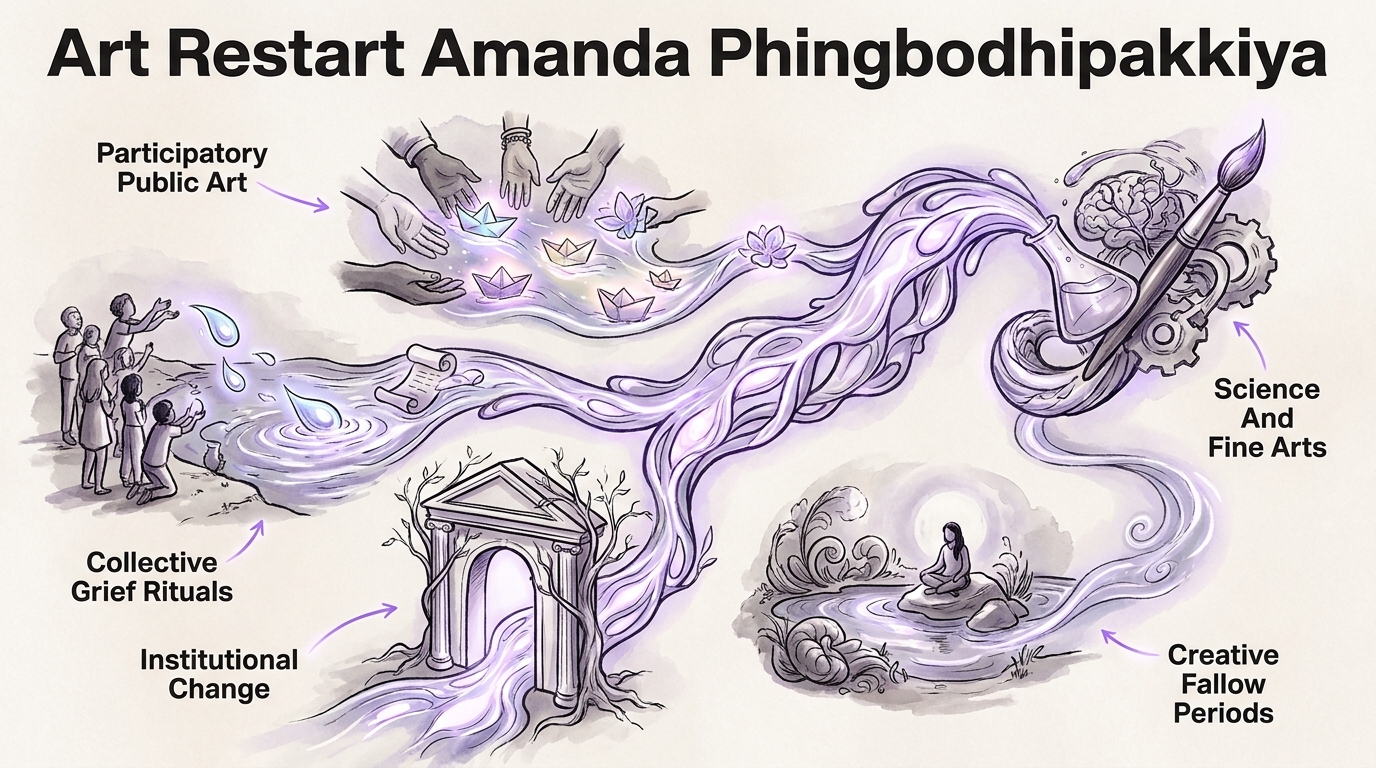
- 4:03Amanda uses participatory art and culturally rooted rituals to invite public spaces into shared moments of emotional healing and grief release
- 10:34Institutional change in the art world requires internal leadership and structural support rather than placing the burden of education entirely on artists
- 15:53True artistic sustainability comes from embracing play, exploration, and periods of reflection rather than being pigeonholed into a single identity
Tap to enlarge
Most valuable section
For whom
Artists, community organizers, and anyone interested in how public art can facilitate collective emotional healing.
Designing Public Rituals for Collective Grief4:03
Amanda breaks down how she adapted the traditional Thai Loy Krathong festival into interactive sculptures at Lincoln Center, demonstrating the transformative power of participatory art.
Detailed summary
1. Introduction to Amanda Phingbodhipakkiya
0:00Host Piercarlo Tolentini introduces artist and neuroscientist Amanda Phingbodhipakkiya for Episode 39 of Art Restart. Amanda's work spans art installations, TED mainstages, and public art campaigns like 'I Still Believe in Our City', which combated anti-Asian hate in New York City.
The introduction sets the stage for a conversation about Amanda's latest work at Lincoln Center, highlighting her mission to create spaces where people can process burden, grief, and community connection through art.
2. Designing Public Rituals for Collective Grief
4:03Amanda discusses 'Gather,' her series of participatory installations at Lincoln Center, specifically focusing on 'Islands in the Sea' located at the Paul Milstein Reflecting Pool. She explains how the project draws inspiration from the Thai festival Loy Krathong, where lotus-shaped vessels carrying worries and incense are floated on water to symbolize forgiveness and renewal.
Featuring nine sculptures—a nod to the Thai homonym for moving forward ('kao na')—the installation invites participants to write down their losses and release them onto floating mirrors. Amanda emphasizes that the goal is not to dwell in sadness, but to acknowledge shared grief and transform broken hearts into open, loving connections.
3. Vulnerability and Public Participation
11:44Amanda reflects on hosting the 'Islands in the Sea' rituals and the unexpected emotional depth shown by participants. She notes how rare and powerful it is for strangers in a bustling city to open up, shed tears, and express vulnerability in a shared public space.
She discusses how society often views public grief as unsightly, which prevents people from properly healing. Holding space for New Yorkers and visitors allows community members to lay down their burdens together and step into shared experiences.
4. Democratizing Art and Institutional Scaffolding
15:53Responding to a question about reforming artistic institutions, Amanda explains that true progress cannot rely on artists taking on the burden of institutional education. Change requires internal leadership and structural scaffolding to ensure champions of diversity are supported rather than burned out.
She stresses that while institutional transformation is a slow process, earnest collaboration between artists and welcoming spaces creates new possibilities, shifts perspectives, and broadens access to broader audiences.
5. Sustaining Playfulness and Expanding Boundaries
20:33Amanda addresses the challenge of maintaining playfulness and exploration in a mature artistic career. She rejects the idea that artists must stay confined to a single style or identity, arguing that different mediums allow for different modes of communication—from the bold public declaration of murals to the slow, deep connection of participatory installations.
She emphasizes the importance of learning to say 'no' to protect her time and avoid burnout. By embracing fallow periods of quiet reflection, artists can discover what they are truly meant to create next and build sustainable careers.
6. Bridging Identity, Science, and Community
28:19The conversation touches on Amanda's journey from neuroscience to fine arts and how media labels often try to pigeonhole artists. Amanda shares her perspective as the child of Thai and Indonesian immigrants, describing how her upbringing shaped her understanding of success and initial hesitation to address topics like equity and racial justice.
Over time, Amanda reclaimed her own narrative, realizing that science, art, justice, and community uplift are deeply interconnected. She views success not through traditional corporate or medical lenses, but through her ability to touch millions of lives and create spaces of belonging.
Questions this video answers
Who is Amanda Phingbodhipakkiya and what is her background?
Amanda Phingbodhipakkiya is a neuroscientist-turned-artist who makes complex scientific and social concepts accessible through art and design. Her work includes TED talks, public art campaigns against anti-Asian hate, and participatory installations at major public spaces like Lincoln Center.
What is the concept behind Amanda's 'Islands in the Sea' installation at Lincoln Center?
Inspired by the Thai Loy Krathong festival, 'Islands in the Sea' features wooden, mirror-topped floating sculptures where participants write down their losses and grief. The interactive ritual invites the public to release their burdens into the water and find a collective sense of light, belonging, and healing.
How does Amanda approach the idea of democratizing art in public institutions?
Amanda believes institutions must possess internal leadership and structural scaffolding to open up opportunities for diverse voices. Rather than relying solely on individual artists to educate institutions, long-term change happens through earnest collaboration and sustained support.
Ask a follow-up Premium
About this summary
SumTube AI wrote this recap from the video's words and chapters. Credit and the original belong to Kenan Institute for the Arts.