
Free AI summary of this YouTube video by SumTube
Arm Vlaanderen
TL;DR
This documentary provides a sobering look at child poverty in Flanders, Belgium, where one in ten children grows up in a household below the poverty line. Through the intimate stories of five families, the report highlights systemic issues such as inadequate social housing, the 'poverty trap' of low-wage work, and the profound social stigma felt by children.
Key takeaways
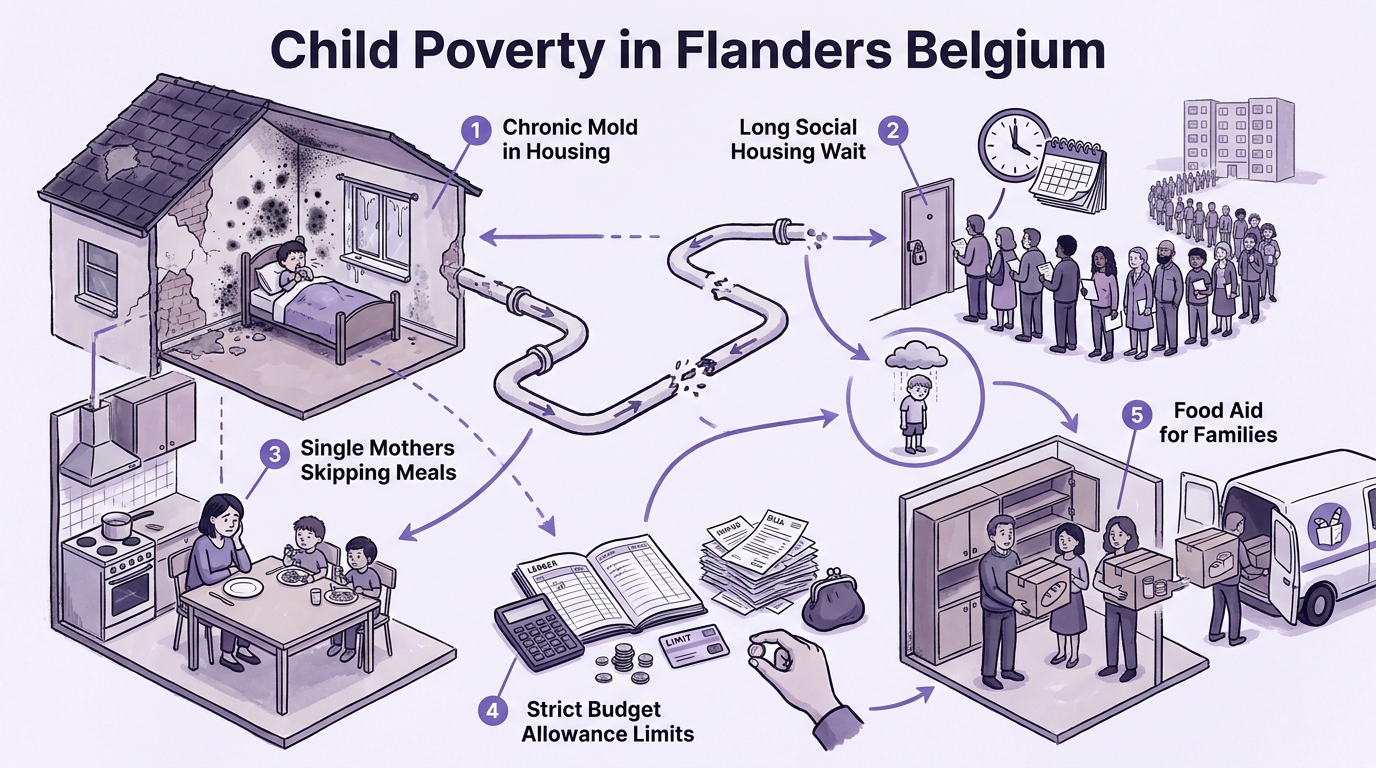
- 2:12Poor housing conditions, specifically chronic mold and moisture in social units, lead to persistent health issues for children
- 21:12The 'working poor' phenomenon shows that employment alone is often insufficient to escape poverty due to high debts and childcare costs
- 51:24Children in poverty experience significant psychological distress and shame, often lying about their lives to fit in at school
- 9:27Systemic barriers in social housing allocation leave many families trapped in overcrowded or unsuitable environments for years
Tap to enlarge
Most valuable section
For whom
Policymakers, social workers, and anyone interested in the socio-economic challenges of modern European welfare states.
Sacrificing for the Children: Jessica's Struggle12:05
This segment offers a raw and heartbreaking look at the personal sacrifices a young mother makes, including skipping meals for weeks, to ensure her children have enough to eat.
Detailed summary
1. Introduction to Child Poverty in Flanders
0:00Phara de Aguirre introduces the documentary, highlighting that child poverty is a widespread but often hidden issue in Flanders. The report focuses on the lived experiences of five families residing in Aalst, Ghent, Leuven, Geel, and Klein-Willebroek to illustrate the reality of living below the poverty line.
The introduction sets the stage by defining the poverty threshold for a family of four as 2,100 euros per month, including child benefits. By giving a platform to the families themselves rather than just experts or politicians, the documentary aims to provide a human face to the statistics.
2. Living with Mold: Els's Family in Aalst
1:33Els, a single mother of three in Aalst, lives in a social housing unit that is severely compromised by moisture and black mold. She explains that despite her best efforts to clean and paint over the mold with bleach, it returns almost immediately because the underlying structure of the building is faulty.
The health implications for her children are severe, as they are constantly sick with respiratory issues. Els expresses deep frustration with the housing company, which has failed to provide a permanent solution, leaving her family trapped in an environment that is fundamentally unsafe for children.
3. The Wait for Social Housing: Marisabel's Story
6:09Marisabel, originally from the Dominican Republic, lives in Ghent with her three children. She has been unemployed for several years and finds it difficult to secure a job that fits around her children's school hours and the high cost of childcare.
The family is currently living in a small apartment that lacks adequate space and privacy. Marisabel has been on a waiting list for a four-bedroom social house for over a decade, illustrating the severe shortage of suitable low-income housing for larger families in the region.
4. Sacrificing for the Children: Jessica's Struggle
12:05Jessica, a 25-year-old mother in Klein-Willebroek, shares the extreme financial pressure of raising two children on a minimal income. After paying for rent, utilities, and basic necessities, she is often left with almost nothing for food, leading her to make drastic personal sacrifices.
She admits to skipping meals for long periods to ensure her daughters have enough to eat and proper clothing. Jessica's story highlights the immediate and desperate nature of poverty for young single parents who lack a strong financial support network.
5. Budget Management and Shame: Rudi and Mika
16:26In Leuven, Rudi raises his son Mika while living under a budget management system due to past debts. They live on a strictly controlled weekly allowance of 140 euros for the entire household, which covers food, clothing, and all other daily expenses.
Mika, who is twelve years old, speaks candidly about the shame he feels at school. He describes the social pressure to have expensive gadgets and go on vacations, and how he often feels excluded or judged by his wealthier classmates because of his family's visible poverty.
6. Working Poor: Vanessa and Steve's Family
20:41Vanessa and Steve live in Geel with their three children and represent the 'working poor.' Despite Steve working and Vanessa pursuing further education, they remain in a precarious financial position due to high debt repayments and the overall cost of living.
The family relies on local food aid and bread distribution services to make ends meet. Their situation demonstrates that employment is not a guaranteed escape from poverty, especially when historical debts and low wages collide with the needs of a growing family.
7. The High Cost of Working: Childcare Barriers
24:47The documentary revisits Marisabel, who has finally found a cleaning job. However, she quickly discovers that the extra income is largely consumed by the cost of after-school childcare, which is necessary because her working hours do not align with school schedules.
This segment illustrates the 'poverty trap,' where the transition from benefits to work can result in very little actual financial improvement for the family. It highlights the need for more affordable and flexible childcare solutions to support low-income parents in the workforce.
8. Social Stigma and School Life
26:53The children in the featured families discuss the social challenges they face at school. From being teased about their clothes to the embarrassment of not being able to participate in school trips or extracurricular activities, the psychological burden of poverty is heavy.
Mika and others explain how they sometimes lie about their lives or stay quiet during discussions about vacations to avoid being singled out. This social isolation can have long-lasting effects on their self-esteem and sense of belonging within their community.
9. Dreams and Aspirations Amidst Hardship
28:44Despite the daily grind of poverty, the children and parents share their dreams for the future. The children aspire to careers in sports, science, or simply living in a house with a garden, showing a resilient hope for a better life.
Parents express a deep desire for their children to break the cycle of poverty. They emphasize the importance of education and stability, hoping that the next generation will have the opportunities that were denied to them due to systemic and personal circumstances.
10. The Cycle of Poverty and Future Outlook
30:33The documentary concludes by addressing the intergenerational nature of poverty. Rudi reflects on how his own upbringing influenced his current situation and expresses his determination to prevent his son from falling into the same 'vicious circle.'
The final notes mention the Flemish government's ambitious goal to halve child poverty by 2020. However, the stories of these five families suggest that significant systemic changes in housing, debt relief, and employment support are still needed to achieve this target and provide a fair start for all children.
Questions this video answers
How many children are affected by poverty in Flanders?
Approximately one in ten children and young people in Flanders grow up in poverty. This statistically translates to about two students in every average-sized classroom of twenty.
What are the primary challenges for single parents seeking employment?
Single parents often face a 'poverty trap' where the cost of childcare and the lack of flexible working hours make low-wage jobs financially unviable. In many cases, the net income gain from working is almost entirely offset by the loss of benefits and increased childcare expenses.
How does poverty impact a child's social life and education?
Poverty creates a sense of isolation and shame, as children cannot afford the same clothes, hobbies, or vacations as their peers. This often leads to bullying and a lack of confidence, which can negatively affect their educational focus and long-term aspirations.
What is the role of budget management in these families' lives?
Some parents utilize professional budget management services to handle debts and ensure essential bills are paid. While this provides some stability, it often leaves families with a very small weekly 'living allowance' that makes handling unexpected costs nearly impossible.
Ask a follow-up Premium
About this summary
SumTube AI wrote this recap from the video's words and chapters. Credit and the original belong to Doc Tube.