
Free AI summary of this YouTube video by SumTube
Apollo Guidance Computer Part 1: Restoring the computer that put man on the Moon
TL;DR
This video follows a team of engineers and collectors as they gather in a Houston hotel room to begin restoring an authentic Apollo Guidance Computer (AGC). The team inspects the rare, unpotted hardware from Lunar Test Article 8 and examines the unique logic modules, power supplies, core rope simulators, and custom test setups.

Key takeaways
- 1:45He meets Jimmie Loocke, the private owner of the AGC unit, and Mike Stewart, an AGC specialist leading the technical restoration effort
- 6:52Jimmie Loocke explains how he originally worked on testing the lunar excursion module at NASA
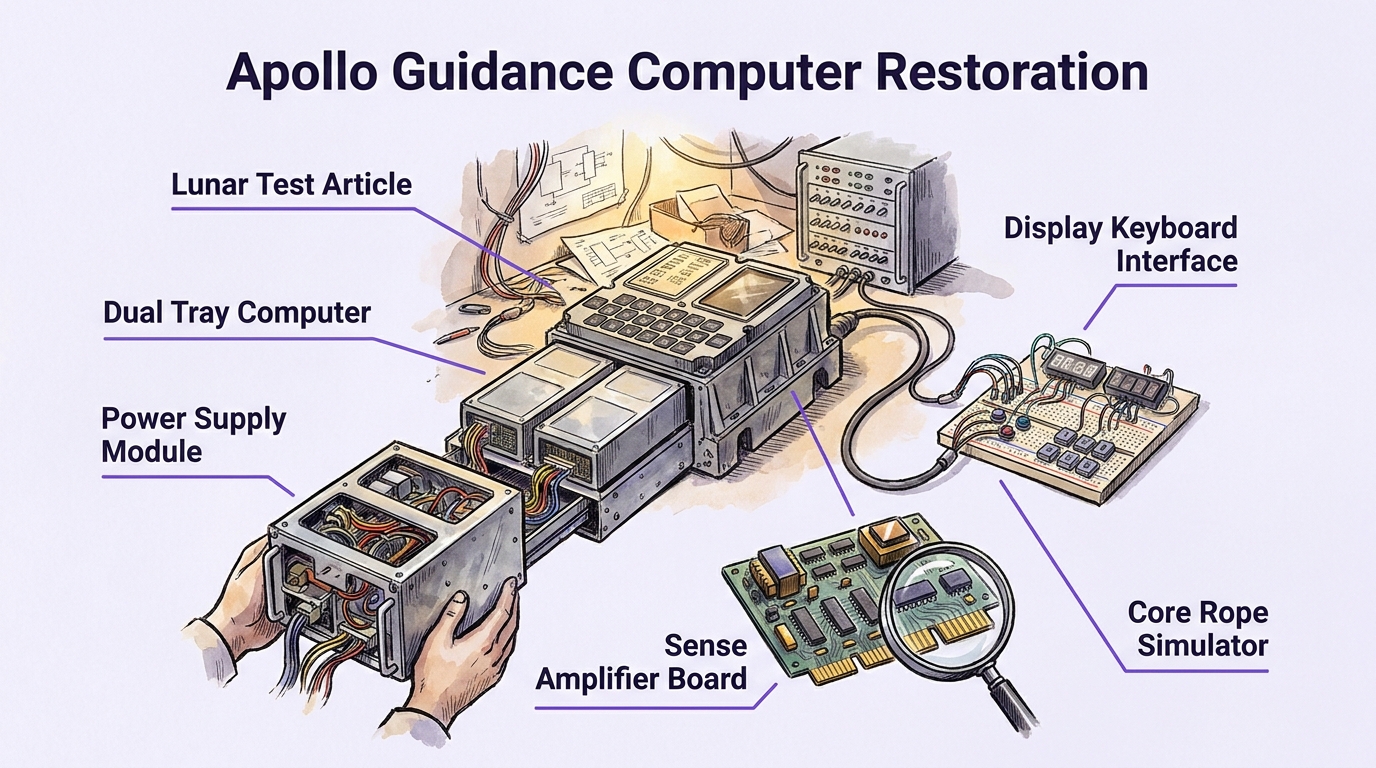
- 11:45Mike Stewart and Carl show the different removable modules inside the dual-tray AGC unit
- 16:37Mike details how he acquired complete schematics for the computer's logic and memory modules, thanks to contributions from original designers Eldon Hall and Don Eyles
- 20:12Ken displays a core rope simulator used during original ground testing to feed custom program instructions into the computer before final ROM ropes were woven
Tap to enlarge
Most valuable section
Jimmie Loocke's Apollo Story6:52
Because it was not filled with protective potting compound, the internal components, logic gates, and wiring remain fully exposed and repairable.
Detailed summary
1. Traveling to Houston
0:00The presenter packs up sensitive electronic equipment into NASA-labeled suitcases to join a restoration team in Houston. The goal of the project is to restore a historic Apollo Guidance Computer (AGC) in time for the 50th anniversary of the Apollo 11 moon landing.
2. Arrival at the Makeshift Lab
1:45The host arrives at a hotel room transformed into an electronics lab by team members Carl, Ken, Mike, and Tim. He meets Jimmie Loocke, the private owner of the AGC unit, and Mike Stewart, an AGC specialist leading the technical restoration effort.
The team introduces the computer unit, which originated from LTA-8 (Lunar Test Article 8), the first man-rated lunar module test article used at Johnson Space Center.
3. Jimmie Loocke's Apollo Story
6:52Jimmie Loocke explains how he originally worked on testing the lunar excursion module at NASA. In 1976, he discovered and purchased two tons of surplus Apollo equipment from a warehouse, which included this rare AGC.
After consulting with lead AGC designer Eldon Hall, Jimmie discovered that this specific computer was unpotted. Because it was not filled with protective potting compound, the internal components, logic gates, and wiring remain fully exposed and repairable.
4. Examining AGC Modules
11:45Mike Stewart and Carl show the different removable modules inside the dual-tray AGC unit. They pull out a 4-volt power supply module utilizing welded cordwood construction, which was originally adapted from Polaris missile technology.
They also demonstrate a sense amplifier module containing custom integrated circuits and transformers used to process core memory signals. They highlight the logic modules, each containing 120 flatpack dual NOR gate ICs.
5. Schematics and Logic Testing
16:37Mike details how he acquired complete schematics for the computer's logic and memory modules, thanks to contributions from original designers Eldon Hall and Don Eyles. These detailed drawings allow the team to trace circuits and test individual gates.
Carl describes their methodical testing process to verify each NOR gate module pin by pin. Despite an initial minor flaw caused by loose conductive debris inside an IC, the logic modules tested so far show a 100% success rate.
6. Core Rope Simulators & DSKY Prototype
20:12Ken displays a core rope simulator used during original ground testing to feed custom program instructions into the computer before final ROM ropes were woven. He explains the challenges of reverse-engineering the module, including dealing with corroded metal parts and loose IC dipsticks.
Carl then reveals a custom breadboard DSKY (Display Keyboard) interface built to simulate astronaut inputs and display outputs at the native 28-volt logic levels of the AGC.
Questions this video answers
What does this video say about Traveling to Houston?
The presenter packs up sensitive electronic equipment into NASA-labeled suitcases to join a restoration team in Houston. The goal of the project is to restore a historic Apollo Guidance Computer (AGC) in time for the 50th anniversary of the Apollo 11 moon landing.
What does this video say about Arrival at the Makeshift Lab?
The host arrives at a hotel room transformed into an electronics lab by team members Carl, Ken, Mike, and Tim. He meets Jimmie Loocke, the private owner of the AGC unit, and Mike Stewart, an AGC specialist leading the technical restoration effort. The team introduces the computer unit, which originated from LTA-8 (Lunar Test Article 8), the first man-rated lunar module test article used at Johnson
What does this video say about Jimmie Loocke's Apollo Story?
Jimmie Loocke explains how he originally worked on testing the lunar excursion module at NASA. In 1976, he discovered and purchased two tons of surplus Apollo equipment from a warehouse, which included this rare AGC. After consulting with lead AGC designer Eldon Hall, Jimmie discovered that this specific computer was unpotted. Because it was not filled with protective potting compound, the interna
What does this video say about Examining AGC Modules?
Mike Stewart and Carl show the different removable modules inside the dual-tray AGC unit. They pull out a 4-volt power supply module utilizing welded cordwood construction, which was originally adapted from Polaris missile technology. They also demonstrate a sense amplifier module containing custom integrated circuits and transformers used to process core memory signals. They highlight the logic m
What does this video say about Schematics and Logic Testing?
Mike details how he acquired complete schematics for the computer's logic and memory modules, thanks to contributions from original designers Eldon Hall and Don Eyles. These detailed drawings allow the team to trace circuits and test individual gates. Carl describes their methodical testing process to verify each NOR gate module pin by pin. Despite an initial minor flaw caused by loose conductive
Ask a follow-up Premium
About this summary
SumTube AI wrote this recap from the video's words and chapters. Credit and the original belong to CuriousMarc.