
Free AI summary of this YouTube video by SumTube
America Forgot It's Allowed to Stop Making Coins
TL;DR
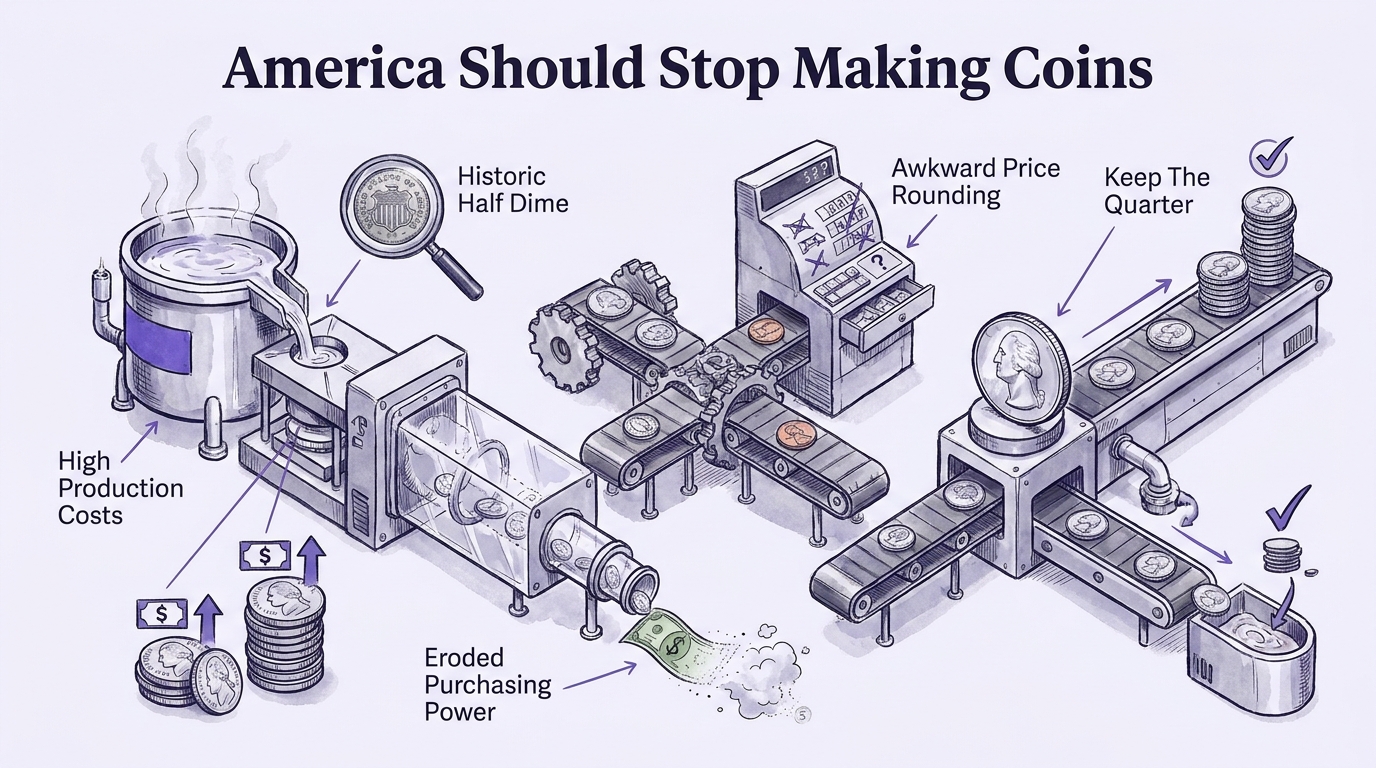
CGP Grey argues that the United States should abolish the nickel alongside the penny because it costs more to produce than it is worth and provides minimal practical value in modern cash transactions. He explores the historical shifts in coin composition, the economic losses of minting low-denomination currency, and proposals to streamline US coinage down to the quarter or standardizing transactions around rounding.

Key takeaways
- 2:17Minting nickels costs the U.S. government roughly 14 cents per coin, resulting in an annual loss of over $135 million.
- 5:23A historic precedent exists for eliminating obsolete currency, such as the discontinuation of the half-cent and three-cent coins in the 19th century
- 7:28Eliminating both the penny and nickel while retaining quarters and dimes creates awkward price-rounding math, making ditching the dime alongside them a compelling alternative
Tap to enlarge
Most valuable section
For whom
Anyone interested in economics, public policy, currency design, or practical monetary reform.
Option 2: Keep the Quarter, Ditch the Dime9:06
It offers a creative and provocative argument for simplifying American currency by removing all coins smaller than a quarter, supported by historical context.
Detailed summary
1. History of the Half-Dime & Nickel
0:00The US Mint originally created five-cent coins out of silver, calling them half-dimes. Over time, rising silver prices and inflation meant the metal content became worth more than the coin's face value, leading citizens to melt them down for profit.
To prevent people from melting currency, the government altered the coin's composition to nickel and copper in the mid-19th century. Although this fixed the issue temporarily, ongoing economic inflation eventually caused the metal value of modern nickels to exceed their nominal value once again.
2. The Economic Loss of Minting Nickels
2:05Manufacturing a single five-cent nickel costs the US Treasury approximately 14 cents when accounting for raw materials, mint machinery, and labor. With 1.5 billion nickels produced annually, this imbalance creates a direct loss of over $135 million every year.
While the government banned melting down coins for profit, it continues to mint them at a significant financial loss. The argument is made that just as the inefficient penny should be retired, the nickel loses even more money per unit and should be eliminated.
3. Why the Nickel is Useless in Daily Life
3:44Coins exist to make cash commerce efficient, but the purchasing power of five cents has eroded to near zero. Most automated vending machines reject nickels, and using them to make exact change at registers wastes time for both cashiers and customers.
Phasing out the nickel would mirror historical decisions to remove redundant coins like the half-cent in 1857 and the three-cent coin in 1889, both of which had higher purchasing power when retired than today's nickel or dime.
4. The Quarter & Dime Mathematical Dilemma
6:54If both the penny and nickel are retired, cash transactions rounded to the nearest 10 cents create an awkward math problem for the 25-cent quarter. Because quarters end in 5, paying with single quarters or three quarters becomes mathematically impossible without a 5-cent increment.
Two main solutions exist: either eliminate the quarter in favor of dimes and half-dollars, or preserve the quarter and remove the dime as well, rounding cash transactions directly to 25-cent increments.
5. Solution: Keep the Quarter, Ditch the Dime
9:06The quarter is the most cost-effective coin to produce, yielding a profit for the mint, and is widely accepted in automated machines nationwide. Retaining only the quarter as the primary coin simplifies the change system down to four quarters per dollar.
Rounding transactions to the nearest quarter matches the purchasing power standards of early American currency while permanently resolving the inefficiency of smaller, money-losing coins.
Questions this video answers
Why does minting nickels lose money for the U.S. government?
The combined cost of raw metal materials, manufacturing machinery, labor, and mint operational overhead totals around 14 cents per nickel. Because the coin is only face-valued at 5 cents, the government loses roughly 9 cents for every nickel it produces.
Has the US government ever eliminated low-denomination coins before?
Yes, the US Mint discontinued the half-cent coin in 1857 and the three-cent coin ('trime') in 1889. Both coins were phased out once inflation rendered their purchasing power too small to be useful for daily commerce.
What would happen to retail transactions if the nickel were eliminated?
Cash transactions would likely be rounded to the nearest 10 cents or 25 cents depending on which coins remain in circulation. Digital and electronic payments would remain exact, while cash processing would become faster and cheaper for businesses and consumers.
Ask a follow-up Premium
About this summary
SumTube AI wrote this recap from the video's words and chapters. Credit and the original belong to CGP Grey.