
Free AI summary of this YouTube video by SumTube
AlphaFold - The Most Useful Thing AI Has Ever Done
TL;DR
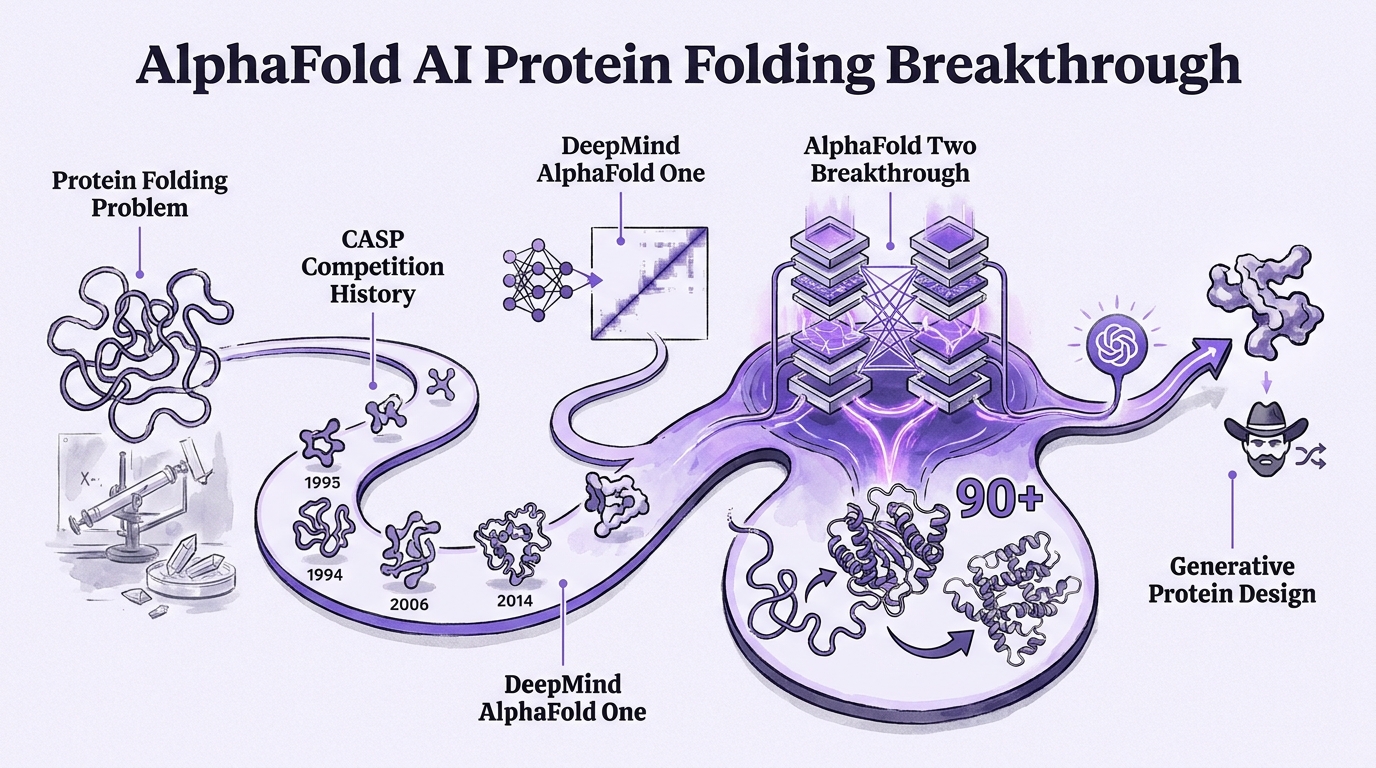
This video explores how artificial intelligence solved the 50-year-old biological mystery of protein folding, culminating in the development of DeepMind's AlphaFold. It chronicles the transition from laborious experimental methods like X-ray crystallography to revolutionary AI architectures that can accurately predict and even design complex 3D protein structures from amino acid sequences.

Key takeaways
- 5:38To accelerate progress in protein structure prediction, Professor John Moult created the Critical Assessment of Structure Prediction (CASP) competition in 1994
- 12:15DeepMind, led by Demis Hassabis, gained international acclaim when its AlphaGo AI defeated world champion Lee Sedol in the game of Go
- 19:02Realizing the limitations of conventional neural networks, DeepMind restructured AlphaFold 2 under the leadership of Dr. John Jumper.
- 30:35At CASP14 in December 2020, AlphaFold 2 achieved a monumental victory, generating protein structure predictions that were virtually indistinguishable from experimental results and smashing the threshold score of 90
- 33:56While AlphaFold predicts existing protein structures, David Baker's team leveraged generative AI models like RF Diffusion to design entirely new, custom-built proteins from scratch
Tap to enlarge
Most valuable section
AlphaFold 2: The Breakthrough Architecture19:02
The refined outputs are passed to a Structure Module, which treats amino acids as independent floating frames in space, allowing the AI to position them without being constrained by the physical connectivity of the prote
Detailed summary
1. The Protein Folding Problem
0:00Proteins are fundamental molecular machines whose function is defined by their unique three-dimensional shape. Each protein originates as a linear chain of amino acids, which folds into a complex 3D structure governed by physical forces like hydrogen bonding and solvent interactions. Understanding this folding process is critical because a protein's shape enables essential biological tasks, such as carrying oxygen in the blood or driving muscle contractions.
Determining a single protein structure experimentally was historically an arduous task. Biologists spent decades using techniques like X-ray crystallography, which required growing crystals from proteins and analyzing diffraction patterns. The first protein structure, myoglobin, took British biochemist John Kendrew 12 years to resolve using sperm whale muscle, earning him a Nobel Prize. Because of the astronomical number of ways a protein chain can fold—a dilemma known as Levinthal's paradox—predicting structure purely from raw physics computationally was considered impossible.
2. The CASP Competition and Rosetta
5:38To accelerate progress in protein structure prediction, Professor John Moult created the Critical Assessment of Structure Prediction (CASP) competition in 1994. In CASP, computational modelers were given undisclosed amino acid sequences and tasked with predicting their 3D structures, which were then evaluated against experimental data on a 0 to 100 scale. A score above 90 meant a structure was accurately solved.
Early progress was slow, but University of Washington biologist David Baker emerged as a leader with his algorithm, Rosetta. To boost computational power, Baker launched Rosetta@home, a distributed computing initiative that harnessed idle processing power from volunteer personal computers worldwide. When volunteers watching their screensavers noticed inefficiencies, Baker helped develop Foldit, a crowdsourced video game that allowed human intuition to solve complex protein structures, outperforming computers on several long-standing problems.
3. DeepMind and AlphaFold 1
12:15DeepMind, led by Demis Hassabis, gained international acclaim when its AlphaGo AI defeated world champion Lee Sedol in the game of Go. Inspired by his experience with Foldit, Hassabis recognized the potential of AI to tackle grand scientific challenges and initiated the AlphaFold project to apply deep learning to the protein folding problem.
AlphaFold 1 utilized a standard deep neural network trained on known protein structures from the Protein Data Bank. Instead of predicting 3D coordinates directly, it predicted a 2D distance map representing the proximity and torsion angles between pairs of amino acids. By leveraging evolutionary co-mutation data—where pairs of amino acids mutate together across species to maintain structural contact—AlphaFold 1 won CASP13 in 2018 with an unprecedented score of 70, though it still fell short of the competitive 90-point benchmark.
4. AlphaFold 2: The Breakthrough Architecture
19:02Realizing the limitations of conventional neural networks, DeepMind restructured AlphaFold 2 under the leadership of Dr. John Jumper. Rather than relying solely on brute-force compute or massive data additions, the team redesigned the AI architecture from the ground up to incorporate spatial, physical, and biological concepts directly into the model.
At the core of AlphaFold 2 is the Evoformer, an attention-based Transformer system featuring two interconnected towers: the Biology Tower and the Geometry Tower. These towers continuously exchange evolutionary and spatial information through a mechanism known as triangular attention, enforcing geometric constraints like the triangle inequality. The refined outputs are passed to a Structure Module, which treats amino acids as independent floating frames in space, allowing the AI to position them without being constrained by the physical connectivity of the protein backbone chain until the final predictions emerge.
5. Solving the Challenge and the Nobel Prize
30:35At CASP14 in December 2020, AlphaFold 2 achieved a monumental victory, generating protein structure predictions that were virtually indistinguishable from experimental results and smashing the threshold score of 90. In a matter of months, AlphaFold predicted the 3D structures of over 200 million proteins—representing nearly every protein known to science—compressing centuries of experimental research into a single AI deployment.
This historic breakthrough revolutionized molecular biology, enabling rapid advances in malaria vaccine development, antibiotic resistance solutions, and disease research. In recognition of these transformative achievements, John Jumper and Demis Hassabis were awarded one-half of the 2024 Nobel Prize in Chemistry. The other half was awarded to David Baker for his pioneering work in de novo protein design.
6. Generative Protein Design and the Future of Science
33:56While AlphaFold predicts existing protein structures, David Baker's team leveraged generative AI models like RF Diffusion to design entirely new, custom-built proteins from scratch. Operating similarly to image generation models like DALL-E, RF Diffusion starts with random molecular noise and iteratively denoises it to build novel proteins optimized for specific functions, such as human-compatible antivenoms, plastic-degrading enzymes, or carbon-capture mechanisms.
This rapid design cycle—dubbed 'cowboy biochemistry'—signals a fundamental shift in how scientific discovery operates. AI is expanding beyond biology into fields like materials science, where models like DeepMind's GNoME have identified millions of new stable crystal structures for advanced batteries and superconductors. By accelerating progress by orders of magnitude, AI-driven scientific discovery is unlocking new frontiers of human knowledge.
Questions this video answers
What does this video say about The Protein Folding Problem?
Proteins are fundamental molecular machines whose function is defined by their unique three-dimensional shape. Each protein originates as a linear chain of amino acids, which folds into a complex 3D structure governed by physical forces like hydrogen bonding and solvent interactions. Understanding this folding process is critical because a protein's shape enables essential biological tasks, such a
What does this video say about The CASP Competition and Rosetta?
To accelerate progress in protein structure prediction, Professor John Moult created the Critical Assessment of Structure Prediction (CASP) competition in 1994. In CASP, computational modelers were given undisclosed amino acid sequences and tasked with predicting their 3D structures, which were then evaluated against experimental data on a 0 to 100 scale. A score above 90 meant a structure was acc
What does this video say about DeepMind and AlphaFold 1?
DeepMind, led by Demis Hassabis, gained international acclaim when its AlphaGo AI defeated world champion Lee Sedol in the game of Go. Inspired by his experience with Foldit, Hassabis recognized the potential of AI to tackle grand scientific challenges and initiated the AlphaFold project to apply deep learning to the protein folding problem. AlphaFold 1 utilized a standard deep neural network trai
What does this video say about AlphaFold 2: The Breakthrough Architecture?
Realizing the limitations of conventional neural networks, DeepMind restructured AlphaFold 2 under the leadership of Dr. John Jumper. Rather than relying solely on brute-force compute or massive data additions, the team redesigned the AI architecture from the ground up to incorporate spatial, physical, and biological concepts directly into the model. At the core of AlphaFold 2 is the Evoformer, an
What does this video say about Solving the Challenge and the Nobel Prize?
At CASP14 in December 2020, AlphaFold 2 achieved a monumental victory, generating protein structure predictions that were virtually indistinguishable from experimental results and smashing the threshold score of 90. In a matter of months, AlphaFold predicted the 3D structures of over 200 million proteins—representing nearly every protein known to science—compressing centuries of experimental resea
Ask a follow-up Premium
About this summary
SumTube AI wrote this recap from the video's words and chapters. Credit and the original belong to Veritasium.