
Free AI summary of this YouTube video by SumTube
A História do Bolsa Família
TL;DR
This video details the comprehensive history, evolution, and social-economic impacts of Brazil's Bolsa Família program. It traces its origins from early 1990s local initiatives to its national unification in 2003, its transition into Auxílio Brasil, and its 2023 restructuring. It also examines the key debate surrounding the policy, weighing its proven benefits in hunger reduction against potential fiscal and labor market concerns.

Key takeaways
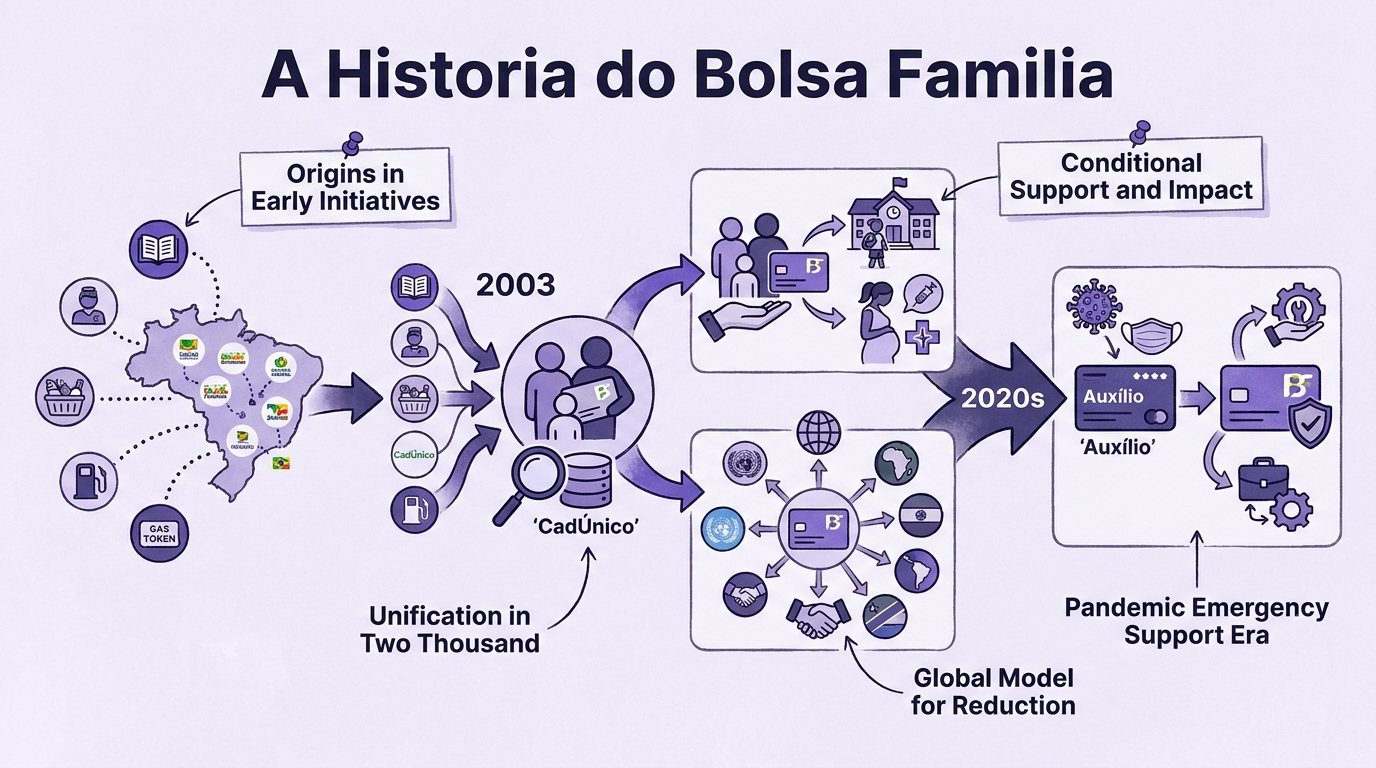
- 2:24Bolsa Família evolved from fragmented municipal schemes into a unified national program that became a global model for poverty reduction
- 5:33The program's success relies on conditionalities—requiring school attendance and healthcare compliance—and issuing payments directly to women
- 10:07Policy debates continue to balance the program's vital social safety net against fiscal sustainability and potential labor market distortions
Tap to enlarge
Most valuable section
For whom
Policy analysts, economics students, and anyone interested in social welfare models and poverty reduction strategies.
Pros & Cons of Bolsa Família10:07
It breaks down the complex trade-offs between immediate poverty relief and long-term fiscal and economic challenges in a clear visual summary.
Detailed summary
1. Introduction & Historical Context
0:00In the early 2000s, approximately 50 million Brazilians lived in extreme poverty or suffered from hunger. The video introduces the severe social conditions in regions like the Jequitinhonha Valley and urban slums, illustrating the daily struggle of families lacking basic food security.
Recognized globally by organizations like the World Bank and the UN, Bolsa Família transformed social assistance in Latin America. This overview sets up the program's historical trajectory from its 1990s roots through various political shifts to its modern implementation.
2. Origins of Income Transfer (1991–2001)
2:34The concept of guaranteed income emerged in 1991 when Senator Eduardo Suplicy proposed the Citizenship Minimum Income project in Congress. Although national implementation stalled initially, local governments in Campinas and the Federal District began testing local income transfers linked to school attendance in 1995 under the name Bolsa Escola.
Following local success, President Fernando Henrique Cardoso's administration expanded the strategy nationally in 2001. This created several separate initiatives, including Bolsa Escola, Bolsa Alimentação, Auxílio Gás, and Cartão Alimentação, laying the groundwork for federal social safety nets.
3. Unification into Bolsa Família (2003)
4:14By 2003, having multiple separate programs created severe administrative fragmentation, redundant registries, and inefficient delivery. In response, President Luiz Inácio Lula da Silva's government initially launched Fome Zero, but quickly pivoted to streamline operations through Provisional Measure 132 in October 2003, officializing Bolsa Família.
This reform merged all previous aid programs into a single system supported by two key pillars: the Cadastro Único (CadÚnico) database to centralize beneficiary tracking, and the Ministry of Social Development (MDS) to oversee national execution.
4. Conditionalities & Social Impact
5:26Bolsa Família operates as a conditional cash transfer program, meaning families receive financial support only if they fulfill key health and education requirements. Children must maintain minimum school attendance, complete vaccination schedules, and pregnant women must attend regular prenatal care.
Additionally, issuing debit cards primarily to female heads of household boosted financial autonomy for women in vulnerable communities. Over the years, this approach drastically reduced child mortality, lowered school dropout rates, improved child nutrition, and stimulated local economies in impoverished municipalities.
5. Global Recognition & International Model (2014)
6:54By 2014, Brazil celebrated its official removal from the UN Hunger Map, attributing much of this success to the integrated social protection system. The combination of CadÚnico and conditional cash transfers established Brazil as an international authority in poverty alleviation.
Over 30 countries sent international delegations to study Brazil's social infrastructure. The program served as a direct model for social initiatives across Latin America, Africa, and even inspired pilot programs in major cities like New York.
6. Pandemic Response & Auxílio Brasil (2020–2021)
7:31The COVID-19 pandemic in 2020 froze economic activity, prompting the federal government to establish Auxílio Emergencial to provide immediate high-value relief. As emergency aid phased out in late 2021, President Jair Bolsonaro's administration restructured social assistance by replacing Bolsa Família with Auxílio Brasil after 18 years of operation.
Auxílio Brasil increased monthly payments to a average of R$600. However, policy experts raised concerns regarding its flat-rate model per household, which unintentionally incentivized single-person household splitting (famílias unipessoais) to claim multiple payouts.
7. Restructuring the New Bolsa Família (2023)
8:58With President Lula returning to office in 2023, the program reverted to its original name while undergoing significant updates. The redesigned Bolsa Família maintained the R$600 floor but restored variable additions based on family size and composition to better support larger households.
To ensure smooth transitions into employment, the government introduced the 'Protection Rule' (Regra de Proteção), allowing workers who land formal jobs to keep 50% of their benefits for up to two years. Concurrently, a major audit of CadÚnico was launched to eliminate fraud and address single-person registry distortions.
8. Pros & Cons of Bolsa Família
10:07The video outlines the key arguments surrounding Bolsa Família's long-term implementation. Key benefits include effective hunger relief, higher school enrollment, economic stimulus in small towns, female empowerment, and centralized administrative efficiency via CadÚnico.
Conversely, critics highlight challenges such as potential disincentives to formal labor, heavy fiscal burdens on the state budget, registration errors, limited long-term exit pathways without job training, and exposure to electoral manipulation before major elections.
9. Conclusion & Legacy
13:57Over more than two decades, Bolsa Família transitioned from a temporary government project into an essential state policy. Despite political debates surrounding fiscal responsibility versus social justice, it remains a cornerstone of Brazilian social welfare.
The video closes by inviting viewers to share their perspectives on the program's evolution, encouraging audience engagement and subscriptions for more content on Brazilian political history.
Questions this video answers
How did the Bolsa Família program originate?
The program started as a proposal for a citizenship minimum income by Senator Eduardo Suplicy in 1991. Local governments later pioneered school-attendance-linked income transfers in 1995, which the federal government unified into Bolsa Família in 2003.
What conditions must families meet to receive Bolsa Família benefits?
To receive benefits, families must ensure children and adolescents maintain minimum school attendance. Additionally, children must keep up with vaccination schedules, and pregnant women must undergo regular prenatal checkups.
What are the main criticisms of the Bolsa Família program?
Critics highlight potential disincentives for formal employment, high costs impacting fiscal sustainability, and past registration errors like artificial household splitting. Additionally, some point to difficulties in creating permanent exit pathways into the job market.
Ask a follow-up Premium
About this summary
SumTube AI wrote this recap from the video's words and chapters. Credit and the original belong to @Rod Splater 🎵.