
Free AI summary of this YouTube video by SumTube
164004 03 32
TL;DR
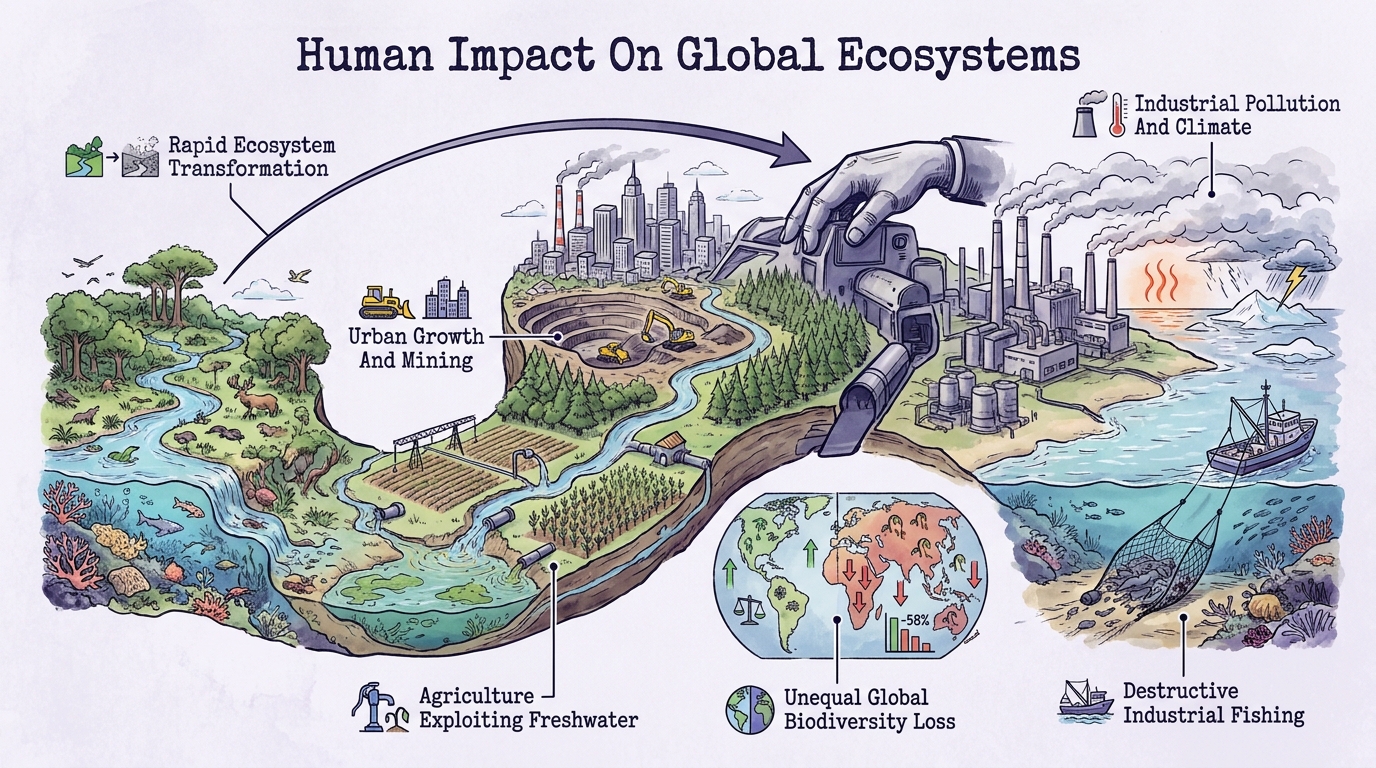
This educational video from the Universidad de Pamplona examines how human actions over the last 50 years have transformed global ecosystems to satisfy growing demands for food, water, and resources. It breaks down the environmental consequences across major sectors: urban expansion, mining, agriculture, industrial manufacturing, and fishing. The narrative highlights the unequal distribution of ecological damage, showing that low-income regions suffer the most severe biodiversity losses and resource depletion.

Key takeaways
- 0:41Human activity over the last 50 years has transformed ecosystems more rapidly and extensively than in any comparable period in history
- 4:54Low-income nations suffer the most severe biodiversity loss (58% decline) as they serve as resource providers for global demands
- 5:39Key drivers of ecosystem destruction include uncontrolled urban growth, open-pit mining, chemical agriculture, heavy industry, and destructive fishing methods
Tap to enlarge
Most valuable section
For whom
Students, environmentalists, and policy makers interested in sustainable development and ecological impact assessment.
Impact of Urban Expansion and Mining5:39
This section clearly articulates how land conversion, infrastructure development, and resource extraction trigger irreversible ecological damage and water pollution.
Detailed summary
1. Human Actions and Ecosystem Degradation
0:00Human beings depend entirely on Earth's ecosystems for food, water, climate regulation, and spiritual well-being. Over the past 50 years, human societies have altered natural landscapes at an unprecedented scale to meet growing demands for food, fresh water, timber, and energy.
While these changes initially supported economic growth and human development, they resulted in significant degradation of natural capital. This deterioration has amplified social inequalities, creating environmental risks that disproportionately affect vulnerable populations.
2. Unequal Global Impact on Biodiversity
3:44The ecological burden of global resource consumption is distributed unequally. People in low and middle-income countries often have smaller ecological footprints individually, yet their regional ecosystems face the highest levels of exploitation and damage.
Data reveals that high-income countries report slight biodiversity gains (+10%), while middle-income (-18%) and low-income countries (-58%) experience drastic declines. Developing regions act as global suppliers of raw materials, exposing their ecosystems to severe habitat loss.
3. Impact of Urban Expansion and Mining
5:39Urban expansion encroaches on vital wetlands, forests, and green spaces, causing irreversible harm to hydrological systems and wildlife habitats. Proper urban planning is essential to reserve public green spaces and halt unmitigated habitat destruction.
Simultaneously, large-scale mining operations lead to widespread deforestation, toxic water pollution from heavy metals (such as gold, copper, and iron extraction), and air pollution. In regions like Colombia, mining threatens strategic ecosystems like paramos and wetlands, disrupting essential freshwater sources.
4. Agriculture and Freshwater Exploitation
10:01Modern agriculture accounts for over half of global accessible freshwater use. To sustain intensive crop production, river systems have been diverted and modified, leading to the destruction of both aquatic and terrestrial ecosystems.
Furthermore, the excessive application of synthetic fertilizers and pesticides contaminates soil and water supplies. These agrochemicals kill non-target pollinators, accelerate soil erosion, and degrade native plant and animal populations.
5. Industrial Pollution and Climate Change
10:51Industrialization since the 18th century has driven a nearly 30% increase in atmospheric carbon dioxide alongside toxic emissions of sulfur and nitrogen oxides. These greenhouse gases fuel global climate change, melting polar ice caps and altering delicate marine and Arctic ecosystems.
Industrial waste runoff creates toxic algal blooms that deplete oxygen in water bodies, harming marine life. Additionally, oil spills and petrochemical extraction inflict catastrophic, long-term damage on coastal and oceanic wildlife.
6. Destructive Fishing Practices
13:14Industrial fishing methods such as bottom trawling, blast fishing, and chemical poisoning severely degrade marine habitats. Heavy nets dragged across the seafloor destroy coral reefs, seagrass beds, and benthic communities while capturing massive amounts of non-target bycatch.
Unsustainable fishing has led to the destruction of over 65% of global seagrass habitats and widespread damage to cold-water coral reefs. The video concludes with a quote by Enrique Leff, emphasizing that no pristine natural ecosystem remains untouched by human history and social structures.
Questions this video answers
How have human actions impacted global ecosystems over the past 50 years?
To meet rapid growth in demand for food, fresh water, timber, fiber, and fuel, humans have altered nature faster and more extensively than during any other period in history. While this generated net economic benefits, it caused severe long-term degradation of natural capital, rising inequality, and heightened ecological risks.
Why do lower-income countries experience greater biodiversity loss?
Lower-income countries often serve as the global supply hub for raw materials, timber, and agricultural goods. Consequently, their natural ecosystems undergo intense exploitation and degradation, leading to a dramatic 58% drop in biodiversity compared to high-income nations that offset local impacts through imports.
What are the primary human activities driving environmental degradation?
The primary activities include urban expansion, which destroys wetlands and forests; large-scale mining, which pollutes water and causes deforestation; intensive agriculture, which consumes over half of available fresh water and uses harmful agrochemicals; industrial pollution, which releases greenhouse gases; and destructive fishing practices like bottom trawling.
Ask a follow-up Premium
About this summary
SumTube AI wrote this recap from the video's words and chapters. Credit and the original belong to UETIC Unipamplona.