
Free AI summary of this YouTube video by SumTube
16 Data Engineering Layers Explained (Real-World Flow) | Tamil
TL;DR
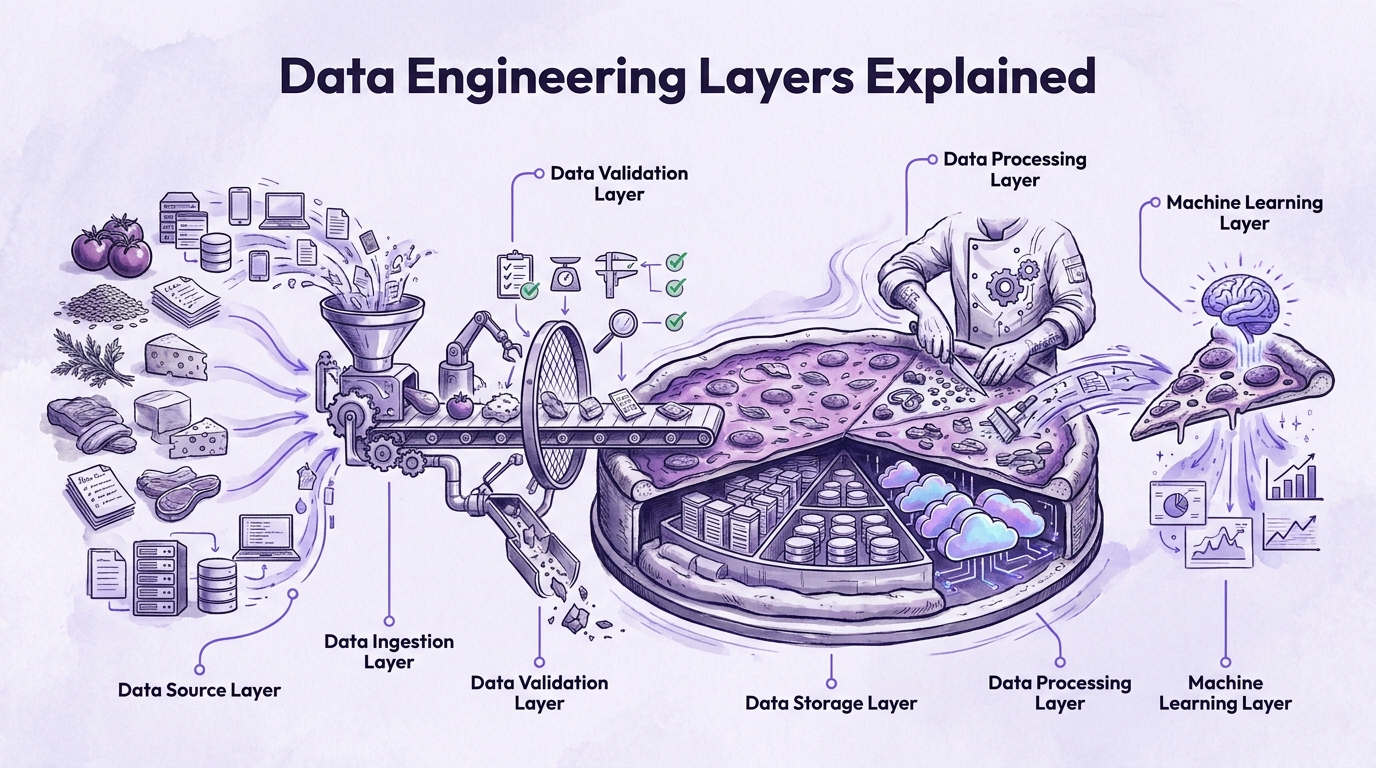
This video breaks down the primary data engineering layers within modern data architectures using a pizza layer analogy. It detail-explores 16 core layers—ranging from ingestion, storage, and transformation to orchestration, security, and machine learning—alongside real-world tech stack examples like Spark, Airflow, and Kafka. The presenter emphasizes that data engineers typically specialize in a subset of these layers (such as processing, storage, and scheduling) while collaborating across the broader architecture.

Key takeaways
- 14:20Data processing focuses on pre-processing and data hygiene, whereas transformation applies business-specific domain logic
- 18:27Modern tools like Apache Airflow often span multiple responsibilities, simultaneously handling workflow dependency management, execution scheduling, and pipeline definitions
- 28:36High-quality data engineering is the necessary prerequisite for training machine learning and AI models effectively
Tap to enlarge
Most valuable section
For whom
Aspiring data engineers and developers looking to understand end-to-end enterprise data architecture and standard tech stacks.
Real-World Tech Stack Mapping31:32
This section maps specific production technologies—such as Kafka, Spark, Airflow, and S3—directly to each architectural layer, providing immediate practical insight.
Detailed summary
1. Introduction & The Pizza Analogy
0:00The instructor introduces the Data Engineering 2.0 master course series and provides a conceptual overview of data architecture layers using a pizza analogy. Just as a pizza consists of multiple layers—crust, sauce, cheese, and toppings—a data system consists of distinct functional layers. Furthermore, just as one chef might prepare every pizza component while another works in a specialized assembly line, a data engineer may either manage the complete end-to-end stack or focus specifically on a few designated layers.
2. Source, Ingestion, and Validation Layers
2:28This section covers the initial stages where raw data enters an ecosystem. The Data Source Layer encompasses upstream origins such as applications, flat files, or external databases. The Data Ingestion Layer focuses on fetching or streaming data from these upstream sources into target downstream systems using specialized ingestion tools.
Following ingestion, the Data Validation Layer enforces quality control. Engineers verify schema accuracy and row counts—ensuring records are not lost or corrupted during transfers or migrations—using programmatic checks written in SQL, Python, or specialized validation frameworks.
3. Storage, Processing, and Transformation Layers
10:20This segment details how data is saved and manipulated. The Data Storage Layer covers structured databases alongside file systems and cloud object stores across operating systems and distributed frameworks.
While often grouped together, Data Processing and Data Transformation have distinct responsibilities. Processing handles data hygiene tasks like deduplication and null-value cleanup. Transformation then applies core business logic to that clean dataset—such as querying specific metrics or aggregating customer behavior—using tools like Python, SQL, or Apache Spark.
4. Orchestration, Scheduling, and Pipeline Layers
16:48Managing dependencies and execution timing is critical to maintaining functional workflows. The Orchestration Layer dictates job order dependencies—ensuring downstream jobs run only after upstream prerequisites succeed. The Scheduling Layer automates job timing so tasks execute on specified schedules without manual intervention.
The Data Pipeline Layer integrates these components into seamless end-to-end data pipelines. Modern tools like Apache Airflow are capable of spanning orchestration, scheduling, and pipeline construction within a unified framework.
5. Visualization, Security, Governance, and Lineage
20:32This section explores analytical dashboards, data administration, and operational tracking. The Visualization Layer presents refined datasets through dashboards and charts using BI software. The Security and Governance Layer handles data encryption, access control, and policy compliance—typically managed by dedicated security teams rather than general data engineers.
Metadata Management tracks descriptive details such as job run logs and schema structures, while Data Lineage provides end-to-end visual tracking of data origin and evolution across every stage of the pipeline stack.
6. Monitoring and Machine Learning Layers
26:48The Data Monitoring Layer tracks pipeline metrics, memory allocation, execution health, and system performance to detect failures early. This layer is frequently maintained by operations or system administrators.
The Machine Learning Layer relies on cleaned and structured outputs produced by data engineers to train artificial intelligence models. Because machine learning algorithms require structured, high-quality data to learn accurately, data engineers remain essential foundation partners for AI initiatives.
7. Real-World Tech Stack Mapping
31:46The instructor systematically maps popular industry software tools to the 16 architectural layers discussed. Key tools include Kafka and NiFi for Ingestion; AWS S3, HDFS, and Azure Data Lake for Storage; Apache Spark and dbt for Processing and Transformation; Apache Airflow for Scheduling and Orchestration; and Power BI and Tableau for Visualization.
The lesson concludes by reminding learners that mastering 60% to 70% of these foundational tools will equip them to work confidently across enterprise data platforms.
Questions this video answers
What is the difference between data processing and data transformation?
Data processing focuses primarily on data hygiene and cleaning, such as handling null values and removing duplicates. Transformation involves applying specific business rules and domain logic to cleanly processed data to derive analytical answers.
Does a data engineer need to work on all 16 architecture layers?
No, a single data engineer rarely handles every layer in a real-world project. Most engineers focus heavily on 3 to 4 core layers, such as Storage, Processing, Transformation, and Orchestration/Scheduling.
What tools are commonly used for workflow orchestration and scheduling?
Apache Airflow is one of the most widely used tools because it can manage execution dependencies, schedule job timings, and build complete end-to-end pipeline flows. Other popular tools include Luigi, Prefect, and standard Cron jobs.
Ask a follow-up Premium
About this summary
SumTube AI wrote this recap from the video's words and chapters. Credit and the original belong to Data Engineering.