
Free AI summary of this YouTube video by SumTube
10 Meter INFERNO-BENGALO aus LEGALEN Chemikalien herstellen [𝟰𝗞] | JJChemistry
TL;DR
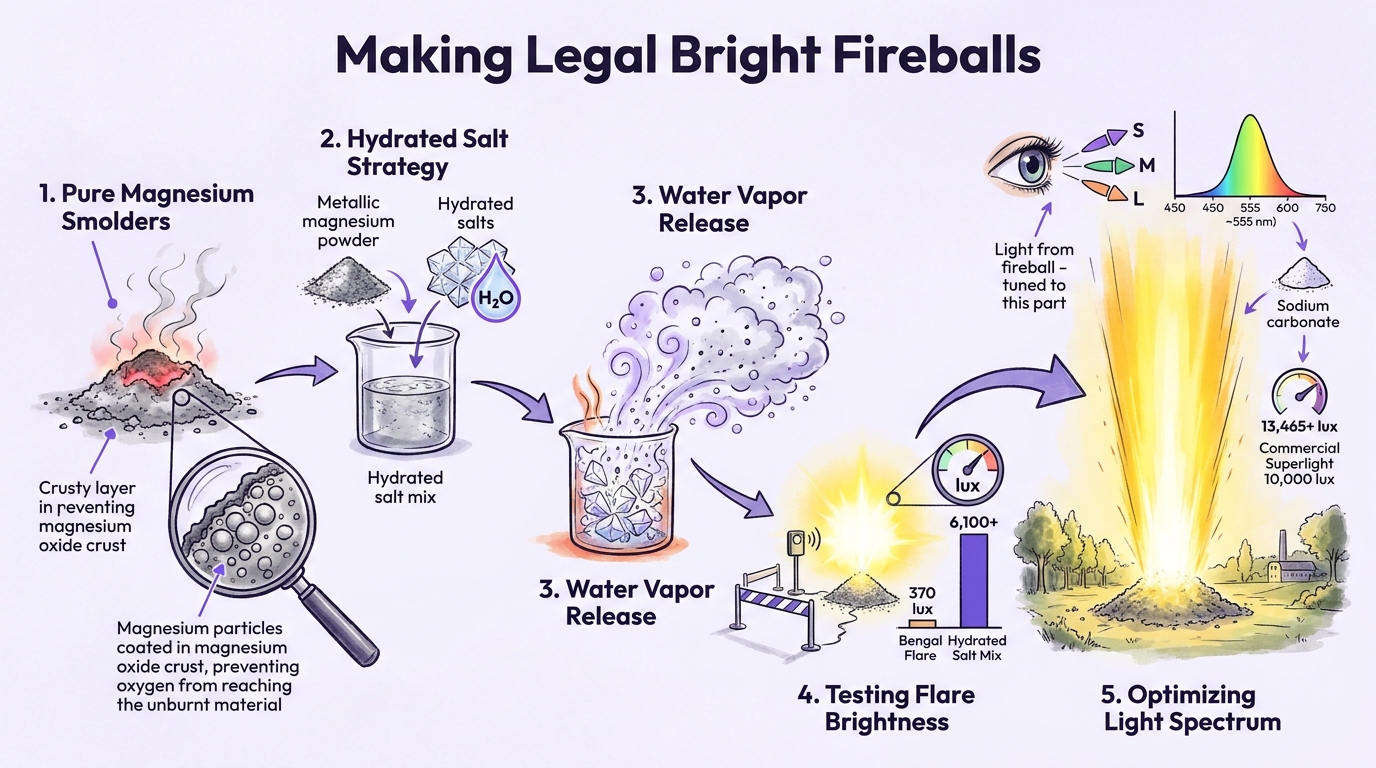
The creator demonstrates how to make an extremely bright, legal, and safe fireball using magnesium powder mixed with hydrated salts such as magnesium chloride hexahydrate. By using hydrated salts to release water vapor and atomize the magnesium, along with additives to shift the flame color toward the human eye's peak sensitivity (around 555 nm), he achieves a massive fireball measuring over 4,100 lux at 15 meters distance.

Key takeaways
- 1:02Pure magnesium powder burns slowly and smolders because an outer layer of magnesium oxide prevents oxygen from reaching the core
- 5:27Mixing magnesium powder with hydrated salts like magnesium chloride hexahydrate forces water vapor release, dispersing magnesium particles into the air to create an explosive fireball
- 7:49Perceived brightness can be optimized without extra heat by altering the chemical composition to emit light closer to the human eye's peak spectral sensitivity (~555 nm)
Tap to enlarge
Most valuable section
For whom
Science enthusiasts and amateur chemists interested in pyrotechnics and optical physics.
The 3kg Grand Finale Fireball19:02
It shows the culmination of all chemical and optical principles tested in the video, producing a massive fireball equivalent to 900 million candles.
Detailed summary
1. Introduction & Bengal Flare Benchmark
0:00The presenter introduces the goal of the video: creating an extremely bright fireball using legal, freely available chemicals that outperforms commercial pyrotechnics. He starts by testing a powerful commercial green Bengal flare to set a baseline light output measurement using a specialized spectrometer.
The benchmark flare reaches nearly 370 lux at a distance of 6 meters, equivalent to roughly 13 million candles. The host explains that he will attempt to surpass this brightness using magnesium powder and legal additives while remaining compliant with local explosive regulations.
2. Why Pure Magnesium Smolders
0:42To test pure magnesium powder, 150 grams are placed on the ground and ignited with a torch fuse. The powder ignites reluctantly, producing only a small flame and low light output, demonstrating that unmixed magnesium powder performs poorly as an outdoor illuminant.
An animation explains the chemistry behind this reaction: burning magnesium produces magnesium oxide, which forms a dense crust over the pile. This crust blocks atmospheric oxygen from reaching the unburned magnesium beneath, causing the fire to choke itself out and merely smolder.
3. Pyrotechnic Chemistry and Legal Constraints
1:57The presenter explains the basic chemistry of pyrotechnic mixtures, which consist of a fuel (reducing agent) and an oxygen source (oxidizing agent). Commercial flares mix magnesium with nitrates to provide internal oxygen, eliminating reliance on surrounding air.
However, mixing GHS-classified reducing agents with GHS-classified oxidizing agents is legally restricted without special permits. To stay strictly within the law, the host must find a way to enhance the burning rate of magnesium without creating a regulated pyrotechnic composition.
4. The Hydrated Salt Strategy
5:04Inspired by how water causes explosive steam expansion when sprayed onto a magnesium fire, the host looks for a dry, safe way to introduce water into the mixture. He selects hydrated salts, which contain water trapped inside their crystalline structures.
When the mixture ignites, the heat forces the crystal water to instantly boil into steam. This sudden expansion disperses fine magnesium powder into the surrounding air, creating a bright fuel-air explosion without using restricted oxidizers.
5. Testing Magnesium Chloride Mixtures
6:38The host prepares a 9:1 mixture of magnesium powder and magnesium chloride hexahydrate. Ignited remotely, this mixture produces a noticeably stronger flame than pure magnesium, confirming the physical concept works.
He then increases the proportion of hydrated salt to a 3:1 ratio. This combination generates a dramatic, blinding flash measuring over 6,100 lux at 6 meters, exceeding the original benchmark flare by nearly twenty times.
6. Testing Commercial Superlight Flare
8:29To challenge his results, the presenter tests an even stronger commercial daylight flare, the Nishiki Superlight. Upon ignition, the flare produces a towering column of brilliant white light.
Measurement shows this commercial flare achieves nearly 10,000 lux at 6 meters. The presenter sets out to modify his legal chemical mixture to beat this new high benchmark.
7. Magnesium Sulfate Test
11:46Seeking to increase the amount of available crystal water, the host switches from magnesium chloride hexahydrate to magnesium sulfate heptahydrate. He mixes this new salt with magnesium powder to test its performance.
Upon ignition, the mix generates a bright fire, but measurement reveals it only yields around 1,700 lux—significantly dimmer than the magnesium chloride mix. The host decides another strategy is necessary.
8. Human Eye Sensitivity & Color Tuning
12:25The host explains that perceived brightness depends heavily on the wavelength of light emitted. The human eye uses three types of cone receptors (S, M, and L), making it most sensitive to green-yellow light peaking around 555 nanometers.
Using red and green lasers of equal power as a demonstration, he shows how the green laser appears vastly brighter to the human eye. By tuning the chemical emission spectrum toward 555 nm, he can dramatically increase measured lux without raising the physical energy output of the fire.
9. Testing Color-Tuned Flame Mixtures
15:24The presenter tests various salt additives to modify the flame color. Adding strontium chloride produces a deep red flame measuring about 4,280 lux, while barium chloride produces a green flame measuring 1,780 lux.
He then adds sodium carbonate to create a yellow flame, taking advantage of the intense sodium D-lines near 589 nm. This mixture produces an astounding 13,465 lux, successfully outperforming the commercial Nishiki Superlight flare.
10. The 3kg Grand Finale Fireball
18:18For the final experiment, the host scales up the optimized sodium-tuned mixture to a massive 3-kilogram pile. After stepping back to a safer distance of 15 meters, he ignites the mixture remotely.
The resulting explosion generates a massive, blinding column of light that illuminates the entire field and nearby buildings. At 15 meters, the sensor measures over 4,100 lux—equivalent to 900 million candles—concluding the experiment as a major success.
Questions this video answers
Why does pure magnesium powder burn so poorly on its own?
When magnesium powder ignites in open air, it rapidly forms a tight outer coating of magnesium oxide. This oxide barrier restricts oxygen flow to the inner unburned metal, causing the pile to smolder rather than burn violently.
How do hydrated salts turn a smoldering magnesium pile into a fireball?
Hydrated salts contain bound crystal water within their lattice. When heated by the burning magnesium, this water rapidly vaporizes and expands, scattering fine magnesium dust into the air where it can burn instantly with atmospheric oxygen.
Why does adding sodium carbonate make the fireball appear significantly brighter?
The human eye is most sensitive to yellow-green light around 555 nm. Adding sodium carbonate introduces intense sodium D-line emissions (~589 nm), which stimulate human eye photoreceptors far more effectively than deep red or green wavelengths using the same energy.
Ask a follow-up Premium
About this summary
SumTube AI wrote this recap from the video's words and chapters. Credit and the original belong to JJChemistry.